
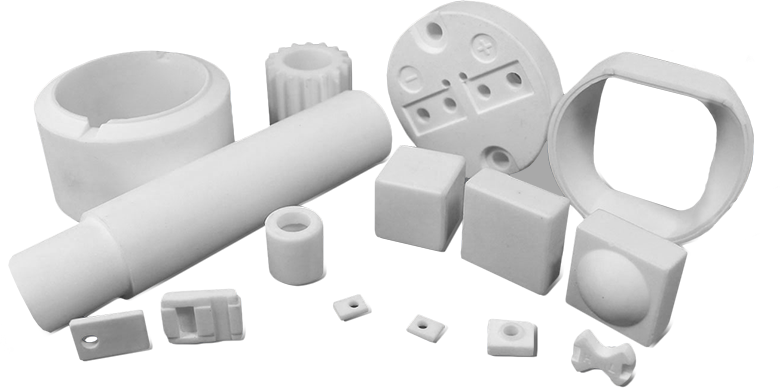
For a ceramic bushing, seal ring, or valve component, start with alumina when electrical insulation, heat transfer, or purchase cost drives the choice. Consider zirconia when repeated chipping or cracking limits service life. If alumina meets most requirements but its edges keep chipping, zirconia-toughened alumina (ZTA) is worth testing.
Look at the worn part before you change the drawing. A bushing with a gradually enlarged bore and one that loses a chip at the entrance may need different fixes, even when both parts are made from the same alumina grade.
Zirconia vs Alumina: Key Properties
On our material data sheet, zirconia has higher flexural strength and fracture toughness, while 99.7% alumina has a higher minimum Vickers hardness and conducts heat more readily. Flexural strength describes resistance to breaking under bending. Fracture toughness describes resistance to the growth of an existing crack. Vickers hardness measures resistance to indentation.
| Property | 99.7% alumina | Zirconia |
|---|---|---|
| Flexural strength (MPa) | 370 | 631 |
| Fracture toughness (MPa·m1/2) | 4.3 | 9.18 |
| Vickers hardness (HV0.5) | ≥1,600 | ≥1,200 |
| Thermal conductivity at 25 °C (W/m·K) | 14.0–21.0 | 1.2–3.0 |
| Dielectric strength (AC, kV/mm) | 17.72 | 9.6 |
| Maximum working temperature (°C) | ≤1,500 | ≤1,200 |
The data sheet does not identify the stabilizer or grade for the zirconia column. Confirm the grade and continuous operating limit for your part, especially when it carries a load at elevated temperature.
We use 99.7% alumina here to keep the comparison specific. If insulation or cost drives your choice, compare the relevant alumina purity grades. If zirconia is on the shortlist, our guide to stabilized zirconia explains how the stabilizer affects grade selection.
How to Choose Based on How the Part Fails
Start with the damage that makes the part unusable. If the bushing bore slowly grows beyond tolerance, investigate wear. If chips repeatedly break off the entrance edge, investigate contact and loading.
- Uniform bore wear. Check for hard particles, a rough shaft, and changes in lubrication. If abrasive particles dominate and the bushing stays free of cracks, keep alumina on the shortlist. For sliding contact, compare the candidates against the actual shaft and lubricant. A higher hardness value alone gives you little basis for predicting hours in service. See our guide to zirconia hardness and wear.
- Chips at the entrance or at one clock position. Check shaft alignment, insertion damage, and the edge geometry. A chip that keeps appearing on the same side is a reason to look for uneven contact. If the bushing still sees unavoidable impact or side loads after those checks, compare zirconia and ZTA for resistance to crack growth.
In a dosing pump, for example, a bushing can lose its fit even though it looks intact. If inspection finds a polished or scored shaft and a worn bore, test the shaft and bushing as a pair. A material change that protects the bushing but transfers wear to a more expensive shaft may raise maintenance costs. If the bore is still within tolerance and chips appear only after installation, check the installation method and entry chamfer before ordering a new material.
How to Choose for Insulation, Heat Transfer, or High Temperatures
Start with alumina when the part must provide electrical insulation or carry heat away. For a part that stays hot for long periods, check the continuous operating limit of the specific grade under the expected load.
- Electrical insulation. For an insulating spacer, use the table's dielectric strength values to screen materials. Verify that the finished part can withstand its working voltage with its actual thickness, electrode arrangement, and geometry.
- Heat transfer. For an electrically insulating plate that also transfers heat into a metal housing, alumina is the starting candidate. Check thermal conductivity at the operating temperature, along with the plate thickness and how it contacts the housing.
- Long-term high-temperature service. For a support that carries a load inside a furnace, check whether the grade retains enough strength and holds its shape over the required time at temperature. For repeated startup and shutdown, also check the expected heating and cooling rates for thermal shock.
When to Test Zirconia-Toughened Alumina (ZTA)
Test ZTA when alumina already meets most of the duty and chips are what force early replacement. ZTA contains zirconia particles in an alumina matrix and may offer a useful balance of hardness and toughness. See the ZTA material page for the composite and its typical applications.
For the first trial, compare the current alumina bushing with a ZTA sample under the same load, speed, and lubrication. Include a zirconia sample if impact or cracking is severe. Use the same edge detail and surface finish, and verify that each sample has the intended running clearance at temperature. Before testing, agree on what counts as failure, such as the first chip that affects assembly or the bore reaching its wear limit.
What Changes the Cost of the Same Part?
Compare quotes for the same drawing, order quantity, and inspection requirements. On a bushing, the bore tolerance, surface roughness, and fit with the shaft can determine how much grinding and inspection the part needs. Mark which surfaces control the fit so each quote reflects the same functional requirements.

Then compare cost per operating hour using observed trial life or maintenance records. Add the part price, replacement labor, and any downtime attributable to that change. Divide by the operating hours between replacements. If the current alumina bushing already lasts until planned maintenance, a longer-lasting grade may save little. If a chipped bushing stops a line between scheduled maintenance periods, preventing that stop can justify a higher part price.
Ask for separate prototype and production quotes if you expect to scale up. A trial quote covers a small batch, while the production quote can account for a different forming route and how much finishing each part needs.
Frequently Asked Questions
Can I use the same steel housing if I switch an alumina bushing to zirconia?
Possibly. Check the fit in the housing and the clearance around the shaft at assembly and operating temperatures. Use thermal expansion data for the exact ceramic and metal grades, along with the drawing tolerances. For a press fit, confirm that the interference stays within design limits throughout the temperature cycle.
Can I add holes to an alumina or zirconia part after firing?
Yes, if the geometry allows it. Both materials typically require diamond tooling after firing. For a new part, ask about making the holes before firing and finishing them afterward where tight tolerances matter. For an existing part, give the machinist the hole diameter and edge distance to assess chipping risk.
Can a ceramic-lined valve handle a sudden switch from cold to hot fluid?
It depends on the temperature change, liner thickness, and how the liner is mounted. Test the assembled valve at representative fluid temperatures and flow rates, matching how quickly the fluid temperature changes in service. Run the expected number of hot and cold cycles, then check for leaks, cracks, or chips.
If your zirconia vs alumina comparison still leaves two candidates, check the ceramic material selection guide. Request a quote with the drawing, quantity, operating conditions, and photos of the failed part so both options can be priced against the same requirements.