
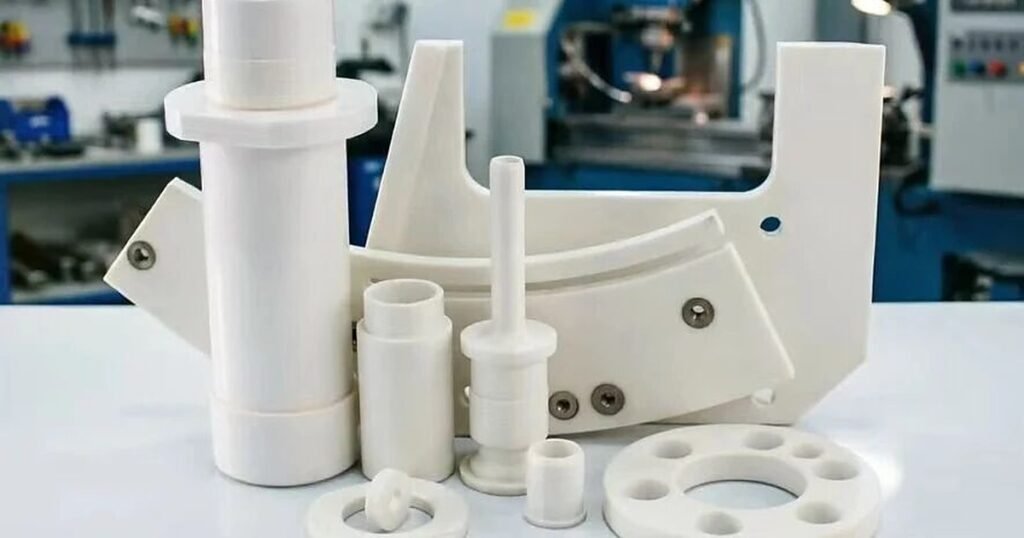
An alumina ceramic insulator is a sintered aluminum oxide part used to block electrical current in feedthroughs, standoffs, bushings, washers, and multi-hole insulators across electronic, industrial, and vacuum systems. Higher purity costs more, but it does not buy higher breakdown strength. Measured breakdown moves up and down across purity grades, while dielectric loss is the one electrical property that improves steadily with purity. That makes 99 percent the practical choice for most high-voltage insulators, and 99.7 percent or higher a choice for low-loss RF duty, low outgassing, or chemical purity. This guide covers electrical properties, purity selection, common forms, engineering design considerations, and typical applications, with links to fuller property data at our alumina ceramic parts page.
- Volume resistivity: >10¹³ Ω·cm at 95%, >10¹⁴ Ω·cm at 99% and higher
- Dielectric strength: 17.7 to 24.4 AC kV/mm, not ranked by purity
- Dielectric loss (tan δ): 4×10⁻⁴ at 95%, down to 1×10⁻⁴ at 99.7% and above
- Max service temperature: 1,350°C at 95%, 1,500°C at 99% and higher
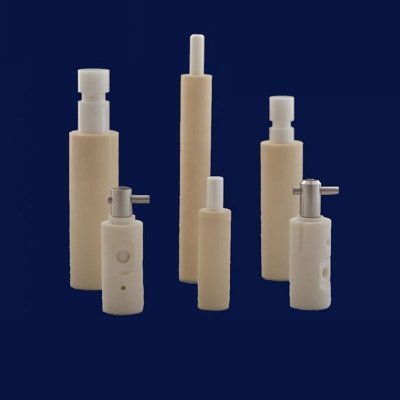
- Standard forms: washers, spacers, bushings, standoffs, feedthroughs, multi-hole insulators
Alumina insulator electrical properties at a glance
Alumina insulator performance rests on four numbers on the data sheet: volume resistivity, dielectric strength, dielectric loss, and dielectric constant. Each shifts with purity, but not in the same direction or at the same rate.
| Property | 95% | 99% | 99.5% | 99.7% |
|---|---|---|---|---|
| Volume resistivity (Ω·cm) | >10¹³ | >10¹⁴ | >10¹⁴ | >10¹⁴ |
| Dielectric strength (AC kV/mm) | 17.8 | 22.5 | 21.5 | 17.7 |
| Dielectric loss (tan δ, 1 MHz) | ≤4×10⁻⁴ | ≤2×10⁻⁴ | ≤2×10⁻⁴ | ≤1×10⁻⁴ |
| Dielectric constant (25°C, 1 MHz) | 9.6 | 10.0 | 7.8 | 10.3 |
Volume resistivity clears 10¹³ Ω·cm at 95 percent purity and passes 10¹⁴ at 99 percent. Dielectric strength does not follow purity: it rises from 17.8 kV/mm at 95 percent to 22.5 at 99 percent, then falls to 17.7 at 99.7 percent. Dielectric loss is the only property that improves steadily, dropping four-fold from 95 to 99.7 percent. Dielectric constant also varies by grade, with the 99.5 percent grade in this data set measuring 7.8. The alumina dielectric constant hub covers the full six-grade property block.
Why higher purity does not mean higher breakdown strength
Paying for higher alumina purity buys lower dielectric loss, not higher breakdown strength. Three observations on the data sheet explain why 99 percent, not the highest grade available, is the default for high-voltage insulation.
Breakdown strength does not rank by purity
Across the six grades in our reference data, AC breakdown reads 17.8 kV/mm at 95 percent, 22.5 at 99 percent, 21.5 at 99.5 percent, 17.7 at 99.7 percent, and 24.4 at 99.99 percent. The 99.7 percent grade tests lower than 95 percent. Breakdown depends heavily on sample thickness, residual porosity, electrode setup, and test method, so a single data-sheet value is not a purity ranking. For high-voltage design, 99 percent delivers one of the highest values at a moderate price.
Dielectric loss is the property purity actually buys
Loss (tan δ at 1 MHz) drops from 4×10⁻⁴ at 95 and 97 percent to 2×10⁻⁴ at 99 and 99.5 percent, then to 1×10⁻⁴ at 99.7 percent and above. This four-fold improvement matters in RF and microwave duty, where loss turns into heat and signal attenuation. It matters little in DC or 50/60 Hz insulation.
Above 99.7 percent, the reasons to pay more are not insulation reasons
Semiconductor and UHV chambers move to 99.9 percent or higher for low outgassing and contamination control. Optical and analytical instruments use 99.99 percent for chemical purity and translucency. Neither choice is driven by breakdown strength.
| Application | Recommended purity | Why |
|---|---|---|
| General insulating washer, low voltage | 95% | Adequate resistivity at lowest cost |
| High-voltage insulator (>5 kV) | 99% | High breakdown at moderate cost |
| RF or microwave insulator | 99.7% | Lowest dielectric loss |
| Vacuum feedthrough | 99% or 99.5% | Hermeticity, brazing compatibility |
| Semiconductor or UHV chamber | 99.9%+ | Low outgassing, not higher breakdown |
| Optical or analytical instrument | 99.99% | Chemical purity, translucency |
Common alumina insulator forms
Alumina insulators ship in six workhorse forms: insulating washers, spacers, bushings, standoffs, feedthroughs, and multi-hole insulators. Each form pairs with typical purity grades and size ranges.
| Form | Common purity | Typical size range |
|---|---|---|
| Insulating washer | 95% or 99% | ID 0.3 to 50 mm, thickness 0.5 to 5 mm |
| Spacer | 95% or 99% | Various |
| Bushing | 95% or 99% | Length 5 to 50 mm |
| Standoff | 95% or 99% | Length 5 to 100 mm |
| Feedthrough insulator | 99.5% or higher | Custom, metallized for brazing |
| Multi-hole insulator | 99% | Custom, per drawing |
Washers, spacers, bushings, and standoffs cover most low-to-medium voltage electronic and industrial isolation duty at 95 or 99 percent alumina. Ground faces and ID/OD tolerances down to ±0.001 mm serve clamping and stack-up requirements. Feedthrough insulators pass conductors through a hermetic or vacuum wall, typically bonded to Kovar or oxygen-free copper via active brazing or Mo-Mn metallization. Multi-hole insulators carry multiple wires or thermocouples through a single body, common in heaters, sensors, and motor windings. FineCer's alumina insulating washers, spacers, and bushings ship in 95 to 99.7 percent grades; feedthroughs and multi-hole geometries are made to drawing.
Engineering design considerations
Alumina insulator design turns on four numbers most data sheets do not spell out: creepage per unit voltage, derating factor, thermal expansion match, and metallization compatibility.
Creepage distance across the surface
Working creepage typically runs 400 AC V/mm to 600 DC V/mm on clean alumina, deciding how far apart electrodes must sit along the insulator surface. Humidity and contamination can drop this figure by an order of magnitude, so a 2x to 4x design margin is standard for outdoor or field-serviced parts.
Derating from short-time coupon values
Data-sheet dielectric strength is measured to failure in seconds under ASTM D149. Apply a 30 to 50 percent derating factor for long-term working stress, plus geometry-specific tests when the margin is tight.
Thermal expansion match with the metal counterpart
Alumina sits at 7.7 to 8.4 ppm/°C. Kovar (4.5 to 5.5) is the standard match for hermetic braze joints, and oxygen-free copper (17) works where flexibility absorbs the CTE gap. Larger CTE mismatches push the joint into shear and can crack the ceramic during thermal cycling.
Metallization compatibility depends on the alumina grade
Mo-Mn metallization delivers 150 MPa braze strength on 95 percent alumina because the glassy phase between grains grips the paste. On 99 percent and higher alumina, the glassy phase is too small for Mo-Mn to hold, and Ag-Cu-Ti active brazing or W-Mo systems are used instead. This constraint often drives the practical purity choice in feedthrough and hermetic package design.
Frequently asked questions
Which alumina grade should I choose for an insulator?
For low-voltage general isolation, 95 percent alumina delivers volume resistivity above 10¹³ Ω·cm at the lowest cost. For high-voltage duty, 99 percent is the practical default, combining strong breakdown values with dielectric loss of 2×10⁻⁴. Choose 99.7 percent for RF or microwave insulators where the lowest loss matters, and 99.9 percent or higher only when outgassing or optical clarity forces the change.
Is higher-purity alumina always a better insulator?
No. Resistivity improves from 95 to 99 percent and then levels off, and breakdown strength does not rank by purity at all: in our reference data, 99.7 percent alumina tests at 17.7 kV/mm, just below 95 percent at 17.8. What higher purity reliably buys is lower dielectric loss, plus low outgassing and chemical purity at 99.9 percent and above. Pick the grade for the property the design actually needs.
Can I braze an alumina insulator directly to metal?
Yes, but the metallization system depends on the alumina grade. Mo-Mn is standard for 95 percent alumina and delivers 150 MPa braze strength because the glassy phase between grains grips the metallization. On 99 percent and higher alumina, Ag-Cu-Ti active brazing or W-Mo systems are required because the glassy phase is too small for Mo-Mn to hold. Kovar or copper CTE match matters equally.
What voltage can an alumina feedthrough handle in vacuum?
Standard commercial alumina feedthroughs cover 5 to 30 kV DC continuous, with individual high-end designs tested to 120 kV. Actual working voltage depends on alumina purity, geometry, creepage distance across the surface, hermetic seal quality, and vacuum level. UHV designs typically hit 10⁻¹⁰ Torr with helium leak rates below 10⁻¹⁰ Pa·m³/s, and the electrical rating drops if any of these degrades.
Next step
Need alumina insulating washers, spacers, bushings, or standoffs? See our ceramic rings and bushings catalog for standard forms in 95 to 99.7 percent alumina grades. For custom feedthroughs, metallized assemblies, or brazed ceramic-metal parts, our custom ceramic parts service returns DFM feedback within 24 hours.