
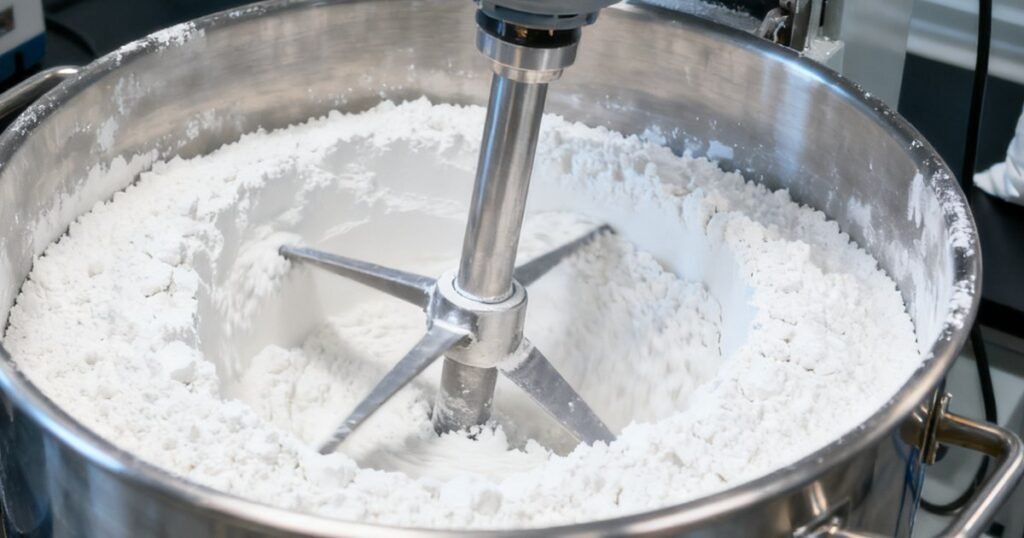
The density of alumina ceramics ranges from 3.62 to 3.95 g/cm³ across the six commercial purity grades (95%, 97%, 99%, 99.5%, 99.7%, and 99.99%), all approaching the theoretical density of pure Al2O3 at 3.98 g/cm³. Density is the property engineers check first when comparing grades, because every other mechanical, thermal, and electrical figure in the alumina properties datasheet tracks with it. This page gives the grade-by-grade numbers, the three different density values that show up on spec sheets, and how to use density as a quick verification check on incoming batches.
Three Densities on a Spec Sheet: True, Apparent, and Theoretical
Alumina datasheets can list up to three different density values, and reading the wrong one leads to real design mistakes. True density (also called skeletal density) is the mass per unit volume of the alumina crystalline solid alone, excluding pores. Apparent density is the mass per unit volume of the finished ceramic including any closed pores it carries; on dense sintered alumina with negligible open porosity, apparent density and bulk density read the same to two decimal places and are used interchangeably in practice. Theoretical density is the calculated value for a perfect pore-free single crystal of Al2O3, universally cited as 3.98 g/cm³.
The apparent density is the number that matters for engineering design because it reflects the ceramic as manufactured, pores and all. When a spec sheet reports "≥3.85 g/cm³" for 99% alumina, that is apparent density measured by water displacement per the Archimedes method. Theoretical density is a ceiling, not a target, and no commercial alumina reaches it because sintering leaves some residual porosity and lower-purity grades carry a glassy phase that is less dense than the pure Al2O3 crystal. True density measurements come from helium pycnometry and typically read within 0.5% of theoretical for well-sintered alumina, but this value has limited engineering use because it excludes the pore volume that actually affects part behavior.
The Six Alumina Grades and Their Densities
Every point of Al2O3 content displaces a fraction of lower-density glassy phase, pushing the finished ceramic closer to the theoretical alumina density of 3.98 g/cm³.
| Grade | Density (g/cm³) | Color | Approach to Theoretical (3.98) |
|---|---|---|---|
| 95% Al2O3 | ≥3.62 | White | 91.0% |
| 97% Al2O3 | ≥3.75 | White | 94.2% |
| 99% Al2O3 | ≥3.85 | Ivory | 96.7% |
| 99.5% Al2O3 | ≥3.90 | Ivory | 98.0% |
| 99.7% Al2O3 | ≥3.93 | Ivory | 98.7% |
| 99.99% Al2O3 | ≥3.95 | White | 99.2% |
The gap between 95% (3.62 g/cm³) and 99.99% (3.95 g/cm³) is 8.3% of the theoretical value, which is large for a single property. That gap is the physical footprint of two things at once: the retreat of the sintering-aid glassy phase (SiO2, MgO, CaO typically) as purity climbs, and the improved sinterability that higher purity allows. The biggest single jump sits between 95% (3.62) and 97% (3.75), reflecting a step-change in glassy phase content; from 99% onward the gains diminish because there is less glassy phase left to displace.
The Four Factors That Set Alumina Density
Alumina density is set at the process level, not chosen from a menu. Four factors control the final value.
Purity of the Al2O3 starting powder. Higher-purity powders sinter to higher densities because they carry less low-density glassy phase in the final microstructure. The relationship is not linear: gains from 95% to 99% are steep, gains from 99.5% upward are incremental.
Grain size. Smaller grains pack more efficiently during firing and leave less trapped porosity, giving higher final density. Alumina fired to abnormally coarse grains (>10 μm typical grains) leaves interstitial voids that reduce density by 0.5 to 1.5% below what the same powder would achieve at controlled grain size (2 to 5 μm).
Residual porosity. Closed pores from incomplete sintering or entrapped gas directly displace ceramic volume and drop density. Well-controlled commercial alumina carries 0.5 to 2% residual porosity; poorly sintered material can carry 5% or more, which shows up on the density reading as a value well below spec.
Sintering profile. Peak temperature, hold time, atmosphere, and heating rate all affect how completely the powder densifies. Isostatic pressing before firing, hot pressing during firing, and hot isostatic pressing (HIP) after firing each add a densification stage that raises the final density by 1 to 3% over conventional pressureless sintering. The higher densities in our 99.5% and 99.99% grades are achieved this way.
Using Density as an Incoming Batch Check
Density is the fastest way to verify that an incoming batch of alumina matches the grade you ordered, because it can be measured accurately in minutes with a lab balance and water displacement.
The Archimedes method is the standard test. A dry ceramic sample is weighed in air, then weighed again suspended in distilled water at a known temperature. Apparent density is calculated as (dry mass) divided by (dry mass minus suspended mass), corrected for water density at the test temperature. Repeatability across three samples from the same batch should be within 0.02 g/cm³.
Density verification works best at the low-purity end of the range, where the gap between adjacent grades is largest. The 95% to 97% jump is 3.6% (3.62 → 3.75), the 97% to 99% jump is 2.7% (3.75 → 3.85), and both are well outside Archimedes measurement noise. From 99% upward, the gaps close: 99% to 99.5% is 1.3% (3.85 → 3.90), 99.5% to 99.7% is 0.77% (3.90 → 3.93), and 99.7% to 99.99% is 0.51% (3.93 → 3.95). At those small gaps, density alone struggles to separate adjacent grades and needs to be cross-checked with Vickers hardness, which usefully separates the low-purity grades (HV 1410 at 95% up to HV 1500 at 99%) but reads the same 1500 for both 99% and 99.5%, so hardness cannot distinguish that specific step. For grade verification above 99.5%, color is a useful third check (white at 95%, 97%, and 99.99%; ivory across 99% to 99.7%), and chemical composition analysis by XRF or ICP is the definitive test when the batch's identity is in question.
For higher-confidence verification our quality control team uses helium pycnometry alongside water displacement, which detects closed porosity that Archimedes measurement misses.
How Density Sets the Other Properties
Density is the leading indicator for the rest of the datasheet because the same microstructural factors that raise density also raise the properties engineers actually specify parts against. A part that comes in below its minimum density will almost always underperform on strength, hardness, thermal conductivity, and electrical resistance too.
The rough transfer functions across our grade range are as follows. A 1% increase in density typically corresponds to a 3 to 5% increase in Vickers hardness, a 3 to 4% increase in bending strength, a 4 to 6% increase in thermal conductivity, and a smaller but measurable increase in dielectric strength. These are correlations across grades, not causation from density alone, but they mean that density is a defensible single-number quality proxy on the shop floor and in incoming inspection.
The physical basis is that pores act simultaneously as stress concentrators for mechanical failure, as phonon scattering sites for heat transport, and as dielectric discontinuities for electrical breakdown. Reducing porosity, which raises density, improves all three at once. The tightest correlation is between density and thermal conductivity because phonon transport is exquisitely sensitive to any interruption in the crystalline lattice.
Frequently Asked Questions
My batch density reads below the minimum spec. Is this a quality problem?
Depends on the gap. Within 0.02 g/cm³ is Archimedes measurement noise, re-test more samples. A gap of 0.02 to 0.05 usually points to a sintering-cycle drift and is worth raising with the supplier. Above 0.05 g/cm³ the batch is likely one grade below the paperwork.
Does higher density always mean better performance for my application?
Usually, but not always. For insulation, thermal conductivity, and chemical resistance, higher is better. For some abrasive wear cases, 95% alumina outlasts 99% because its slightly larger grain size and glassy phase absorb impact better. Match density to your failure mode, not to the highest available.
Can I request a target density above the minimum spec?
Yes. Minimum spec is a conservative floor, and typical batches run 0.02 to 0.05 g/cm³ above it. For a specific value like 3.94 on 99.5% alumina, we hold it with a tighter sintering profile, or add a HIP step for near-theoretical density. Cost impact is 30 to 50% above standard, higher for HIP.
Ready to Specify Alumina by Grade?
Density is the entry point to alumina ceramic grade selection. If you know the density range your part needs, we can match the grade and the process route that delivers it. Request a quote with your target property range and part geometry, and we will confirm the grade and lead time within 24 hours.