
Green machining is cutting a ceramic part while it is still a pressed powder blank, before the furnace makes it hard. "Green" means unfired: a little organic binder holds the powder together. It lowers cost when a part has holes, slots, and steps that would each need slow diamond grinding after firing, and when the order is too small to pay for a mold, roughly 1 to 500 pieces.
On FineCer's small batch ceramic machining line, blanks are pressed and roughed green, then sintered, and only the critical features go to the diamond grinder, with no tooling charge.
Key takeaways
- Before firing, a ceramic blank cuts with carbide tools. After firing, it needs diamond tools.
- Firing shrinks the part by about 15 to 20%, not perfectly evenly, so even with shrinkage measured for each batch, anything cut before firing lands within about ±1% of size.
- Loose-tolerance features are finished before firing, and precision features are ground after it. That split is what makes small batches affordable without a mold.
Green Dimensions Are Calculated Backward from the Fired Part
Every green dimension is the finished size divided by one minus the shrinkage, so the number that matters is the measured shrinkage of the actual powder lot, not a textbook range. Sintering, the firing step that fuses the powder into solid ceramic, shrinks a pressed part by around 15 to 20% in each direction, much as clay shrinks on its way to porcelain. The spread inside that range is bigger than most drawings can absorb. Take a simple example: an alumina mounting plate with six clearance holes for its bolts and one 20 mm bore for a bearing.
| Linear shrinkage | Enlargement factor | Green size for the 20.00 mm bearing bore |
|---|---|---|
| 15% | 1.176 | 23.53 mm |
| 17.5% | 1.212 | 24.24 mm |
| 20% | 1.250 | 25.00 mm |
Enlargement factor = 1 ÷ (1 − shrinkage). Green size = fired size × enlargement factor.
A wrong guess inside the 15 to 20% band moves the green bore by up to 1.47 mm, about two stacked credit cards. Shops avoid that guess by measuring each powder lot. They press a test piece, fire it, measure it, and program the green toolpath from that number. On FineCer's line, formed blanks are also checked before they go into the furnace. Dental labs work the same way. Zirconia blocks for crowns are milled before firing, and the maker prints that batch's enlargement factor on the block, such as 1.217, which means 17.8% shrinkage.
A measured factor still leaves about ±1%. Shrinkage differs by direction and by region, because pressing leaves denser and looser zones, and looser zones shrink more. On a 20 mm feature, ±1% is ±0.2 mm, two to three human hair widths. Grinding exists to remove exactly that scatter.

Green or Bisque: Pre-Firing Temperature Is a Trade-Off
Cut a fully green blank when speed and tool life matter most, and cut a bisque blank when the part has small holes, cross holes, or thin walls that a green blank would break. A bisque blank, also called pre-sintered, has been fired well below sintering temperature. Its particles are lightly bonded, but it still cuts with conventional tools.
The pre-firing temperature is a setting, and zirconia, the most widely studied bisque material, shows how much it matters. A Chinese study found that 3Y-TZP zirconia (zirconia stabilized with 3 mol% yttria) pre-sintered at 800 to 900 °C gave the smoothest cut faces and cleanest edges. A 2016 study of porous zirconia by Xiong and Peng, published in Materials and Mechanical Engineering, found that above about 1,000 °C, bonds form between particles and strength rises sharply; its best milling temperature was 1,050 °C. Both sit far below the roughly 1,500 °C used to fully sinter zirconia.
Too cool a pre-fire leaves a blank that chips at the edges; too hot, and it becomes hard to cut. The best setting sits in between and depends on the powder and the part.
| Factor | Green blank | Bisque blank |
|---|---|---|
| Held together by | Organic binder | Light ceramic bonds from partial firing |
| Handling strength | Low; edges break out easily | Higher; survives drilling and thin sections better |
| Tooling | Carbide or high-speed steel | Carbide wears fast; diamond-coated carbide is common |
| Shrinkage still to come | Full 15 to 20% | Still large; one commercial alumina bisque lists 15% after firing |
| Best suited to | Outer profiles, pockets, large steps | Small holes, cross holes, thin walls |
| Cutting fluid | Dry, with dust extraction | Often dry; pre-sintered zirconia is also milled wet with a dedicated fluid |
Which Features to Cut Green, and Which to Leave for Diamond
Cut a feature green when about ±1% after firing is good enough, rough it green and grind it after firing when it is a fit, and leave it to grinding and lapping after firing when the surface itself does the work. How to mark that split on a drawing is covered in our guide to ceramic machining tolerances and cost; the table below sorts common features by stage.
| Feature | Stage | Why |
|---|---|---|
| Outer profile, steps, chamfers, pockets, weight-saving holes | Green, finished | ±1% is enough, and green removal takes a fraction of the time diamond needs |
| Clearance holes and slots | Green or bisque, finished | The clearance absorbs the scatter; small or crossing holes are safer in bisque |
| Bearing bores, locating diameters, press fits | Roughed green, ground after firing | Left with extra material so the grinder removes the ±1% scatter |
| Sealing, sliding, and datum (reference) faces | Ground or lapped after firing | Flatness and a mirror finish (Ra 0.1 μm average roughness, about 1/1000 to 1/700 of a hair's width) come only from grinding, lapping, and polishing after firing |
| Internal threads | Can be cut green, but usually avoided | A ceramic thread can chip under load or when reassembled; load-bearing joints normally use a metal insert |
On the mounting plate, that means the six clearance holes are cut green and left as fired. The bearing bore is cut green slightly undersize instead, leaving material that grinding removes after firing to reach the final 20 mm.
For roughed fits, how much grinding stock to leave is covered in our notes on machining alumina after firing.
When Green Machining Saves Money, and When It Doesn't
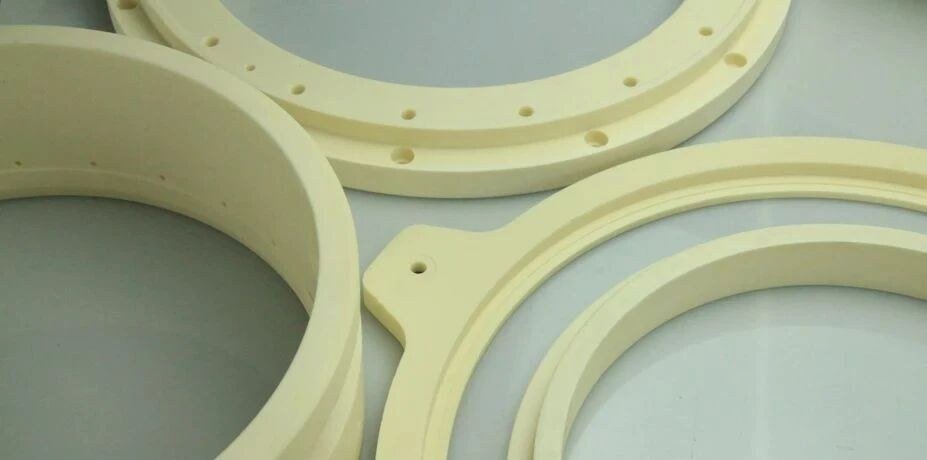
Green machining saves the most on small runs of parts with many non-critical features.
| Route | Part-specific tooling | Where it usually wins |
|---|---|---|
| Pressed blank, green machining, selective grinding | None | 1 to about 500 pieces; generally below about 1,000 |
| Ceramic injection molding (CIM) | About $2,000 to $10,000+ per mold | Complex parts, mostly under 50 mm, above 1,000 to 5,000 pieces |
| Dry pressing to near shape | Lower than a CIM mold | Simple sleeves and discs at volume |
On the green route, price comes from material, kiln time, diamond time, and inspection, and diamond time dominates. The saving is the diamond time green machining removes, and it shrinks in three situations:
- Almost every face is toleranced. If the drawing calls for grinding everywhere, cutting green only saves the roughing.
- A small, complex part is needed by the thousand. At that volume, a mold spreads into a per-piece price machining cannot match. Near that line, FineCer quotes both the machining route and ceramic injection molding side by side.
- Walls are too thin to survive the fixture. A green blank that cracks during clamping costs more than the time it saved.
What Goes Wrong in Green Machining, and How Shops Prevent It
Most green machining defects come from the blank's low strength and uneven density, not from the cutting itself.
| Problem | Cause | Prevention |
|---|---|---|
| Edge breakout at tool exit | Weakly bonded particles tear away instead of being cut | Gentler feeds at exits, supported edges, bisque for fine edges |
| Blank cracks in the fixture | Low tensile strength; a slightly warped blank snaps in a vise, and vacuum chucks struggle to hold a porous blank | Distributed, low-force clamping in purpose-made holders |
| Warping after firing | Density gradients from pressing, concentrated in the outer layer | Remove an outer allowance (a layer of extra material) while green |
| Soft or swollen green surfaces | Water-based coolant attacks the binder | Dry cutting with dust extraction |
| Fast tool wear | Ceramic powder is abrasive even before firing | Polycrystalline diamond (PCD) or diamond-coated tools |
Green machining can improve the fired shape, not just save grinding time. In a São Paulo State University study on 99.8% alumina, pressed blanks were turned with carbide tools and 1 to 5 mm of allowance was removed before firing. Removing that outer layer cut distortion by up to 81.4%, because pressing concentrates density gradients near the surface.
In practice, green machining comes down to deciding, feature by feature, what to cut before the furnace and what to leave for after it. On FineCer's ceramic CNC machining line, that decision is made during the design-for-manufacturing (DFM) review that comes with every quote.
Not sure which features of your part can be cut green? Send the drawing to sales@finecer.com or through our ceramic quote request form. Our engineers reply within 24 hours with that free DFM review, a material recommendation, and a quote, and every shipment is inspected under an ISO 9001:2015 quality system.
Frequently Asked Questions
The fired size. Green sizes are the supplier's working numbers, calculated from its measured shrinkage, and they change from lot to lot. Putting them on a drawing ties you to one process and muddles inspection. Give finished dimensions and tolerances, and mark which features may stay as-fired (straight from the furnace).
Shrinkage is uneven: looser zones of the pressed blank shrink more, pulling nearby holes oval or off position. Expect about ±1%, or ±0.2 mm on a 20 mm spacing. If the hole is a fit, rough it green and grind it after firing; otherwise set its tolerance to the as-fired result.
Material properties can match if the powder grade stays the same, but the dimensions need re-checking. Molding feedstock (the powder-and-binder mix that is injected) shrinks 15 to 22%, and the mold is sized around its own measured value. Approve the design on the first parts off the production mold, typically 15 to 25 days because mold making sets the schedule.
Yes. Green machining works on both, as well as alumina and zirconia. The payoff is largest on silicon carbide, the hardest of the four, so every millimeter shaped before firing saves the most diamond time.