
What is Zirconia Toughened Alumina?
Zirconia toughened alumina (ZTA) is the composite engineers turn to when pure alumina keeps chipping and pure zirconia blows the budget. Zirconia toughened alumina disperses 10–20% (most commonly 15–20%) fine zirconia particles through an alumina matrix; under crack-tip stress those particles undergo the same tetragonal-to-monoclinic phase transformation that toughens zirconia, expanding 3–5% in volume and squeezing cracks shut. The result: fracture toughness of 5–7 MPa·m¹/² — roughly double pure alumina — while keeping alumina's 15–17 GPa hardness and most of its temperature ceiling. FineCer manufactures custom ZTA wear parts from 1-piece prototypes to volume production.
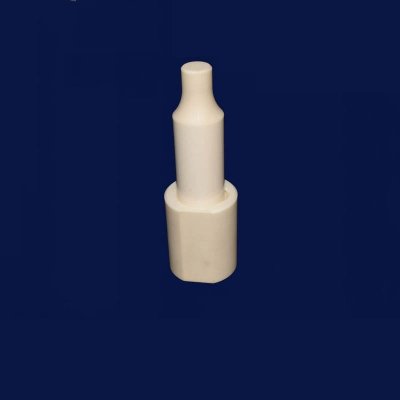
ZTA vs Pure Alumina vs Pure Zirconia
| Property | ZTA | Pure Al₂O₃ | Pure ZrO₂ |
|---|---|---|---|
| Toughness (MPa·m¹/²) | 5–7 | 3–4 | 10–15 |
| Hardness (GPa) | 15–17 | 15–17 | 12–13 |
| Max Service Temp | 1,500°C+ | 1,700°C | 1,000°C |
| Cost | $$ | $ | $$$ |
Read the table as a positioning map. ZTA matches alumina's hardness column, sits halfway to zirconia on toughness, beats zirconia by 500°C on service temperature, and undercuts zirconia on cost. The one thing ZTA does not do is replace zirconia where toughness is the absolute requirement — a 10–15 MPa·m¹/² duty is still a zirconia duty.
How Transformation Toughening Works in a Composite
In ZTA the alumina matrix does double duty: it carries hardness and stiffness, and it clamps the dispersed zirconia grains in compression, holding them in their metastable tetragonal phase. When a crack enters the neighborhood, the local stress field releases that clamp, the zirconia transforms and expands, and the crack loses its driving force. Because the toughening only activates where cracks actually form, the composite spends its "toughness budget" exactly where needed. Grain size control matters enormously here — zirconia particles too coarse transform spontaneously and microcrack the matrix — which is why our process holds powder quality and sintering curves under the same quality control regime as our medical-grade zirconia.
When to Choose ZTA
Typical wins from our project history: pump and industrial machinery wear parts where alumina edges chipped during installation or cavitation; paper and textile guides where alumina survived the abrasion but not the handling; valve trim seeing particle impact in slurry; and mining/mineral processing liners where ZTA's hardness-plus-toughness outlived both parent materials. If your alumina part history shows edge chips, corner fractures, or installation cracking — rather than uniform wear-through — ZTA is the first upgrade to test, and we can prototype it from a single piece via 1-piece prototyping.
Temperature Behavior and Practical Limits
ZTA inherits most of alumina's thermal headroom: continuous service at 1,500°C+ versus zirconia's ~1,000°C ceiling. There is one mechanism to respect, though. The toughening effect depends on zirconia staying in its metastable tetragonal phase, and that benefit gradually fades as operating temperature climbs toward the transformation range — so a ZTA part at 1,400°C behaves more like a fine-grained alumina than like a toughened composite. In practice this rarely matters: the impact and chipping events ZTA is bought for almost always happen at or near room temperature (installation, handling, startup, slurry strikes), exactly where transformation toughening is strongest. For duties that combine sustained extreme heat with mechanical shock, tell us both numbers — peak temperature and the nature of the impact — and we will advise whether ZTA, pure alumina with a geometry change, or silicon nitride ceramic is the sounder choice.
Design and Manufacturing Notes
ZTA forms and sinters much like a fine-grained alumina: dry pressing and CIP for blocks and liners, injection molding for complex small parts, then diamond grinding to final dimension. We hold ±0.001mm on ground features with Ra 0.1μm finishes available on sealing faces. Wall sections, radii, and hole spacing follow alumina design rules, so converting an existing alumina drawing to ZTA usually requires no geometry change at all — send the drawing and we will quote both materials side by side within 24 hours, a comparison only a single supplier for all four advanced ceramics can give you without bias.
Need ZTA Parts?
Send your drawings or specs to sales@finecer.com — response within 24 hours.
Frequently Asked Questions
Ready to Test ZTA in Your Application?
Send your alumina or zirconia drawing — we will quote ZTA alongside it within 24 hours, prototypes from 1 piece.
Request a Free Quote → Order a Sample