
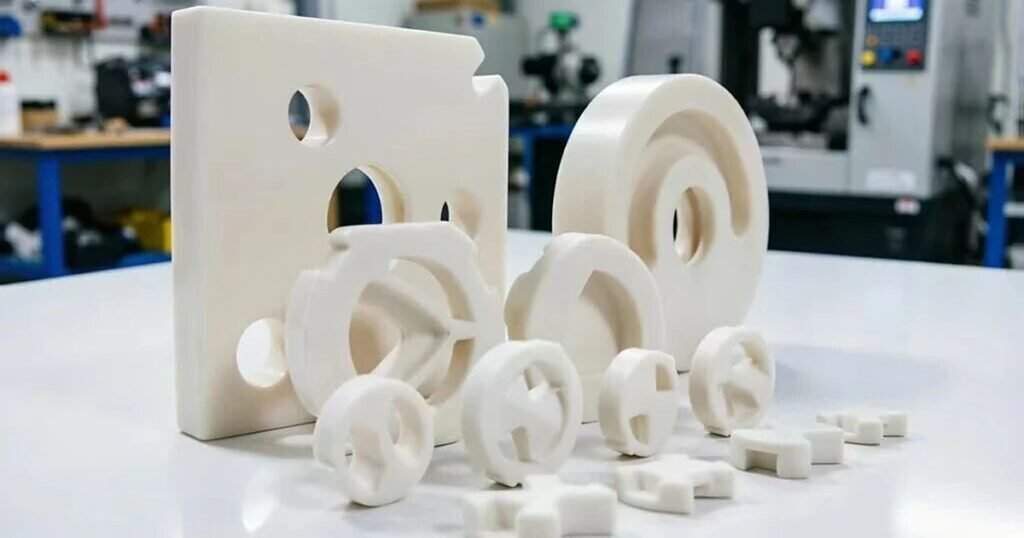
A ceramic washer is a thin, flat sintered ceramic piece that sits under a fastener head or nut to provide electrical isolation, thermal isolation, or both between the fastener and the mating surface. Five materials cover almost every commercial ceramic washer: alumina, zirconia, steatite, aluminum nitride, and silicon nitride. This guide covers when to use each material, the common washer forms, design considerations, and the specifics of TO-220 and TO-247 semiconductor mounting, with links to fuller property data for alumina ceramic parts.
- Five main materials: alumina, zirconia, steatite, aluminum nitride, silicon nitride
- Volume resistivity: 10¹² to >10¹⁴ Ω·cm depending on material
- Dielectric strength: 9.6 to 26 AC kV/mm
- Typical thickness: 0.5 to 5 mm
- Standard forms: flat, flanged, grooved, slotted, stepped, TO-220/247 thermal pad
Ceramic washer vs spacer: what this article covers
A ceramic washer is a thin, flat piece that sits under a fastener to isolate the joint electrically or thermally, distinct from a ceramic spacer which is thicker and sits between two components to maintain distance. Washers are typically 0.5 to 5 mm thick with a single center hole; spacers are 5 to 20 mm thick, often cylindrical, and can carry multiple holes. This guide covers washer selection only.
Ceramic washer materials
Five ceramic materials cover almost every commercial ceramic washer: alumina, zirconia, steatite, aluminum nitride, and silicon nitride. Alumina is the workhorse across general electrical isolation. Zirconia handles high mechanical stress and thermal cycling. Steatite fills cost-sensitive low-voltage duty. Aluminum nitride serves high-heat semiconductor mounting. Silicon nitride carries the highest mechanical margin for EV inverter and thermally cycled duty.
| Material | Bending (MPa) | Max temp | Thermal cond. (W/m·K) | Resistivity (Ω·cm) | Cost |
|---|---|---|---|---|---|
| Alumina (95-99%) | 292 to 346 | 1,350 to 1,500°C | 10 to 21 | >10¹³ | Baseline |
| Zirconia (YSZ) | 631 | 1,200°C | 1.2 to 3.0 | >10¹² | 3x to 5x |
| Steatite | 100 to 170 | 1,000 to 1,200°C | 1.8 to 2.5 | >10¹³ | 0.3x to 0.5x |
| Aluminum nitride | 300 to 400 | 1,200°C | 170 to 230 | >10¹⁴ | 5x to 10x |
| Silicon nitride | 812 | 1,200°C | 80 to 100 | >10¹⁴ | 8x to 15x |
Alumina covers most electrical isolation duty because its cost-to-performance ratio suits general electronic, industrial, and mid-voltage insulation. Purity selection from 95 to 99.7 percent drives further performance, covered in our alumina ceramic insulator guide.
Zirconia's fracture toughness is roughly twice alumina's, useful where the washer sees vibration, thermal cycling, or high clamping load. The trade-off is thermal conductivity below 3 W/m·K, so zirconia is a mechanical-duty choice rather than a pure electrical isolator.
Steatite fills low-voltage duty at low cost. Terminal blocks, appliance heaters, and small connector isolation are the classic applications, with the caveat that bending strength runs only 100 to 170 MPa and the part must not carry direct mechanical load.
Aluminum nitride is chosen when heat, not electrics, drives the design. Its 170 to 230 W/m·K thermal conductivity is roughly ten to twenty times alumina's, making it the standard for TO-220 and TO-247 semiconductor washers on power supplies, motor drives, and EV modules.
Silicon nitride carries the highest mechanical margin at 812 MPa bending strength and high fracture toughness, earning its premium in EV inverter modules and thermally cycled high-power washers where alumina cracks over time.
Common ceramic washer forms
Ceramic washers ship in six workhorse forms: flat, flanged, grooved, slotted, stepped, and TO-220/247 thermal pads. Each pairs with a specific assembly constraint.
| Form | Purpose | Typical use |
|---|---|---|
| Flat | Standard clamping isolation | Terminal boards, sensor mounting, general fasteners |
| Flanged | Larger clamping surface, distributes load | Busbar isolation, high-torque joints |
| Grooved | Anti-rotation seat, gasket retention | Vibration-resistant assemblies |
| Slotted | Easy install or removal without disassembly | Field-serviced components |
| Stepped | Fits stepped or counterbored holes | Precision alignment joints |
| TO-220 / TO-247 thermal pad | Combined electrical and thermal isolation | MOSFET, IGBT, transistor to heat sink mounting |
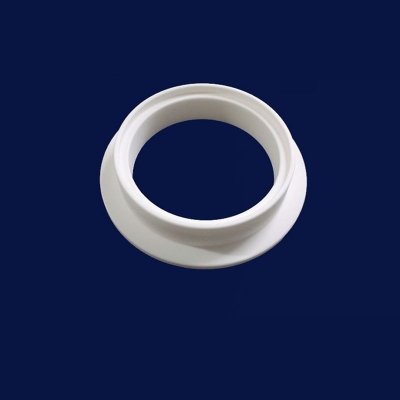
Standard IDs run from 0.3 mm up to 50 mm, and ODs up to 100 mm on production tooling. Non-standard sizes and multi-slot geometries are made to drawing, in 95 to 99.7 percent alumina and YSZ zirconia across all six form categories.
Design considerations
Ceramic washer design turns on four things most data sheets do not spell out: torque limit, thermal cycling tolerance, dimensional tolerance and clamping pressure distribution, and thickness selection.
Torque and clamping force
Ceramic compressive strength runs three to five times that of steel, but tensile strength is far lower and the material is brittle. Applied torque translates into uneven clamping pressure through the washer face, and edge stress concentrations crack the ceramic when torque approaches steel-washer values. A safe rule is to derate torque to 50 percent of the equivalent steel washer, then verify by test for critical joints.
Thermal cycling tolerance
Alumina's CTE sits at 7.7 to 8.4 ppm/°C, stainless steel bolts at 16 to 17, a two-fold gap that shifts the clamping load every thermal cycle. Belleville washers or a small OD clearance absorb the mismatch. Zirconia at 10.1 ppm/°C is closer to steel and tolerates cycles better.
Dimensional tolerance and clamping pressure distribution
Flat and parallel faces matter more than the headline OD tolerance. A washer with ±0.001 mm dimensions but out-of-flat by 5 μm still concentrates load on one edge under torque. Lapped faces at Ra 0.1 μm give the most even pressure distribution; ground faces at Ra 0.4 to 0.6 μm serve general assembly.
Thickness selection
Thin washers have low thermal resistance but crack more easily under torque and offer less voltage margin. Thick washers do the reverse. For general electrical isolation, 1 to 2 mm is the practical sweet spot. Thermal isolation duty (TO-220, TO-247) uses 0.5 to 1 mm to minimize the thermal path between the die and the heat sink.
Ceramic washers for TO-220 and TO-247 thermal isolation
TO-220 and TO-247 semiconductor mounting is the largest single application for ceramic washers, and the reason most designs move away from mica and silicone pads once power density crosses a threshold. The washer sits between the transistor tab and the heat sink, providing electrical isolation of the drain or collector while carrying the die heat through to the sink.
The thermal difference decides most designs. Mica delivers about 0.7 W/m·K thermal conductivity, silicone rubber pads sit at 1 to 3 W/m·K, alumina reaches 14 to 21 W/m·K, and aluminum nitride tops out around 200 W/m·K. On the same isolation thickness, aluminum nitride cuts junction-to-sink thermal resistance by more than an order of magnitude versus mica, which is why SiC MOSFET and IGBT designs at multi-kilowatt levels default to AlN pads.
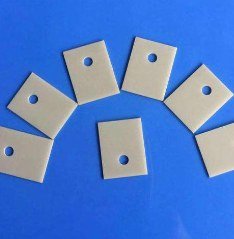
Standard TO-220 washers ship at 20 mm by 15 mm with a 3.2 mm mounting hole; TO-247 washers ship at 25 mm by 20 mm with a 3.7 mm hole. Both are cut from lapped alumina or aluminum nitride sheet to 0.5 to 1 mm thick. The ceramic substrate guide covers the wider substrate market these pads are cut from.
Frequently asked questions
Which material should I choose for a ceramic washer: alumina, zirconia, steatite, or aluminum nitride?
For general electrical isolation and industrial duty, alumina at 95 or 99 percent is the workhorse. For high mechanical stress, vibration, or thermal cycling, zirconia doubles the toughness at three to five times the cost. For low-voltage, cost-sensitive appliance and terminal work, steatite is the cheapest option. For TO-220 or TO-247 semiconductor mounting where heat matters as much as isolation, aluminum nitride delivers ten to twenty times alumina's thermal conductivity at a premium.
How much does switching from mica to a ceramic washer improve TO-220 or TO-247 thermal performance?
Aluminum nitride delivers roughly 200 W/m·K versus mica's 0.7, cutting the pad's thermal resistance by more than two orders of magnitude at the same thickness. Alumina delivers 14 to 21 W/m·K, roughly twenty to thirty times mica. Ceramics also do not age, deform under clamping load, or absorb thermal grease, so long-term thermal performance holds steady across the life of the module.
How much torque can a ceramic washer handle before cracking?
Ceramic compressive strength is three to five times that of steel, but the material is brittle and cracks under tensile or bending stress from uneven clamping. A safe starting point is 50 percent of the torque used with a same-size steel washer, applied evenly and with a proper flat mating surface. Belleville washers or a compliant metal washer stack help distribute load and absorb thermal cycling.
Ceramic washer versus silicone pad versus mica: which one should I use?
Ceramic wins on temperature ceiling, aging resistance, and long-term thermal stability, and is standard for industrial, EV, and semiconductor power modules. Silicone pads are cheaper, easier to install, and self-align but degrade above 200°C and absorb thermal grease over time. Mica is the lowest cost but has poor thermal conductivity and cracks under vibration. Ceramic is the right choice when reliability outranks first cost.
Next step
Need alumina or zirconia ceramic washers in standard sizes? See our ceramic rings and bushings catalog for 95 to 99.7 percent alumina and YSZ zirconia washers across flat, flanged, grooved, slotted, and stepped forms. For TO-220 or TO-247 thermal pads, non-standard geometries, or aluminum nitride variants, our custom ceramic parts service returns DFM feedback within 24 hours.