
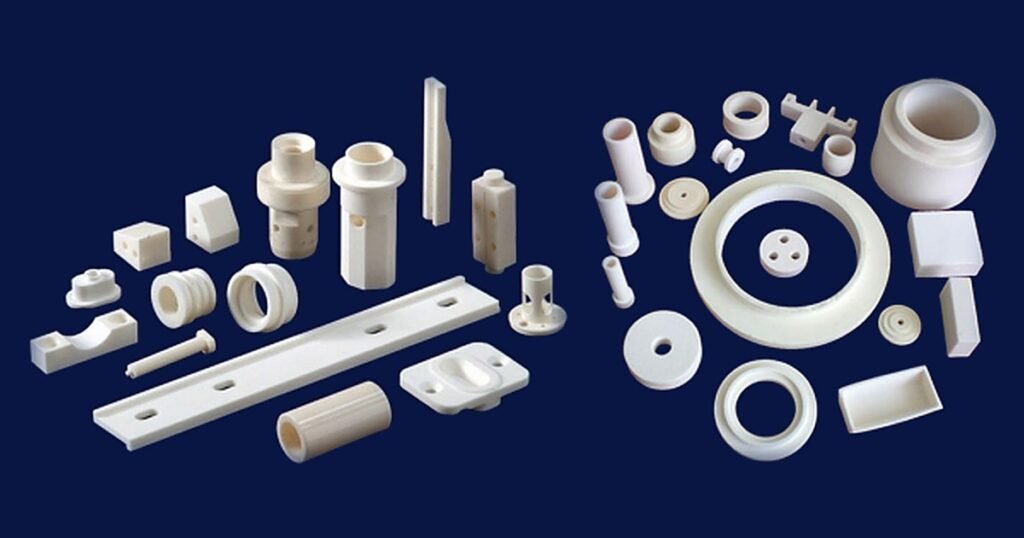
Compared with our 97%, alumina 99.5 buys four things: better electrical insulation, half the dielectric loss, better heat conduction, and the highest fracture toughness of any alumina grade we make.
It does not buy better acid resistance, much more temperature headroom, or a large jump in strength. And for most electrical and thermal needs, 99% delivers the same gains as 99.5%, so the decision usually comes down to 97% versus 99%.
Grade data below is our alumina QC data unless labeled otherwise. If your drawing calls for at least 96%, our 97% meets it, and 96% itself is available as a custom grade. Our guide to matching a drawing’s purity to a standard alumina grade explains why a nominal 96% may only guarantee 95%.
Alumina 99.5 vs 97%: Properties Side by Side
Nearly every electrical and thermal value improves from 97% to 99.5%, while acid resistance and strength move far less.
| Property | 97% | 99.5% | Change |
|---|---|---|---|
| Volume resistivity (Ω·cm) | >10¹³ | >10¹⁴ | 10 times higher |
| Dielectric loss (25 °C, 1 MHz) | ≤4×10⁻⁴ | ≤2×10⁻⁴ | Halved |
| Thermal conductivity (25 °C, W/m·K) | 10 to 16 | 14 to 21 | Higher band |
| Max working temperature | ≤1,450 °C | ≤1,500 °C | +50 °C |
| Bending strength (MPa) | 311 | 355 | +14% |
| Fracture toughness (MPa·m½) | 4.0 | 5.37 | +34% |
| Dielectric strength (AC kV/mm) | 18.44 | 21.5 | Higher, but see below |
| Dielectric constant (25 °C, 1 MHz) | 9.3 | 7.8* | See note |
| Acid resistance (1:9 HCl, 100 h, mg/cm²) | ≤0.7 | ≤0.7 | No change |
| Alkali resistance (10% NaOH, 100 h, mg/cm²) | ≤0.2 | ≤0.1 | Halved loss |
Values from our QC data, at 25 °C unless noted. *The 7.8 reflects the specific formulation of our 99.5% grade, not a purity trend; published 99.5% grades from other suppliers typically read about 9.7 to 9.9. The full set of alumina 99.5 properties, alongside our other five grades, is on our alumina properties data hub.
What the Upgrade to 99.5% Buys
Four properties improve enough to change a design decision.
Insulation. Volume resistivity rises a full order of magnitude, from above 10¹³ to above 10¹⁴ Ω·cm. It is the main reason 99% and above are the usual choice for line-voltage and high-voltage insulation.
Signal loss. Dielectric loss (tan δ, the share of an electric field’s energy a material turns into heat) halves from 4×10⁻⁴ to 2×10⁻⁴. It matters in RF and microwave parts and in high-frequency substrates, and barely at all in DC or 50/60 Hz insulation. Our alumina dielectric constant and electrical properties hub covers how loss and permittivity behave across all six grades.
Heat transfer. Room-temperature conductivity moves from the 10 to 16 W/m·K band to 14 to 21 W/m·K. Comparing band midpoints, 13 against 17.5 W/m·K, the same plate carries roughly a third more heat at the same temperature difference. Our thermal conductivity of alumina guide shows how these values fall at working temperature.
Chipping resistance. Fracture toughness (how well a material resists a crack growing once it starts) climbs from 4.0 to 5.37 MPa·m½, the highest of our six grades. Parts that take light knocks in handling or assembly chip less. Even at 5.37, alumina remains far less tough than structural metals, so it is not impact-proof; for repeated impact loads, zirconia or zirconia toughened alumina is the better choice.
What 99.5% Does Not Buy
Three common reasons for upgrading gain little or nothing, and a fourth needs a closer look.
- Acid resistance stays the same. Both grades lose up to 0.7 mg/cm² in hydrochloric acid. The acid step comes at 99.7%, where loss drops to 0.1 mg/cm².
- Temperature headroom grows by 50 °C. The limit rises from 1,450 to 1,500 °C. For service between 1,450 and 1,500 °C that matters; below 1,450 °C it changes nothing.
- Strength rises modestly. Bending strength goes up 14%, from 311 to 355 MPa. Treat that as a small margin, not a fix for a part already close to its strength limit.
- Breakdown strength improves, but not because of purity. 99.5% reads 21.5 kV/mm against 18.44 at 97%, yet 99% reads higher at 22.5 and 99.7% lower at 17.72, so purity is the wrong lever for breakdown. Our alumina ceramic insulator guide explains why breakdown strength does not rank by purity.
Why 99% Often Does the Same Job
Most of what 99.5% offers over 97% is already in 99%. In our data 99% and 99.5% share the same volume resistivity, dielectric loss, thermal conductivity band, maximum working temperature, and acid and alkali resistance.
| Property | 99% | 99.5% |
|---|---|---|
| Volume resistivity (Ω·cm) | >10¹⁴ | >10¹⁴ |
| Dielectric loss (25 °C, 1 MHz) | ≤2×10⁻⁴ | ≤2×10⁻⁴ |
| Thermal conductivity (W/m·K) | 14 to 21 | 14 to 21 |
| Max working temperature | ≤1,500 °C | ≤1,500 °C |
| Fracture toughness (MPa·m½) | 4.2 | 5.37 |
| Dielectric constant (25 °C, 1 MHz) | 10.04 | 7.8* |
| Dielectric strength (AC kV/mm) | 22.5 | 21.5 |
| Bending strength (MPa) | 346 | 355 |
The clear differences are toughness, 5.37 against 4.2 MPa·m½, and, for RF design, dielectric constant. So if a supplier proposes 99.5% for an insulation, loss, or heat-transfer reason, ask whether 99% meets the same requirement. The step that changes those properties is 97% to 99%. From 99% to 99.5%, the only clear gain is chipping resistance; the lower dielectric constant helps only if your RF design calls for it.
Substrates: Thick Film vs Thin Film
For circuit substrates, the choice usually follows the circuit process rather than any single property. Industry practice calls 96% plates thick-film substrates and 99.6% plates thin-film substrates.
Thick-film pastes are screen-printed and fired at roughly 600 to 900 °C, and 96% alumina remains the industry’s volume default for hybrid circuits, power resistor carriers, and sensor packages. Thin-film circuits are sputtered and patterned at much finer line widths, so they need a smoother, finer-grained surface. That points to 99.5% and above, which comes out of the kiln at around Ra 0.1 μm (average surface roughness, roughly 1/700 to 1/1,000 of a human hair’s width) and is lapped or polished when the circuit needs a finer finish.
Metallization for brazed joints follows the same split. Standard molybdenum-manganese (Mo-Mn) metallization relies on the glassy phase between grains. Published work shows the standard process works on 94% to 96% alumina but not on 99.5%, so high-purity grades need a metallizing route developed for them, or active brazing (a titanium-bearing braze alloy that bonds to the ceramic without a metallized layer).
Our ceramic substrate guide covers metallization routes and when to move to aluminum nitride. For standard plate and substrate forms, see our alumina substrates and ceramic plates page.
Which Grade to Specify: A Quick Checklist
Most requirements are met by 95%, 97%, or 99%; 99.5% is the answer mainly for thin-film substrates and parts that chip. Find the requirement your part cannot meet at the lower grade, then read across.
| Your requirement | Grade that meets it | Why |
|---|---|---|
| Wear parts, low-voltage insulation | 95% or 97% | Resistivity above 10¹³ Ω·cm; service to 1,350 °C at 95% and 1,450 °C at 97% |
| Thick-film circuit substrate | 96% (a custom grade with us); 99% if the insulation or heat-transfer rows also apply | The industry’s volume default for thick-film circuits |
| Line-voltage or high-voltage insulation | 99% | Resistivity crosses 10¹⁴ Ω·cm; breakdown reads 22.5 kV/mm |
| Better heat spreading | 99% | Conductivity band rises to 14 to 21 W/m·K |
| Continuous service from 1,450 to 1,500 °C | 99% | Limit rises from 1,450 to 1,500 °C |
| Caustic (alkali) exposure | 99% | Alkali loss halves to 0.1 mg/cm² |
| Vacuum feedthroughs | 99.5% (99% is also used) | The common choice for brazed feedthroughs; see our insulator guide |
| Thin-film circuit substrate | 99.5% or higher | Finer grain and a smoother as-fired surface |
| Parts that chip in handling or assembly | 99.5% | Highest toughness of our grades, 5.37 MPa·m½ |
| Lowest RF loss | 99.7% | Loss falls to 1×10⁻⁴ |
| Strong acid exposure | 99.7% | Acid loss drops from 0.7 to 0.1 mg/cm² |
If your part sits between two rows, send the operating conditions with your drawing through our quote request form. Our engineers recommend an alumina grade free of charge and reply within 24 hours on business days, and will tell you whether 99% covers the duty or alumina 99.5 is worth specifying.
Frequently Asked Questions
Not in our data. Both our 97% and 99.5% lose up to 0.7 mg/cm² after 100 hours in 1:9 hydrochloric acid. Acid resistance improves sharply only at 99.7%, where loss drops to 0.1 mg/cm². Alkali resistance is different: it improves from 0.2 to 0.1 mg/cm² at 99% and stays there through 99.5%.
Usually 99% is the better match. It already reaches volume resistivity above 10¹⁴ Ω·cm and reads 22.5 kV/mm on breakdown, slightly above 99.5%. The lower dielectric loss of high-purity grades matters at radio frequencies, not at mains frequency. Choose 99.5% for a mains insulator only if chipping during assembly or handling is a known problem.
Datasheets differ in test method, sample condition, and whether a figure is a typical batch value or a guaranteed minimum. Our 99.5% reads a dielectric constant of 7.8 because of the specific formulation of that grade, while other suppliers’ 99.5% grades typically read about 9.7 to 9.9. Compare grades within one datasheet, and confirm the values for the exact grade you will order.
References
- CoorsTek, Advanced Alumina material properties datasheet (AD-995 dielectric constant)
- Morgan Advanced Materials datasheets, alumina with a minimum of 95.0% Al2O3 (typically 96%)
- Valley Design, 96%, 99.5%, and 99.6% alumina ceramics (thick-film and thin-film substrates)
- Kyocera Fineceramics Europe, AO476O (≥96% alumina) hybrid IC substrate datasheet
- US Patent 7,222,775, metallization of oxide ceramics (Mo-Mn on 94% to 96% vs 99.5% alumina)
- CeramTec, material selection guide for 92% to 99.5% alumina