
Why Ceramic Plungers?
A pump plunger has one job: hold a sealing surface against pressure, stroke after stroke, in whatever the pump moves. Metal plungers lose that fight to scratching and corrosion; custom ceramic plungers from FineCer win it with extreme hardness, complete chemical inertness, and mirror-finish surfaces ground to Ra 0.1μm — delivering dramatically superior sealing and consistently 5–8× the service life of stainless steel equivalents. We manufacture plungers and pistons in all four advanced ceramics, as bare sleeves or complete ceramic-to-steel bonded assemblies, from 1-piece prototypes to volume production.
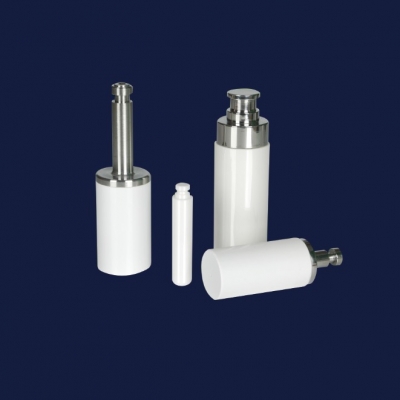
Plunger Specifications
| Parameter | Spec |
|---|---|
| Materials | ZrO₂, Al₂O₃, SiC, Si₃N₄ |
| Tolerance | ±0.001mm |
| Surface Finish | Ra 0.1μm (mirror-grade) |
| Life vs Metal | 5–8× longer |
| Metal Bonding | Ceramic-to-steel brazing available |
How We Reach Ra 0.1μm — The Four-Stage Process
- Pre-grinding: CNC cylindrical grinding to ±0.005mm
- Fine grinding: Diamond wheel (800–1200 grit) to ±0.002mm
- Lapping: Diamond slurry (W3.5–W1) to Ra 0.2μm
- Polishing: Cerium oxide paste to Ra 0.1μm
Why the Mirror Finish Matters
In a packed or close-clearance pump, the plunger surface is the seal. Every micro-scratch on a metal plunger becomes a leak path and a packing-shredder; at Ra 0.1μm there is nothing for fluid to track along and nothing abrasive for the packing to ride against, so leakage stays at commissioning levels and packing life stretches with the plunger's. The same finish slashes friction heat in high-cycle metering duty — one reason dosing accuracy holds over time on ceramic.
Material Selection for Ceramic Plungers
| Application | Material | Reason |
|---|---|---|
| High-pressure hydraulic | ZrO₂ | Toughness, metal-bondable |
| Chemical dosing | Al₂O₃ (99%) | Chemical inertness |
| Abrasive slurry | SiC | Extreme hardness |
| Food/pharma | Al₂O₃ or ZrO₂ | Biocompatible |
High-Pressure Pump and Metering Plungers
The two classic conversions we quote weekly: high-pressure plunger pumps — water-jet, hydraulic, descaling — where zirconia brings 10–15 MPa·m¹/² fracture toughness to survive pressure spikes that crack lesser ceramics; and chemical metering or dosing pumps, where 99% alumina simply ignores the acids, solvents, and CIP chemistry that pit 316 and even Hastelloy plungers. For abrasive slurry duty, SiC adds 9.5 Mohs hardness on top of the inertness. Food and pharmaceutical lines specify alumina or zirconia for biocompatible, non-porous, fully sterilizable surfaces.
Ceramic-to-Steel Bonded Assemblies
Most plungers must couple to a metal drive end, and this is where material physics decides reliability: zirconia's thermal expansion (10.3×10⁻⁶/°C) closely matches steel, so a properly designed brazed or shrink-fit joint stays in compression through every thermal and pressure cycle. FineCer supplies the complete bonded assembly — ceramic working section, steel adapter, joint design, and final co-grinding so the assembled plunger runs true to the same ±0.001mm and cylindricity standards as a monolithic part. You install one finished component instead of engineering a joint. Where the drive end carries threads, flats, or keyways, those features live in the steel half — machined conventionally and cheaply — while the ceramic half does what ceramic does best. It is the division of labor that makes ceramic plungers practical to retrofit into pumps that were never designed for them.
Converting an Existing Metal Plunger
Send the drawing of your current plunger — or the worn part itself — and we return a conversion package within 24 hours: matching envelope dimensions, ceramic-appropriate corner radii and lead-in chamfers, recommended bore clearance, and a quote for samples from 1 piece. Where the mating cylinder is also worn, quote the pair: grinding plunger and sleeve in one facility is the only clean way to guarantee the 0.005–0.015mm running clearance rather than hoping two suppliers' tolerances stack kindly. Every shipment includes measured diameter, cylindricity, and surface-finish data from our quality control lab, and the prototyping service lets you field-trial before fleet conversion.
Need Ceramic Plungers?
Send your drawings or specs to sales@finecer.com — response within 24 hours.
Frequently Asked Questions
Ready to Convert Your Plungers?
Send your plunger drawing or the worn part — free conversion review, material recommendation, and quote within 24 hours.
Request a Free Quote → Order a Sample