
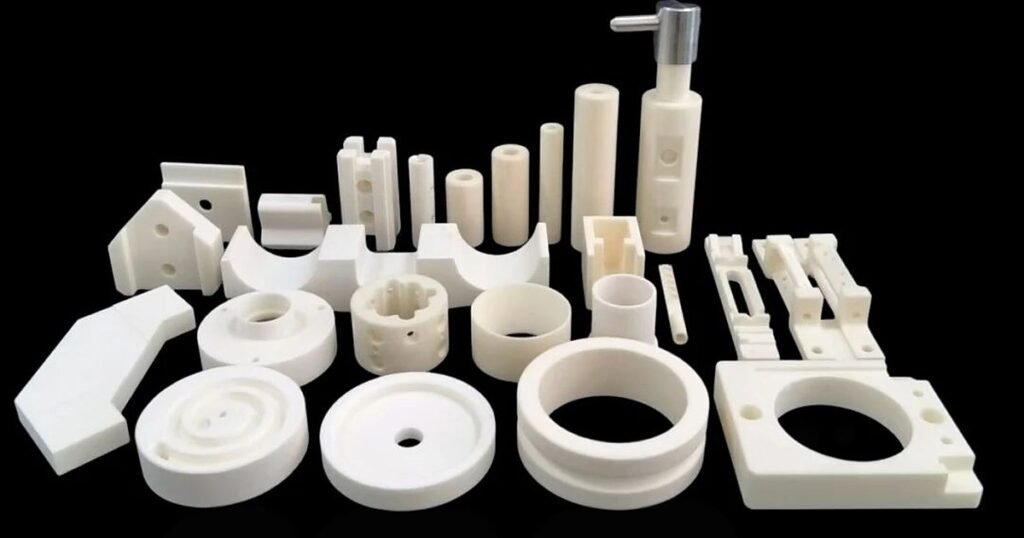
Alumina's dielectric constant sits between 7.8 and 10.3 at 1 MHz and 25°C, shifting with purity grade and microstructure rather than crystal chemistry alone. This page consolidates the dielectric constant of alumina alongside dielectric strength, dielectric loss, and volume resistivity for six commercial purity grades from 95 to 99.99 per cent, plus a cross-material view against zirconia, silicon nitride, and silicon carbide. Use it to specify alumina electrical properties for insulators, washers, spacers, and substrates, and to compare grades before requesting a quote. Fuller mechanical, thermal, and dimensional data lives in our alumina properties data hub, and the material overview for alumina ceramic parts covers grade selection outside the electrical domain.
- Dielectric constant: 7.8 to 10.3
- Dielectric strength: 17.7 to 24.4 AC kV/mm
- Dielectric loss: ≤1×10⁻⁴ to ≤4×10⁻⁴
- Volume resistivity: >10¹³ to >10¹⁴ Ω·cm
Alumina electrical properties by purity grade
Higher purity raises alumina's volume resistivity from 10¹³ to 10¹⁴ Ω·cm, but dielectric strength does not follow purity: the 99.7 per cent grade tests lowest of the six at 17.7 kV/mm. The dielectric constant peaks at 99.7 per cent and dips at 99.5 per cent. That pattern is a reminder that dielectric behaviour is set by both chemistry and firing route: sintering aid packages, grain size, and residual porosity each influence the number you read from a supplier's data sheet.
The table below carries the six-grade property block we use for RFQ, drawing checks, and specification writing. All values are measured at 25°C and 1 MHz unless noted.
| Property (25°C @ 1 MHz) | 95% | 97% | 99% | 99.5% | 99.7% | 99.99% |
|---|---|---|---|---|---|---|
| Dielectric constant | 9.6 | 9.3 | 10.04 | 7.8 | 10.26 | 10.18 |
| Dielectric strength (AC kV/mm) | 17.84 | 18.44 | 22.5 | 21.5 | 17.72 | 24.38 |
| Dielectric loss | ≤4×10⁻⁴ | ≤4×10⁻⁴ | ≤2×10⁻⁴ | ≤2×10⁻⁴ | ≤1×10⁻⁴ | ≤1×10⁻⁴ |
| Volume resistivity (Ω·cm) | >10¹³ | >10¹³ | >10¹⁴ | >10¹⁴ | >10¹⁴ | >10¹⁴ |
The 99.5 per cent value of 7.8 sits well below the 10 range shared by every other grade, and it is not a typographical mistake. Different sintering aid formulations shift the local dielectric environment, so a nominally higher purity grade can present a lower ε if its additive package favours mullite or glassy grain-boundary phases. If your design depends on a specific dielectric constant, confirm the value against the supplier's data sheet for the exact grade you plan to order, rather than assuming a smooth trend across purity.
Dielectric constant of alumina explained
- Range: 7.8 to 10.3
- Conditions: 25°C @ 1 MHz
- Standard: ASTM D150
The dielectric constant of alumina, 7.8 to 10.3 across commercial grades, sets how much charge an insulator stores per unit voltage and how a capacitor, feedthrough, or substrate behaves under alternating current. In the language of the data sheet, ε is the ratio of the material's permittivity to that of free space, measured on a thin coupon between electrodes at a stated frequency and temperature.
Frequency dependence is mild in the audio-to-radio range. From 1 kHz to 1 MHz, alumina's dielectric constant typically shifts by less than 3 per cent, which is why most data sheets quote a single 1 MHz figure. Above 1 GHz, ε begins to fall as dipolar mechanisms drop out; microwave and millimetre-wave designs need frequency-specific measurements rather than the room-frequency value.
Temperature dependence is stronger. Industry-typical behaviour is a rise of 10 to 15 per cent from room temperature to 500°C, driven by increased ionic mobility. If your part operates hot, ask the supplier for values at working temperature or apply a documented derating factor. Aluminium nitride and beryllia sit in a similar ε range and see occasional service in the same sockets, but neither displaces alumina for cost and general-purpose insulation duty. Where the value matters most is thick-film circuit substrates, RF and microwave feedthroughs, high-voltage standoff insulators, and vacuum or semiconductor-process components: each of those sockets rewards a specific ε range, so grade selection cannot be made on cost alone.
Dielectric strength: how much voltage alumina holds
- Range: 17.7 to 24.4 AC kV/mm
- Standard: ASTM D149
- Derating: 30 to 50%
Alumina's short-time dielectric strength runs from 17.7 to 24.4 AC kV/mm across the six grades in the table above, measured per ASTM D149 on thin ground coupons. That figure is the voltage at which the coupon fails in a controlled ramp, not the voltage the finished insulator holds for years in service.
Thickness matters more than most drawings recognise. Dielectric strength falls as sample thickness rises, because larger volumes are more likely to contain a critical flaw. A 1 mm test coupon rated at 24 kV/mm does not translate into 240 kV/mm at 100 micrometres, nor into 24 kV holding on a 1 mm insulator in a real assembly. For thicker parts, expect a lower kV/mm and confirm with the supplier's part-geometry testing where a design cannot tolerate uncertainty.
Long-term operation cuts allowable field further. Partial discharge, thermal ageing, and moisture together drive the industry-typical practice of applying a 30 to 50 per cent derating factor to short-time values when setting a working voltage stress. Surface contamination, tracking paths, and clamping stress at the electrode edge are the usual real-world failure triggers, not bulk breakdown, so specify surface finish and creepage distance alongside the bulk kV/mm figure.
Dielectric loss and loss tangent
- Range: ≤1×10⁻⁴ to ≤4×10⁻⁴
- Frequency: 1 MHz
- Standard: ASTM D150
Alumina's dielectric loss sits in the 10⁻⁴ range at 1 MHz, low enough to serve as an RF substrate, high-frequency insulator, or low-noise feedthrough. Higher purity grades reach ≤1×10⁻⁴, mid-range grades ≤2×10⁻⁴, and the 95 to 97 per cent grades ≤4×10⁻⁴, reflecting the influence of glassy grain-boundary phases on dielectric relaxation.
Terminology deserves care. The values in the property table are dielectric loss numbers as reported on the source data sheet, which for alumina track the loss tangent (tan δ) within the same order of magnitude at 1 MHz. Where a design requires a formal tan δ value at a specific frequency, request the tan δ measurement explicitly rather than assuming equivalence, especially at frequencies far from 1 MHz.
Silicon nitride, at <0.005 total loss, and silicon carbide, at <0.03, sit an order or two above alumina and are not natural low-loss substrates. For RF, radar, and microwave insulator duty, alumina's combination of low loss, favourable ε, and standardised manufacturing keeps it the default across the 95 to 99.7 per cent grade band.
Volume resistivity: the insulation baseline
- Range: >10¹³ to >10¹⁴ Ω·cm
- Conditions: 25°C, bulk
- Standard: ASTM D257
All six alumina grades exceed 10¹³ Ω·cm at room temperature, and 99 per cent and higher pass 10¹⁴, which is why alumina remains the reference material for insulator, washer, spacer, and substrate duty across electronics and power engineering. The gap between 10¹³ and 10¹⁴ is not academic at high voltage: it decides leakage currents in feedthroughs, standoff insulators, and vacuum interrupters.
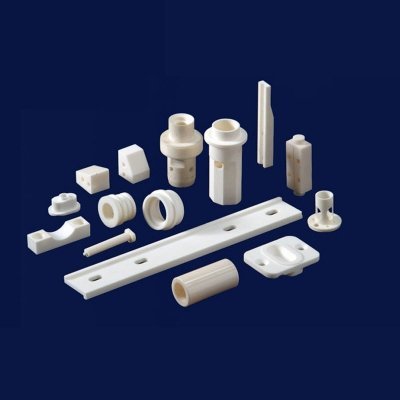
Temperature reduces resistivity sharply. Industry-typical behaviour is a drop of several orders of magnitude between room temperature and 500°C, and a further drop above that, driven by thermally activated ionic conduction. Alumina still outperforms most technical ceramics at elevated temperature, but any high-temperature insulator design needs supplier-specific data at working temperature rather than the room-temperature headline number.
Surface resistivity is a separate parameter from the volume value quoted in the table. Bulk alumina is a superb insulator, yet a contaminated or wet surface can drop the surface resistivity by several orders of magnitude and drive tracking or flashover long before the bulk gives way. Clean handling, controlled humidity, and appropriate creepage geometry usually matter more than incremental improvements in bulk resistivity for real assemblies.
Alumina vs zirconia vs silicon nitride vs silicon carbide
Alumina is the balanced-cost insulation default, while zirconia, silicon nitride, and silicon carbide each win narrower use cases. The cross-material block below draws from the same reference source as the six-grade alumina data above, so numbers on either side of the comparison are directly comparable.
| Property (25°C @ 1 MHz) | Al₂O₃ (99.5%) | ZrO₂ | Si₃N₄ | SiC |
|---|---|---|---|---|
| Dielectric constant | 7.8 | 29 | 8.7 | 10 |
| Dielectric strength (AC kV/mm) | 21.5 | 9.6 | 26 | not applicable |
| Dielectric loss | ≤2×10⁻⁴ | ≤18×10⁻⁴ | <0.005 | <0.03 |
| Volume resistivity (Ω·cm) | >10¹⁴ | >10¹² | >10¹⁴ | >10⁴ |
Zirconia's ε of 29 is the outlier. It carries a strong dipolar response that makes zirconia unattractive as a general-purpose insulator, though the same polarisability supports oxygen sensor and solid electrolyte applications where alumina is not a fit. Silicon nitride matches alumina on resistivity and beats it on dielectric strength, but the material cost sits far above alumina and rarely justifies substitution for pure insulation duty. Silicon carbide is not an insulator: at >10⁴ Ω·cm it is a semiconductor by comparison, and belongs in heater elements, seal faces, and wear parts rather than dielectric applications. For a wider view of how ceramics compare as insulators across the four main material families, see our insulator ceramic guide.
How to choose the right alumina grade for your electrical duty
Three parameters drive the grade choice: the working voltage the part must hold, the working temperature it will see, and the loss budget your circuit tolerates. The decision tree below encodes the industry-typical selection guidance that shortlists a grade in one pass.
Higher purity is not automatically the safer choice. Every step up in grade raises material cost, tightens the sintering window, and adds hardness that can complicate diamond finishing on tight tolerance parts. Where 99 per cent alumina holds working voltage with margin and meets the loss budget, moving to 99.7 per cent buys headroom the design does not need and cost the buyer notices. When a real design does need the higher grade, see our catalogue of alumina insulating washers, spacers, and bushings for the standard forms already stocked in the 99 to 99.7 per cent range.
Reading a supplier data sheet and setting design margin
A useful electrical spec sheet lists purity grade, test standard, test frequency, sample thickness, and test temperature; anything missing is a data-quality flag rather than a rounding oversight. Dielectric constant and loss follow ASTM D150, dielectric strength follows ASTM D149, and volume resistivity follows ASTM D257. Numbers taken under different conditions are not directly comparable, so cross-supplier benchmarking requires like-for-like test paperwork rather than headline figures.
Five items are worth confirming before you specify a grade: the exact purity, the test frequency in Hz, the coupon thickness in millimetres, the test temperature in degrees Celsius, and the ambient humidity. Any of these can move the reported number by more than the difference between two adjacent grades, which is how apparently identical materials produce non-identical results in production.
Design margin turns short-time test data into a working voltage stress. Industry-typical practice applies a derating factor of 30 to 50 per cent to the short-time dielectric strength for continuous service, with an extra allowance for elevated temperature, partial discharge exposure, or aggressive humidity. Where a part sits in a partial-discharge-free zone the derating can loosen; where it sees repeated switching transients or a contaminated atmosphere, tighten it further and specify creepage and clearance distances alongside the bulk kV/mm number.
Frequently asked questions
Does a higher dielectric constant mean better electrical insulation?
No. Dielectric constant measures how much charge a material stores per unit voltage, not how well it blocks current. Volume resistivity and dielectric strength govern insulation. Zirconia's ε of 29 is far above alumina's 10, yet its resistivity is two orders of magnitude lower, making it the weaker insulator.
Why do different sources report different dielectric constants for alumina?
Six factors move the value: purity, sintering additive formulation, grain size, residual porosity, test frequency, and test temperature. Two suppliers can both be honest and report 9.5 and 10.1 for nominally similar grades. When comparing values, match test conditions and grade recipe, not just the Al₂O₃ percentage.
Does 24 kV/mm dielectric strength mean my 1 mm insulator safely holds 24 kV?
No. The 24 kV/mm figure is a short-time coupon test, not a continuous rating for a finished part. Real insulators fail earlier through thickness scaling, partial discharge, and ageing. Apply a 30 to 50 per cent derating factor for continuous service and confirm against a supplier test of your geometry.
Does temperature affect the dielectric constant of alumina?
Yes, modestly. Industry-typical behaviour is a rise of 10 to 15 per cent from 25°C to 500°C, driven by increased ionic mobility. Below 100°C the shift is small enough to ignore. For hot service, ask the supplier for values at working temperature or apply a documented temperature-derating factor.
How much does surface contamination reduce alumina's insulation performance?
Bulk volume resistivity is unaffected, but surface resistivity can fall by four orders of magnitude under humid, contaminated conditions, driving tracking and flashover. Design creepage distances, specify clean handling, and consider a glaze for high-humidity duty. In most field failures, the surface is the villain and the bulk is intact.
Next step
Need alumina insulators, washers, or spacers in a specific grade and geometry? See our catalogue of ceramic rings, bushings, and insulating washers for standard forms in the 95 to 99.7 per cent grade range. For non-standard geometries or drawing-based parts, our custom ceramic parts service returns DFM feedback and a quote within 24 hours.