
What is Zirconia Ceramic?
Zirconia ceramic (zirconium dioxide, ZrO₂) is the toughest structural ceramic in industrial use — the material engineers specify when alumina chips or steel wears out. Custom zirconia ceramic parts combine 950–1,500 MPa flexural strength with fracture toughness of 10–15 MPa·m¹/², roughly 3–4× that of alumina. The secret is a unique transformation toughening mechanism: when a crack tries to propagate, stress triggers a tetragonal-to-monoclinic phase transformation with 3–5% volume expansion that compresses and arrests the crack tip — a self-defending microstructure no other ceramic offers. FineCer manufactures zirconia components from 1-piece prototypes to volume production, ground to ±0.001mm.
With a melting point of 2,715°C and thermal expansion close to steel, zirconia is also uniquely suited for ceramic-to-metal bonded assemblies. Its thermal conductivity is only 1/10th that of metals, providing excellent thermal insulation in the same part that carries the mechanical load.
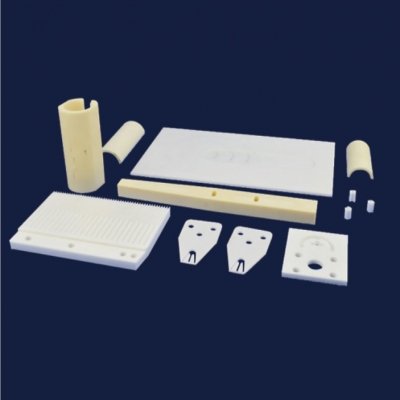
Key Properties of Zirconia
| Property | Value | Notes |
|---|---|---|
| Melting Point | 2,715°C | Pure ZrO₂ ~2,900°C |
| Density | 5.6–6.1 g/cm³ | Y-TZP: ~6.05 |
| Flexural Strength | 950–1,500 MPa | Y-TZP exceeds 1,000 MPa |
| Fracture Toughness | 10–15 MPa·m¹/² | Highest among all ceramics |
| Thermal Conductivity | 1.6–2.03 W/(m·K) | 1/10th of metals — excellent insulator |
| Thermal Expansion | 10.3 × 10⁻⁶/°C | Close to steel — ideal for metal bonding |
| Biocompatibility | Excellent | ISO 13356 certified |
These figures explain why designers treat zirconia as the "metal-like" ceramic: it bends before it breaks (relatively speaking), insulates heat, matches steel's expansion for hybrid assemblies, and carries ISO 13356 biocompatibility certification for implantable devices.
Zirconia Grades We Produce
Y-PSZ / Y-TZP (Yttria Stabilized)
The most widely used structural grade, stabilized with 2–3 mol% Y₂O₃ and sintered at 1,400–1,500°C. Y-TZP offers the best combination of strength and toughness of any commercial zirconia, which is why it dominates dental, fluid-handling, and precision wear applications.
Mg-PSZ (Magnesia Stabilized)
Requires higher sintering temperatures (1,700–1,800°C) but delivers superior high-temperature creep resistance and stays dimensionally stable in the 600–800°C range. Best for: high-temperature structural parts and aerospace components.
Ce-TZP (Ceria Stabilized)
Superior resistance to low-temperature degradation (hydrothermal aging) at lower cost than Y-TZP. Best for: ZTA composites and wear parts in hot, wet environments such as pump internals.
CSZ (Calcia Stabilized)
High ionic conductivity at elevated temperatures — the standard electrolyte material for oxygen sensors, solid oxide fuel cells, and oxygen pumps.
Stabilizer Comparison: Y-TZP vs Mg-PSZ vs Ce-TZP vs CSZ
| Factor | Y-TZP | Mg-PSZ | Ce-TZP | CSZ |
|---|---|---|---|---|
| Sintering Temp | 1400–1500°C | 1700–1800°C | Medium | Medium |
| Strength | >1000 MPa | Medium | Lower | Lower |
| Aging Resistance | Moderate | Good | Excellent | — |
| High-Temp Performance | Moderate | Excellent | Moderate | Good |
| Cost | Higher | Medium | Lower | Lowest |
| Primary Use | Dental, bearings | High-temp structure | Toughening agent | Oxygen sensors |
Sintering Parameters for Zirconia
| Parameter | Recommended | Effect |
|---|---|---|
| Temperature | 1,500–1,550°C optimal | Max density and strength |
| Heating Rate | 200°C/hr optimal | Slower = more uniform grain structure |
| Hold Time | 2–4 hrs at peak | Standard: 1,550°C / 2–4h |
| Cooling Rate | 1–5°C/min | Prevents cracking and warping |
Machining Zirconia: Tolerances & Surface Finish
Sintered zirconia at 12–13 GPa hardness can only be finished with diamond tooling. FineCer's ceramic machining department grinds, laps, and polishes zirconia to ±0.001mm dimensional tolerance, Ra 0.1μm surface finish, and ±0.003mm concentricity — the level required for plunger-and-bore pairs running on 0.005–0.015mm clearances. Where geometry is too complex for economical grinding, our ceramic injection molding line forms near-net shapes first, cutting finishing cost on volume runs. Every dimension is verified by CMM before shipment.
Available Zirconia Product Forms


Zirconia vs Alumina: Which Should You Choose?
| Factor | Choose Zirconia | Choose Alumina |
|---|---|---|
| Primary need | Impact resistance | Electrical insulation, cost |
| Toughness | 10–15 MPa·m¹/² | 3–4 |
| Hardness | 12–13 GPa | 15–17 GPa |
| Max temp | ~1,000°C | ~1,700°C |
| Cost | Higher | Lower |
The short version: choose zirconia when parts crack, chip, or see impact; choose alumina ceramic parts when electrical insulation, temperatures above 1,000°C, or cost dominate. Need both toughness and hardness in one material? Consider the zirconia toughened alumina composite. And if you are still comparing, the ceramic material selection guide maps all four of our materials to application requirements in two tables.
Why Buy Zirconia Parts from FineCer
Because zirconia is one of four ceramics we run in-house — not the only product we have to sell — our recommendation is driven by your application, not our inventory. We quote within 24 hours, accept 1-piece prototype orders produced on the same lines as volume runs, and assign a dedicated engineer to every project. That model has carried 500+ projects to 40+ countries with >98% on-time delivery.
Need Zirconia Ceramic Parts?
Send your drawings or specs to sales@finecer.com — response within 24 hours.
Frequently Asked Questions
Ready to Order Zirconia Components?
From single prototypes to volume production — we manufacture custom zirconia parts to your exact specifications, with a free quote within 24 hours.
Request a Free Quote → Order a Sample