
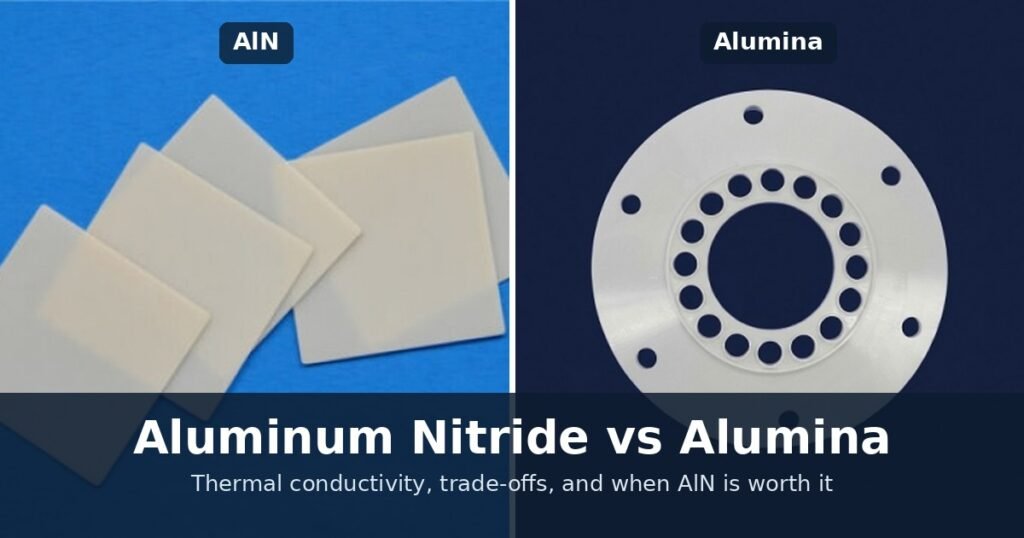
Aluminum nitride thermal conductivity is about 7 to 16 times higher than that of 99% alumina. Supplier datasheets list most aluminum nitride (AlN) grades at 150 to 230 W/m·K, while 99% alumina on our datasheet sits at 14 to 21 W/m·K.
Both ceramics also block electricity. That is why engineers weigh alumina vs aluminum nitride for the same jobs: circuit substrates, insulating pads, and heat spreaders that sit between a live part and a metal heat sink.
Faster heat transfer does not make AlN the automatic choice in an AlN vs alumina decision. It cracks more easily, holds less voltage per millimeter, and loses much of its insulation when hot. Where the ceramic is not the main barrier to heat, alumina does the job and is easier to handle. The alumina figures here come from our own datasheet, and the AlN figures from published supplier datasheets. For a wider view that includes zirconia, silicon nitride, and silicon carbide, see our guide to the thermal conductivity of ceramics.
Aluminum Nitride Thermal Conductivity vs Alumina, by Grade
Every AlN grade in the table conducts heat at least three times better than the best alumina, and most reach seven times the value of 99% alumina or more. The figures are all at room temperature.
| Material and grade | Thermal conductivity at 25 °C (W/m·K) | Source |
|---|---|---|
| Alumina 95% and 97% | 10 to 16 | Our datasheet |
| Alumina 99%, 99.5%, and 99.7% | 14 to 21 | Our datasheet |
| Alumina 99.99% | 16 to 22 | Our datasheet |
| AlN, high-purity grade for plasma-resistant parts (Kyocera AN2000) | 67 | Supplier datasheet |
| AlN, standard grade (Kyocera AN216A) | 150 | Supplier datasheet |
| AlN substrates (MARUWA AN-170, AN-200, AN-230) | 180, 200, and 230 | Supplier datasheet |
W/m·K (watts per meter-kelvin) tells you how easily heat passes through a material. The higher the number, the less hot the part gets for the same amount of heat.
Here is what the gap means. Send the same heat through two identical plates, and the 150 W/m·K AlN plate ends up with one-seventh to one-tenth of the temperature rise of the 99% alumina plate.
AlN figures vary widely by grade, from 67 W/m·K for Kyocera's high-purity AN2000 to 230 W/m·K for MARUWA's best substrate grade. When you compare quotes, ask for the grade name, the test temperature, and whether the figure is typical or guaranteed. Both ceramics also conduct less heat as they warm up, and our thermal conductivity of alumina guide shows how much alumina drops by grade.
When Higher Thermal Conductivity Shows Up in the Heat Path
AlN only makes a noticeable difference when the ceramic is the biggest barrier to heat on its way out. Heat leaving a chip passes through several layers: solder, the ceramic plate, thermal grease, and the heat sink. Think of them as doors in a row: the slowest door sets the pace.
Thickness matters as much as the material. A thinner plate lets heat through faster, so thin alumina closes part of the gap with AlN. The table compares alumina vs AlN at two standard plate thicknesses. "Heat flux" means how much heat passes through each square centimeter.
| Plate | Thermal resistance (K·cm²/W) | Temperature rise at 10 W/cm² (°C) | Temperature rise at 50 W/cm² (°C) |
|---|---|---|---|
| 99% alumina, 0.635 mm | 0.30 to 0.45 | 3.0 to 4.5 | 15 to 23 |
| 99% alumina, 0.38 mm | 0.18 to 0.27 | 1.8 to 2.7 | 9.0 to 14 |
| AlN at 150 W/m·K, 0.635 mm | 0.042 | 0.42 | 2.1 |
| AlN at 230 W/m·K, 0.635 mm | 0.028 | 0.28 | 1.4 |
Thermal resistance is thickness divided by thermal conductivity: the lower it is, the easier heat gets through. Values assume heat flows straight through the plate at room temperature. Solder, grease, and the heat sink add their own rise and are not included.
At low power, the difference is small. At 10 W/cm², switching from thin alumina to AlN keeps the part only 1.4 to 2.4 °C cooler.
The gap grows with power. At 50 W/cm², thin alumina still adds 9 to 14 °C, against 1.4 to 2.1 °C for AlN. That can be the margin between a power chip staying inside its temperature limit or not.
You cannot keep thinning alumina, though. A thinner plate holds less voltage before it breaks down. Our datasheet rates the dielectric strength of 99% alumina, the voltage it holds per millimeter, at 22.5 kV/mm. So a 0.38 mm plate holds about 8.6 kV on paper, against about 14 kV at 0.635 mm. Thin plates also break more easily in handling. Our ceramic substrate guide covers standard thicknesses and how to choose one.
What You Give Up When You Switch to Aluminum Nitride
The costs are in toughness, voltage per millimeter, and hot insulation rather than bending strength, and the one extra gain is thermal expansion closer to silicon. The table puts the numbers side by side.
| Property | 99% alumina (our datasheet) | Aluminum nitride (supplier datasheets) |
|---|---|---|
| Bending strength (MPa) | 346 | 310 (Kyocera AN216A); above 350 (MARUWA HAN-170) |
| Fracture toughness (MPa·m½) | 4.2 | 2.9 (Roditi) |
| Dielectric strength (kV/mm) | 22.5 | 14 (Kyocera AN216A) |
| Volume resistivity (Ω·cm) | >10¹⁴ at room temperature | >10¹⁴ at 20 °C, 10¹⁰ at 300 °C, 10⁸ at 500 °C (Kyocera AN216A) |
| Thermal expansion (10⁻⁶/K) | 7.7 (25 to 800 °C) | 5.2 (MARUWA) to 5.3 (Kyocera AN216A), 40 to 800 °C |
Values come from different datasheets and test methods. Trust the direction of each difference more than small gaps.
AlN chips and cracks more easily. Fracture toughness tells you how well a material stops a crack once it starts. AlN, at about 2.9, sits below every alumina grade we make, which run from 3.8 to 5.37. Thin AlN plates need careful handling during assembly.
Hot insulation drops. Volume resistivity measures how strongly a material blocks current. On Kyocera's datasheet, AlN's value falls 10,000 times between 20 and 300 °C. Our alumina datasheet only gives room-temperature values, so if your part must insulate while hot, ask for figures at your working temperature for either material.
Expansion is closer to silicon. Every material grows a little when heated. Silicon grows about 2.5 millionths of its length per degree at room temperature. Over nearly the same range, up to 800 °C, AlN expands 5.2 to 5.3 millionths per degree and 99% alumina 7.7. Because AlN is closer to silicon, a chip soldered onto it is pulled on less each time the module heats up and cools down.
When 99% Alumina Is Enough, and When AlN Is Worth It
For an AlN vs alumina substrate decision, start with 99% alumina. Move to AlN when the ceramic is the slowest layer for heat and you cannot make it thinner, or when a silicon chip is soldered straight onto the plate. The table covers the usual cases. One caution for high-voltage parts: on these datasheets AlN holds about 14 kV/mm against 22.5 kV/mm for 99% alumina, so at the same thickness AlN breaks down first.
| Your situation | Start with | Why |
|---|---|---|
| Moderate power; the solder or grease is the slowest layer | 99% alumina | A faster ceramic changes little when another layer holds the heat back |
| The ceramic is the slowest layer, and the voltage allows a thinner plate | Thinner 99% alumina | Going from 0.635 to 0.38 mm cuts the ceramic's resistance by 40% |
| The ceramic is the slowest layer, and voltage sets a minimum thickness | Aluminum nitride, about 1.6 times thicker | Matching 0.635 mm alumina's 14 kV on paper takes about 1.0 mm of AlN, which still has 4 to 7 times lower resistance |
| A silicon chip soldered straight onto the plate, heated and cooled many times | Aluminum nitride | Expansion closer to silicon puts less stress on the solder joint |
| Parts that take knocks in handling or assembly | 99% alumina | Higher fracture toughness, 4.2 against about 2.9 |
If your part fits the first two rows, the more useful upgrade is usually from 97% to 99% alumina, explained in our alumina 99.5% vs 97% comparison. Going on to 99.5% adds nothing for heat, because our 99.5% grade shares the 14 to 21 W/m·K band of 99%. Before paying for aluminum nitride thermal conductivity, work out the temperature rise with your own power and plate thickness.
When alumina passes that check, our alumina plates and substrates page lists the forms we supply. Send your power, voltage, and drawing with a request for quote. We reply within 24 hours with the alumina grade and thickness we would start from.
Frequently Asked Questions
The documented risk is mainly in the powder. AlN powder reacts with water and releases ammonia, so it is stored dry, and a safety data sheet says AlN hydrolyzes slowly in water. Kyocera lists dense AlN at 0% water absorption. If a finished part will see wet grinding, aqueous cleaning, or humid service, ask the supplier for its limits.
It depends on the power. Say 50 W passes through a 0.6 mm pad with 2 cm² of contact. A 99% alumina pad at 14 to 21 W/m·K adds about 7 to 11 °C, while AlN at 150 to 230 W/m·K adds about 0.7 to 1.0 °C. At a few watts, the difference is small. Both pads are brittle, so use the device maker's mounting torque.
The same process families exist for both. MARUWA offers its AlN substrates with thin film, thick film, and copper bonded, brazed, or plated on (DBC, AMB, and DPC), the routes also used on alumina. Before switching, confirm your metallizer has run its process on AlN, and ask for bond strength data on the ceramic you will order.
References
- Kyocera Fineceramics Europe, AN216A aluminum nitride datasheet
- Kyocera Fineceramics Europe, AN2000 aluminum nitride datasheet
- MARUWA, ceramic substrate properties (AN-170, AN-200, AN-230)
- MARUWA, aluminum nitride components (HAN-170)
- Roditi International, aluminium nitride properties
- Surmet, aluminum nitride safety data sheet
- The linear coefficient of thermal expansion of silicon at room temperature, Powder Diffraction