
What is Alumina Ceramic?
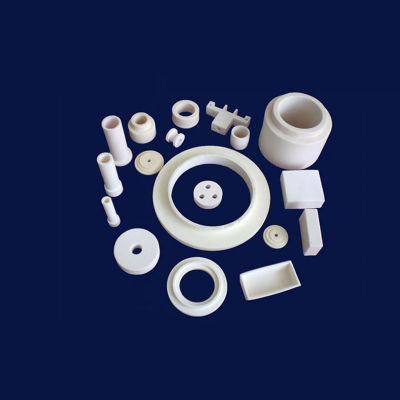
Alumina ceramic (aluminum oxide, Al₂O₃) is the workhorse of technical ceramics — the default material engineers reach for when they need electrical insulation, wear resistance, or chemical inertness at a sane price. Custom alumina ceramic parts account for roughly 80% of the global advanced ceramics market because the material delivers volume resistivity above 10¹⁴ Ω·cm, hardness to 15.7 GPa, and continuous service to 1,700°C, while costing a fraction of zirconia or silicon nitride. FineCer manufactures alumina components across the full purity spectrum, from cost-effective 95% to ultra-high-purity 99.99% grades for semiconductor and optical applications — from 1-piece samples to volume production.
Why Purity Matters in Alumina
Alumina is sold by purity because nearly every property tracks the Al₂O₃ content. The balance is a glassy grain-boundary phase (silica, calcia, magnesia) that makes lower grades easier and cheaper to sinter, but softens hardness, lowers thermal conductivity, and contaminates ultra-clean processes. Moving from 95% to 99.5% raises hardness from 13.7 to 15.7 GPa and thermal conductivity from 24 to 32 W/m·K — and raises cost with it. The engineering discipline is to specify the lowest purity that meets the spec, and that is exactly how our engineers quote: if 95% solves your wear problem, we will not sell you 99.5%.
Alumina Purity Grades — Detailed Comparison (95% to 99.5%)
| Property | 95% | 96% | 99% | 99.5% |
|---|---|---|---|---|
| Color | White | White/Ivory | Yellow-white | Yellow-white |
| Density (g/cm³) | 3.70 | 3.75–3.95 | 3.85 | 3.90 |
| Hardness (GPa) | 13.7 | 14–15 | 15.2 | 15.7 |
| Flexural Strength (MPa) | 280 | 300–630 | 310 | 350 |
| Thermal Conductivity (W/m·K) | 24 | 20–30 | 29 | 32 |
| Dielectric Constant @1MHz | 9.4 | 9.8 | 9.9 | 9.9 |
| Volume Resistivity (Ω·cm) | >10¹⁴ | 10¹⁴–10¹⁵ | >10¹⁴ | >10¹⁴ |
Grade Selection Guide by Application
| Grade | Market Share | Typical Applications |
|---|---|---|
| 92% (with 85%) | ~60% | General wear protection — solves 80% of industrial wear problems |
| 95%/96% | ~20% | Electronic substrates, seal rings, corrosion-resistant parts |
| 99% | ~5% | High-temp crucibles, aerospace, medical |
| 99.5%–99.99% | Specialty | Semiconductor, RF/microwave, optical |
Key Applications of Alumina Ceramic Parts
Electrical & electronics: insulators, substrates and plates with a 9.8 dielectric constant at 1 MHz, sensor housings, and feedthroughs. Wear protection: liners, guides, and seal rings where 14–15 GPa hardness outlasts hardened steel many times over. High temperature: furnace tubes, crucibles, and kiln furniture serving continuously at up to 1,700°C — the highest of our four materials. Chemical processing: pump components and labware that shrug off acids and alkalis across the pH range. The same versatility is why alumina is usually the baseline candidate in any material selection exercise — other ceramics are chosen only where alumina's toughness (3–4 MPa·m¹/²) or thermal shock limits are exceeded.
When Alumina Is Not the Answer
Alumina chips under impact and cracks under rapid temperature swings. If your part sees mechanical shocks, step up to zirconia ceramic parts (toughness 10–15 MPa·m¹/²) or the zirconia toughened alumina composite, which keeps alumina's hardness while roughly doubling toughness. If the duty is severe abrasion plus heat transfer, silicon carbide ceramic is the better tool. Because FineCer runs all four materials in-house, switching candidates mid-project means a new quote — not a new supplier audit.
Manufacturing & Tolerances
We form alumina by dry pressing, cold isostatic pressing (CIP), extrusion, and ceramic injection molding, then sinter and finish in-house. As-fired surfaces hold roughly ±1% of dimension; diamond grinding brings critical features to ±0.001mm with Ra 0.1μm surface finish. Every production batch passes CMM dimensional checks, density verification, and visual inspection in our quality control lab, with the full report shipped alongside your parts.
Need Alumina Ceramic Parts?
Send your drawings or specs to sales@finecer.com — response within 24 hours.
Frequently Asked Questions
Ready to Order Alumina Components?
Send us your drawings or specifications — our engineers will confirm the right purity grade and provide a detailed quote within 24 hours.
Request a Free Quote → Order a Sample