
Overview
Precision ceramic rings, washers, seals, bearings, and bushings are the quiet critical parts of fluid and motion systems — the components that set gaps, isolate currents, seal pressure, and carry rotation. FineCer manufactures them across an exceptionally wide envelope, from 0.3mm-ID wire-drawing dies to 400mm-OD seal rings, in all four of our advanced ceramics. Blanks are formed by cold isostatic pressing for enhanced density uniformity or dry pressing for volume production, then diamond-ground to ±0.001mm OD and ±0.002mm ID tolerances. Minimum order: 1 piece, on production tooling.
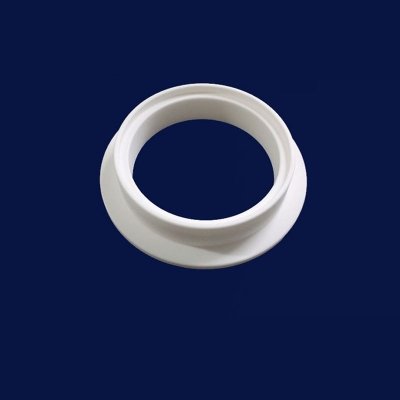
Ring & Bushing Specifications
| Parameter | Range |
|---|---|
| Min ID | 0.3mm |
| Max OD | 400mm |
| ID Tolerance | ±0.002mm |
| OD Tolerance | ±0.001mm |
Ring Types We Manufacture
- Mechanical seal rings
- Ceramic bearings (full/hybrid)
- Insulating washers
- Wire drawing dies
- Threaded rings
- Stepped/flanged profiles
Mechanical Seal Rings and SiC Seal Faces
Seal faces are the most demanding ring duty: two surfaces lapped flat, running against each other on a microns-thick fluid film, in whatever the pump moves. SSiC seal faces dominate here — 9.5 Mohs hardness, total acid/alkali immunity, and high thermal conductivity to carry away face heat — which is why SiC-on-SiC and SiC-on-carbon pairs are the chemical-pump standard. We grind and lap stationary and rotating rings, including stepped and flanged profiles, with face flatness held to sealing-grade standards and Ra 0.1μm finish available. Alumina rings remain the value choice for water and mild media; zirconia steps in where pressure spikes or misalignment chip harder faces.
Ceramic Bearing Rings — Full and Hybrid
Bearing service rewards Si₃N₄: 3.2 g/cm³ density slashes centrifugal load, the surface self-lubricates through brief oil starvation, and corrosion simply does not happen. We supply the ceramic elements — races, rings, sleeves, and bushings — for full-ceramic assemblies in chemical and vacuum service, and for hybrid bearings where ceramic rolling surfaces run in steel housings. Roundness ±0.002mm and concentricity ±0.003mm are ground in and measured per batch in our quality lab.
Insulating Washers and Spacers
Where a washer must isolate as well as space, alumina is the default: volume resistivity above 10¹⁴ Ω·cm, zero moisture uptake, and stable dielectric behavior to temperatures no polymer washer survives. Typical uses include busbar standoffs, sensor isolation, heater terminations, and vacuum feedthrough stacks. Flat-lapped faces keep clamping stress even — important, since ceramics prefer uniform compression — and chamfered edges are standard for assembly safety.
Wire Drawing Dies and Micro-Bushings
At the small end of the envelope, 0.3mm-ID rings serve as wire and fiber guides where a polished hard bore decides product quality. Fine-grained zirconia is the usual choice — its toughness protects the tiny working edge — with bores polished to Ra 0.1μm so wire and yarn glide rather than scrape. Custom entry radii and exit cones are ground to your profile.
Why Forming Method Matters for Rings
A ring's reliability is set before it is ever ground: density uniformity from forming determines how round it sinters and how predictably it survives clamping loads. That is why we CIP larger and critical rings — isostatic pressure packs powder evenly so the sintered blank is homogenous — and reserve dry pressing for high-volume smaller rings where tooling pays back. Either route ends on the same diamond ID/OD grinders and the same inspection bench, with measured dimensional reports shipped per order. Unusual profiles — flanges, steps, threads (≥M2), slots — are handled as custom features, and 1-piece samples let you validate fit before a production release.
Choosing Between Ring Materials at a Glance
If one line each helps: SiC for chemical attack and the hardest faces; alumina for insulation and the best cost; zirconia for impact, pressure spikes, and anything brazed to steel; Si₃N₄ for speed, weight, and thermal cycling. Because we manufacture all four in-house, the recommendation that comes back with your quote is grade-by-application — and when the duty sits on a boundary, we will say so and offer to sample two materials side by side. Full property data lives in the ceramic material selection guide.
Need Ceramic Rings?
Send your drawings or specs to sales@finecer.com — response within 24 hours.
Frequently Asked Questions
Ready to Order Ceramic Rings?
Send ring drawings with media, speed, and pressure — material recommendation and quote within 24 hours.
Request a Free Quote → Order a Sample