
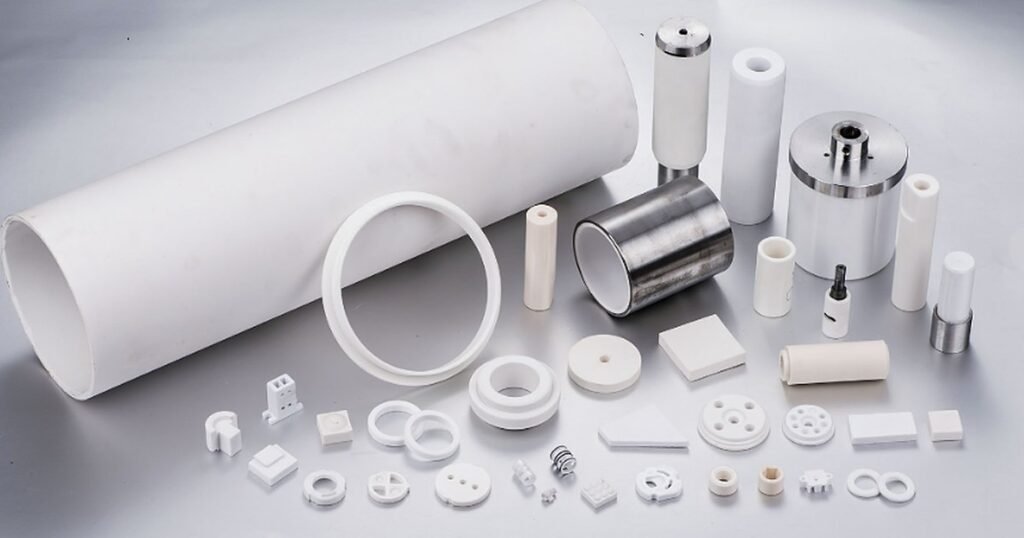
Alumina properties come down to five plain facts. It is very hard. It does not conduct electricity. It keeps working at 1,350 to 1,500 °C. It resists most acids and alkalis. And when it fails, it cracks rather than bends. How well it does each of these depends on its purity grade.
Alumina (aluminum oxide, Al2O3) is sold as finished alumina ceramic parts in purity grades. We produce six, from 95% to 99.99%. All alumina properties listed for those six grades come from our property datasheet. Figures from other sources are labeled and listed under References.
Alumina Properties in Plain Terms
Six alumina properties explain most of what the material is used for. The table gives each one in everyday terms first, then the number behind it.
| Property | What it means in practice | Value across our six grades |
|---|---|---|
| Very hard | Resists scratching and abrasive wear, which is why it is used for pump liners, seal faces, and wear plates | Vickers hardness HV 1410 to 1660; its mineral form, corundum, rates 9 on the 10-step Mohs scratch scale |
| Electrical insulator | Blocks current, so it can hold live wires and electrodes apart | Volume resistivity above 1013 to above 1014 Ω·cm at room temperature |
| Heat resistant | Keeps working inside furnaces and next to heating elements | In use up to 1,350 to 1,500 °C |
| Chemically resistant | Loses very little material in acid or alkali | ≤0.1 to ≤0.7 mg of weight loss per cm² in 1:9 hydrochloric acid |
| Dense | A 1 cm cube weighs about 3.6 to 4.0 grams, roughly four times as much as the same cube of water | Density 3.62 to 3.95 g/cm³ |
| Brittle | Cracks instead of bending or denting under impact | Fracture toughness 3.8 to 5.37 MPa·m½, against 9.18 for zirconia on the same datasheet |
Brittleness is the one weakness to plan around. A metal part usually bends before it breaks, which gives a warning. An alumina part does not, so it suits jobs where it is pressed, rubbed, heated, or used under voltage, and handles repeated impact poorly. When a part will take regular knocks, zirconia toughened alumina is usually a better fit.
What the Purity Grade Means
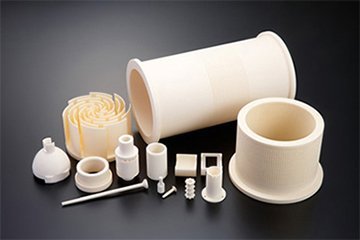
The purity grade is the share of aluminum oxide by weight, so 99.5% alumina is 99.5% Al2O3. The rest is sintering aids. These are small amounts of other oxides, commonly silica (SiO2), magnesia (MgO), and calcium oxide (CaO). They help the powder fuse into a solid part at a lower firing temperature.
After firing, those additives sit as a thin glassy layer between the alumina crystals. Ceramic engineers call it the glassy grain-boundary phase, or glassy phase for short. Picture the alumina crystals as bricks and the glassy phase as the mortar between them. The mortar is the weak point: published work shows, for example, that hydrofluoric acid attacks this glassy phase between grains. Less glassy phase usually means a better part, and the alumina properties below show where that pays off.
Alumina Properties by Grade at a Glance
Most properties improve with purity, but not evenly: the biggest jumps come at 99% and 99.7%, and a few properties do not follow purity at all. The short table below covers seven key values.
| Property | 95% | 97% | 99% | 99.5% | 99.7% | 99.99% |
|---|---|---|---|---|---|---|
| Density (g/cm³) | ≥3.62 | ≥3.75 | ≥3.85 | ≥3.90 | ≥3.93 | ≥3.95 |
| Hardness (HV0.5) | ≥1410 | ≥1460 | ≥1500 | ≥1500 | ≥1600 | ≥1660 |
| Flexural strength (MPa) | 292 | 311 | 346 | 355 | 370 | 392 |
| Max working temperature (°C) | ≤1350 | ≤1450 | ≤1500 | ≤1500 | ≤1500 | ≤1500 |
| Thermal conductivity, 25 °C (W/m·K) | 10.0 to 16.0 | 10.0 to 16.0 | 14.0 to 21.0 | 14.0 to 21.0 | 14.0 to 21.0 | 16.0 to 22.0 |
| Volume resistivity (Ω·cm) | >1×10¹³ | >1×10¹³ | >1×10¹⁴ | >1×10¹⁴ | >1×10¹⁴ | >1×10¹⁴ |
| Acid weight loss, 1:9 HCl (mg/cm²) | ≤0.7 | ≤0.7 | ≤0.7 | ≤0.7 | ≤0.1 | ≤0.1 |
Higher purity is not automatically better, because most properties improve in steps rather than smoothly. Three steps in the range change what a part can do:
For a step-by-step way to pick between them, see our guide to choosing an alumina grade.
The sections below give the full alumina properties for each group, with a plain explanation of what each number tells you.
Mechanical Properties of Alumina by Grade
Hardness and strength rise with purity, compressive strength levels off at 99.5%, and fracture toughness peaks at 99.5% instead of rising steadily.
| Property | Unit | 95% | 97% | 99% | 99.5% | 99.7% | 99.99% |
|---|---|---|---|---|---|---|---|
| Density | g/cm³ | ≥3.62 | ≥3.75 | ≥3.85 | ≥3.90 | ≥3.93 | ≥3.95 |
| Vickers hardness | HV0.5 | ≥1410 | ≥1460 | ≥1500 | ≥1500 | ≥1600 | ≥1660 |
| Flexural strength | MPa | 292 | 311 | 346 | 355 | 370 | 392 |
| Compressive strength | MPa | 1910 | 2100 | 2210 | 2300 | 2300 | 2300 |
| Fracture toughness | MPa·m½ | 3.8 | 4.0 | 4.2 | 5.37 | 4.3 | 4.4 |
| Water absorption | % | ≤0.01 | ≤0.01 | ≤0.01 | ≤0.01 | ≤0.01 | ≤0.01 |
Density tells you how solid the ceramic is. A flawless alumina crystal has a density of about 3.99 g/cm³, so the 99.99% grade, at 3.95, reaches about 99% of it. Our guide to the density of alumina by grade covers how density is measured and used as an incoming check.
Vickers hardness is the standard measure of alumina hardness. It is found by pressing a small diamond point into the surface. The smaller the dent, the higher the number. It rises 17.7% across the range, from HV 1410 at 95% to HV 1660 at 99.99%, while the 99% and 99.5% grades share the same HV 1500. The Mohs scale is too coarse to show any of this; it simply places alumina's mineral form at 9. Because the finished ceramic is so hard, it is shaped with diamond tools; our guide to machining alumina explains the methods.
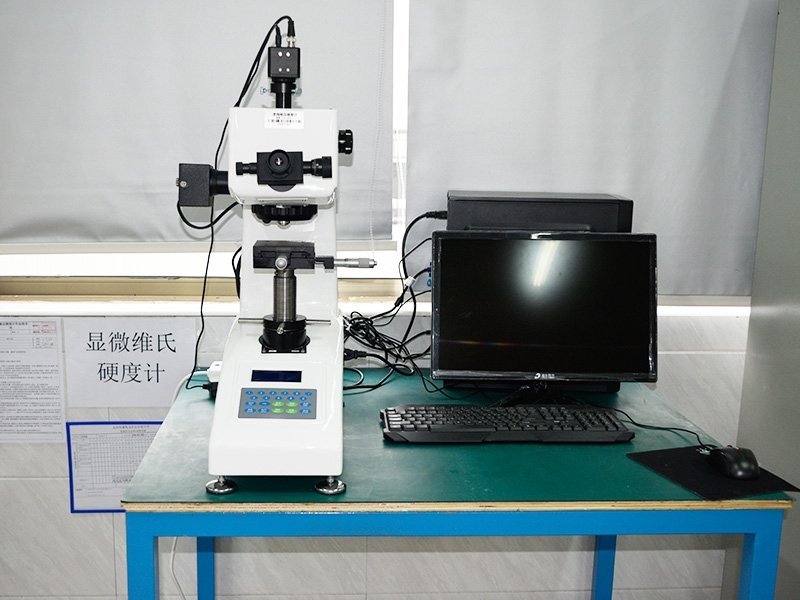
Flexural strength is the bending load a test bar takes before it snaps, and it climbs 34%, from 292 to 392 MPa. Ceramic datasheets list it instead of tensile strength; why alumina datasheets list flexural rather than tensile strength explains the reason.
Compressive strength is the squeezing load before failure. Alumina is roughly six times stronger when squeezed than when bent: 1910 against 292 MPa at 95%, and 2300 against 392 MPa at 99.99%. Designs that keep it in compression get the most from it. Above 99.5% this value stops rising.
Fracture toughness measures how well the ceramic stops a crack from spreading once it starts. It is the one mechanical value that falls again at higher purity: 99.5% reads highest at 5.37 MPa·m½, and 99.7% and 99.99% fall back to 4.3 and 4.4. Our datasheet does not list elastic modulus (stiffness); for that, see our guide to the Young's modulus of alumina.
Thermal Properties of Alumina by Grade
Thermal conductivity steps up at 99%, maximum working temperature tops out at 1,500 °C, and thermal expansion stays between 7.7 and 8.4 × 10⁻⁶/°C for all six grades.
| Property | Unit | 95% | 97% | 99% | 99.5% | 99.7% | 99.99% |
|---|---|---|---|---|---|---|---|
| Max working temperature | °C | ≤1350 | ≤1450 | ≤1500 | ≤1500 | ≤1500 | ≤1500 |
| Thermal conductivity (25 °C) | W/m·K | 10.0 to 16.0 | 10.0 to 16.0 | 14.0 to 21.0 | 14.0 to 21.0 | 14.0 to 21.0 | 16.0 to 22.0 |
| Thermal expansion (25 to 800 °C) | 10−6/°C | 8.4 | 8.3 | 7.7 | 7.8 | 7.8 | 8.0 |
| Thermal shock (25 to 800 °C) | – | Pass | Pass | Pass | Pass | Pass | Pass |
Maximum working temperature is the highest temperature the datasheet allows in use, not the melting point. Pure alumina melts at about 2,054 °C, far above any of these limits. The service limit rises with purity, from 1,350 °C at 95% to 1,500 °C from 99% up. Treat the melting point as a fact about the material, not a design temperature.
Thermal conductivity is how quickly heat passes through the part. The 95% and 97% grades share the 10 to 16 W/m·K band. The 99% to 99.7% grades share 14 to 21 W/m·K, and 99.99% reaches 16 to 22 W/m·K. These are room-temperature values. For parts that run hot, our guide to the thermal conductivity of alumina covers design use.
Thermal expansion is how much the part grows when heated. At these values, a 100 mm alumina part grows about 0.6 mm between 25 and 800 °C. The spread between grades looks small, but 8.4 is about 9% higher than 7.7, which matters when alumina is joined to metal. Use the value for the exact grade in any seal or braze design.
The thermal shock "Pass" means test samples survived a change between 25 and 800 °C. It does not guarantee that a thick or unevenly heated part will survive the same change in service; the FAQ below explains why.
Electrical Properties of Alumina by Grade
Every grade insulates well, and two values improve in clear steps: volume resistivity at 99%, and dielectric loss at 99% and again at 99.7%. Dielectric strength and dielectric constant do not follow purity.
| Property | Unit | 95% | 97% | 99% | 99.5% | 99.7% | 99.99% |
|---|---|---|---|---|---|---|---|
| Volume resistivity | Ω·cm | >1×10¹³ | >1×10¹³ | >1×10¹⁴ | >1×10¹⁴ | >1×10¹⁴ | >1×10¹⁴ |
| Dielectric strength (AC) | kV/mm | 17.84 | 18.44 | 22.5 | 21.5 | 17.72 | 24.38 |
| Dielectric constant (25 °C, 1 MHz) | – | 9.6 | 9.3 | 10.04 | 7.8 | 10.26 | 10.18 |
| Dielectric loss (25 °C, 1 MHz) | – | ≤4×10⁻⁴ | ≤4×10⁻⁴ | ≤2×10⁻⁴ | ≤2×10⁻⁴ | ≤1×10⁻⁴ | ≤1×10⁻⁴ |
Volume resistivity is how strongly the material blocks current flowing through it. It rises tenfold at 99%, from above 1013 to above 1014 Ω·cm, which makes 99% a natural starting point for line-voltage and high-voltage insulators. The 95% and 97% grades still insulate well at lower voltages. These are room-temperature values; resistivity drops sharply in hot service, as the FAQ explains.
Dielectric strength is the voltage per millimeter of thickness that the material holds before current punches through it. It runs from 17.72 kV/mm at 99.7% to 24.38 kV/mm at 99.99%, with no steady link to purity. When breakdown matters, choose a grade on the measured value, not the purity number. Our alumina ceramic insulator guide covers insulator design in more depth.
Dielectric constant describes how much electric charge the material stores in an electric field, which matters for circuit substrates and radio-frequency (RF) parts. Five grades read 9.3 to 10.26. Our 99.5% grade reads 7.8, while one published supplier datasheet lists 9.8 for its own 99.5% alumina. Confirm this value for the exact grade in any RF design.
Dielectric loss is the share of an electrical signal's energy that the material turns into heat, and it matters most in RF and microwave parts. It halves from ≤4×10⁻⁴ to ≤2×10⁻⁴ at 99%, and halves again to ≤1×10⁻⁴ at 99.7%. More detail on both is in our hub on alumina dielectric constant and electrical properties.
Chemical Resistance of Alumina by Grade
Acid resistance improves sharply only at 99.7%, and alkali resistance improves at 99%.
| Property | Unit | 95% | 97% | 99% | 99.5% | 99.7% | 99.99% |
|---|---|---|---|---|---|---|---|
| Acid resistance (1:9 HCl) | mg/cm² | ≤0.7 | ≤0.7 | ≤0.7 | ≤0.7 | ≤0.1 | ≤0.1 |
| Alkali resistance (10% NaOH) | mg/cm² | ≤0.2 | ≤0.2 | ≤0.1 | ≤0.1 | ≤0.1 | ≤0.1 |
Both values are weight lost per square centimeter of surface in the test solution, so lower is better. In hydrochloric acid, the 99.7% and 99.99% grades lose at most one-seventh as much as the four lower grades (≤0.1 against ≤0.7 mg/cm²). In sodium hydroxide, the loss halves at 99%. For a part that sits in strong acid, 99.7% is the grade to start from; for caustic service, 99% is the minimum. These two tests do not cover every chemical, and a few common ones attack alumina, as the FAQ explains. For a direct comparison of two mid-range grades, see our alumina 99.5% vs 97% comparison.
Which Property Drives Each Failure Mode
Start from how a part is most likely to fail, then look up the alumina properties that control it.
| How the part could fail | Property that controls it | Grade to start from |
|---|---|---|
| Abrasive wear on pump liners, seal faces, or slurry valves | Hardness | 95% or 97% for cost; higher grades when wear is severe (up to HV 1660 at 99.99%) |
| Current leakage or breakdown at line voltage | Volume resistivity, dielectric strength | 99% (above 1014 Ω·cm; 22.5 kV/mm) |
| Signal loss at radio frequencies | Dielectric loss | 99.7% or 99.99% (≤1×10⁻⁴) |
| Working temperature from 1,350 to 1,450 °C | Max working temperature | 97% |
| Working temperature from 1,450 to 1,500 °C | Max working temperature | 99% or higher |
| Strong acid exposure | Acid resistance | 99.7% or 99.99% |
| Caustic (alkali) exposure | Alkali resistance | 99% or higher |
| Chipping in handling or assembly | Fracture toughness | 99.5% (5.37 MPa·m½); for repeated impact, zirconia toughened alumina |
| Contamination in semiconductor processes | Impurity content | 99.99%, with impurity limits written into the order |
When more than one row applies, the higher grade usually wins, but check that it does not lose ground elsewhere. For example, 99.7% shares the best acid resistance and the lowest dielectric strength of the six grades. The alumina grade selection guide walks through those trade-offs grade by grade.
How to Compare These Values With Other Datasheets
Compare like with like. These alumina properties belong to six specific grades under the test conditions below, so they will not match broad published ranges or another supplier's figures line by line.
Test conditions behind each value
The datasheet states the following conditions. It gives no test duration or sample size, so none is listed.
| Property | Condition on the datasheet |
|---|---|
| Vickers hardness | HV0.5 (0.5 kgf test load) |
| Thermal conductivity | At 25 °C |
| Thermal expansion | Average over 25 to 800 °C |
| Thermal shock resistance | 25 to 800 °C, pass or fail |
| Dielectric strength | AC |
| Dielectric constant and loss | 25 °C, 1 MHz |
| Acid resistance | 1:9 hydrochloric acid |
| Alkali resistance | 10% sodium hydroxide |
| Permeability and airtightness | Pass for all six grades |
| Straightness | 1‰ for all six grades (a deviation of 1 part per thousand of length, or 0.1 mm over 100 mm) |
Values shown with ≥ or ≤ are limits. Values without a sign, such as flexural strength and fracture toughness, are the figures the datasheet lists.
Why published alumina ranges can run higher
Published alumina properties for the same purity can sit well above ours. One supplier's datasheet lists 30 W/m·K and a maximum use temperature of 1,675 °C for its 99.5% alumina. Our 99.5% grade lists 14 to 21 W/m·K and 1,500 °C. Another supplier lists 30 W/m·K at 25 °C for its two 99.5% grades.
Gaps like these can come from the test method, how a sample was prepared, how a maximum temperature is defined, or whether a figure is a typical result or a guaranteed limit. A datasheet that does not state these is hard to compare line by line with another. Design to the values for the exact grade you order, and before switching suppliers on the strength of one number, ask for the test conditions behind it. Our quality control page describes how finished parts are inspected.
Frequently Asked Questions
Yes, but much less than at room temperature, where our values are measured. One supplier's data show 95% alumina dropping to 3×10⁸ Ω·cm at 700 °C, while its 99.5% grade holds 2×10⁹. For hot insulators, a higher grade keeps more of its resistance.
The pass applies to test samples. A real tube has thicker walls and heats unevenly, which raises stress. In one published study, a tube cracked at a cooling rate of about 257 °C per hour, below the furnace maker's 300 °C per hour limit. Heat and cool slowly and evenly.
Hydrofluoric acid and hot phosphoric acid. Published work shows hydrofluoric acid attacking the glassy phase between grains, and a boiling phosphoric acid solution is used in labs to etch alumina. Our datasheet covers only hydrochloric acid and sodium hydroxide, so test other chemicals under real conditions.
Each beats alumina in at least one way. Zirconia is about twice as tough (9.18 MPa·m½), silicon nitride is the strongest in bending (812 MPa), and silicon carbide is the hardest (HV 2100) but does not insulate. Alumina's six grades let it match a job more closely.
Get a Grade Recommendation for Your Part
If you know how your part will be used but not which grade fits, send the operating temperature, voltage, chemicals, and loads through our quote request form. Our engineers recommend an alumina grade free of charge and reply within 24 hours on business days, starting from the alumina properties on this page.
References
- Wikipedia, Aluminium oxide (density, melting point, and Mohs hardness of corundum)
- Superior Technical Ceramics, high purity alumina white paper and property chart (99.5% alumina)
- Superior Technical Ceramics, alumina property chart (volume resistivity at 500 and 700 °C)
- CeramTec, material selection guide for 92% to 99.5% alumina
- US Patent 5,411,583, HF-resistant ceramics (sintering additives and hydrofluoric acid attack on glassy grain boundary films)
- Metallographic etchants for ceramics (boiling phosphoric acid etch for alumina)
- Suntoro, analysis of crack and fracture of an alumina furnace tube, Jurnal Prima (BATAN)
Pingback: Alumina Dielectric Constant & Electrical Properties Hub