
Product Overview
Custom ceramic rods and shafts solve the four failure modes that retire metal rods: corrosion, magnetism, electrical conduction, and thermal drift. FineCer manufactures ceramic rods through isostatic pressing and high-temperature sintering, followed by precision CNC centerless grinding to tolerances that metal rods cannot maintain under the same operating conditions — diameter ±0.001mm, straightness ±0.001mm, roundness ±0.002mm, in diameters of 0.5–50mm and lengths to 600mm. The fundamental advantage: ceramic rods do not corrode, do not magnetize, do not conduct electricity, and stay dimensionally stable at temperatures where steel softens.
In semiconductor pick-and-place machines, alumina guide rods replace steel to eliminate magnetic interference with sensitive components. In chemical reactors, SiC stirring rods survive environments that dissolve Hastelloy. In high-speed textile machinery, zirconia guide pins reduce fiber breakage by 40% compared to hardened steel — because ceramic surfaces are smoother and harder than any metal.
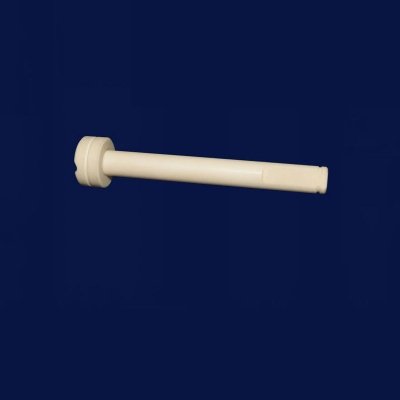
Technical Specifications
| Parameter | Range |
|---|---|
| Materials | Al₂O₃ (95–99.99%), ZrO₂, SiC, Si₃N₄ |
| Diameter | 0.5 – 50 mm |
| Length | Up to 600 mm |
| Diameter Tolerance | ±0.001 mm |
| Straightness | ±0.001 mm |
| Surface Finish | Ra 0.1 – 1.6 μm |
| Roundness | ±0.002 mm |
Material Selection for Ceramic Rods
| Application | Material | Key Reason |
|---|---|---|
| Wire drawing guides / capstans | Al₂O₃ (99%) | High hardness (15 GPa), smooth surface reduces wire breakage |
| Motor drive shafts | ZrO₂ | Fracture toughness, bondable to metal hubs |
| Chemical stirring rods | SiC | Chemical inertness even in conc. H₂SO₄, high temp resistance |
| High-speed spindle shafts | Si₃N₄ | 60% lighter than steel, self-lubricating, 2× speed capability |
| Semiconductor guide rods | Al₂O₃ (99.5%+) | Non-magnetic, non-conductive, particle-free |
| Textile thread guides | ZrO₂ or Al₂O₃ | Ultra-smooth surface, low friction coefficient |
| Thermocouple protection | Al₂O₃ or Si₃N₄ | High-temperature service, thermal shock resistance |
| Welding positioning pins | Si₃N₄ or Al₂O₃ | Non-wetting to molten metal, spatter-resistant |
Product Types
- Precision guide rods and linear rails — for automation equipment and semiconductor tools
- Stirring and mixing rods — for chemical reactors and laboratory equipment
- Ceramic drive shafts and pump shafts — motor and pump applications with non-magnetic or corrosion-immune requirements
- Positioning pins and dowels — thermal fixture pins, alignment pins for molds
- Wire drawing capstans and thread guides — for textile and wire/cable manufacturing
- Thermocouple protection sheaths — solid and hollow configurations
- Custom-profile rods — stepped, grooved, threaded (≥M2), tapered
Ceramic vs Metal Rods
| Factor | Ceramic Rod | Hardened Steel Rod |
|---|---|---|
| Hardness | Up to 9.5 Mohs (SiC) | ~6.5 Mohs (HRC 60) |
| Corrosion | Immune | Susceptible |
| Magnetic | Non-magnetic | Magnetic |
| Electrical | Insulating | Conductive |
| Max Temperature | 1,200–1,700°C | ~400°C |
| Weight | 40–60% lighter | Baseline |
| Dimensional Stability | Superior (low CTE) | Thermally unstable |
Why Centerless Grinding Matters
A rod's value lives in its geometry, and geometry is made in finishing. Our centerless grinding lines support the rod on its own surface rather than between centers, so long slender rods come off straight to ±0.001mm without the bowing that chucked grinding induces — the difference between a guide rod that glides and one that binds. Diamond wheels handle all four materials; stepped diameters, undercuts, and threads are added on CNC tool grinders afterward. Surface finish is selectable from economical Ra 1.6μm for static pins down to Ra 0.1μm for sliding and sealing surfaces, and each batch ships with measured diameter, straightness, and roundness data from our quality lab. For rods that mate with bushings or bearings, we recommend quoting the rod and its mating ring together — grinding both halves of the fit in one facility is the simplest way to guarantee the clearance you actually specified.
Ceramic Pump Shafts and Rotating Service
Rotating duty adds two demands: balance and fatigue. Fully dense fine-grained ceramic takes both well — there are no inclusions to seed fatigue cracks and no corrosion pits to grow them, which is why zirconia pump shafts in magnetic-drive chemical pumps routinely outlive the pump's wet end. For high-speed spindles, Si₃N₄ cuts rotor mass roughly 60% versus steel, raising critical speed and trimming bearing load in the same stroke. Where a ceramic shaft must couple to a metal drive, zirconia's steel-matched expansion allows shrink-fit or brazed hubs that survive thermal cycling — the same joining technology proven in our bonded plunger assemblies. Send shaft drawings with speed, load, and media, and we will recommend the material and grade — from 1-piece prototypes to volume.
Need Ceramic Rods?
Send your drawings or specs to sales@finecer.com — response within 24 hours.
Frequently Asked Questions
Ready to Start Your Project?
Send us your drawings, specifications, or even a rough concept. Our ceramic engineers respond within 24 hours with a DFM review, material recommendation, and detailed quotation — with no obligation.
Request a Free Quote → Order a Sample