
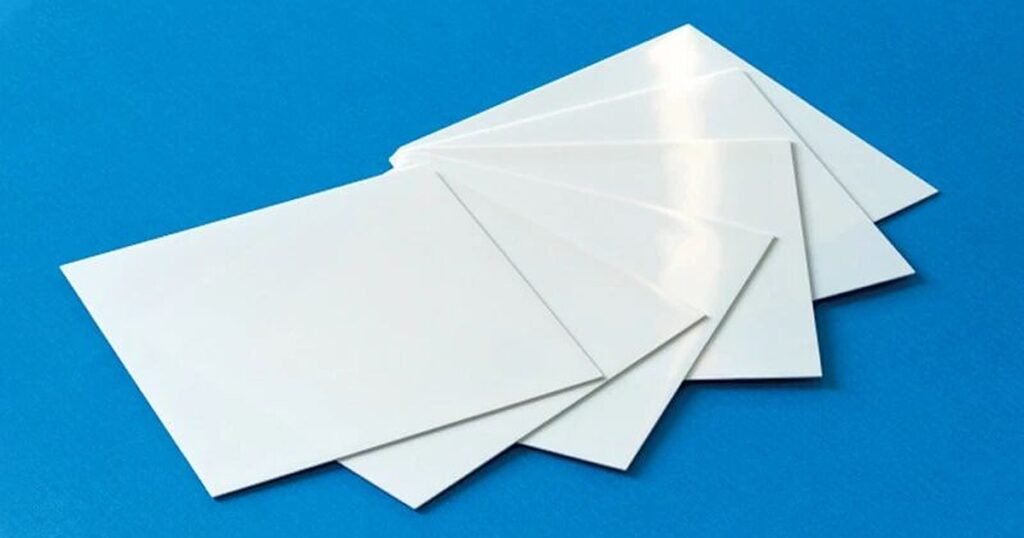
The thermal conductivity of alumina runs from 10 to 22 W/m·K at 25 °C across the six grades on our datasheet, rising with purity. That number falls fast in hot service: published reference data for high-purity alumina shows only about 35% of the room-temperature value left at 500 °C.
Alumina is the common name for aluminum oxide (Al2O3, spelled aluminium oxide outside the US), sold as finished alumina parts in purity grades. The two US supplier datasheets compared below list 19 to 35 W/m·K for comparable grades. Grade and test method can account for much of that gap. The rest of the datasheet values for our six grades are in our alumina properties data hub.
What Alumina's Thermal Conductivity Means in Practice
Alumina conducts heat roughly 25 to 65 times better than FR4, the glass-epoxy laminate most circuit boards are made from. FR4 conducts about 0.35 to 0.38 W/m·K through its thickness. Our 95% and 97% grades start at 10 W/m·K, and the 99.99% grade reaches 22.
The unit is simple once spelled out. W/m·K is the number of watts that flow through a slab 1 meter thick and 1 square meter in area when its two faces differ by 1 °C (one kelvin). A higher number means a smaller temperature difference across the part for the same heat.
What makes alumina useful is the second half of the picture. Metals that carry heat well also carry current. Alumina does not: its volume resistivity, a measure of how strongly a material blocks current, is above 1013 Ω·cm for the 95% and 97% grades and above 1014 Ω·cm from 99% up. So it can pull heat away from something electrically live without shorting it.
Thermal Conductivity of Alumina by Grade
Alumina's thermal conductivity rises with purity in three steps, and density rises alongside it.
| Grade | Thermal conductivity at 25 °C (W/m·K) | Density (g/cm³) |
|---|---|---|
| 95% Al2O3 | 10.0 to 16.0 | ≥3.62 |
| 97% Al2O3 | 10.0 to 16.0 | ≥3.75 |
| 99% Al2O3 | 14.0 to 21.0 | ≥3.85 |
| 99.5% Al2O3 | 14.0 to 21.0 | ≥3.90 |
| 99.7% Al2O3 | 14.0 to 21.0 | ≥3.93 |
| 99.99% Al2O3 | 16.0 to 22.0 | ≥3.95 |
Both columns are from our property datasheet. Density values are minimums.
The step from 97% to 99% is the big one. The low end of the range rises 40%, from 10 to 14 W/m·K, and the high end rises 31%, from 16 to 21. Above 99%, only the 99.99% grade moves again, to 16 to 22 W/m·K.
The reason sits between the crystals. Lower grades contain more sintering aids, small amounts of other oxides added so the powder fuses at a lower firing temperature. After firing, these additives form a thin glassy layer around the alumina crystals. Impurities and grain boundaries (the borders between crystals) both slow heat flow in a ceramic, and this glassy layer is both, so less of it means higher conductivity. Our guide to choosing an alumina grade covers what else each step in purity changes.
Pores work against heat flow too. A pore is a small pocket of gas, and heat has to detour around it, so a denser part conducts better. That makes density a quick first check, and our guide to the density of alumina by grade explains how it is measured.
How Much Thermal Conductivity Alumina Loses When Hot
By 500 °C, high-purity alumina keeps only about a third of its room-temperature thermal conductivity, and by 1000 °C just over a fifth. Our datasheet lists 25 °C values only. The table below uses published reference data for sintered alumina of 99.5% purity or higher, at least 98% of full density, with grains about 5 µm across.
| Temperature | Thermal conductivity (W/m·K) | Share of the 20 °C value |
|---|---|---|
| 20 °C | 33 | 100% |
| 500 °C | 11.4 | 35% |
| 1000 °C | 7.22 | 22% |
| 1200 °C | 6.67 | 20% |
| 1400 °C | 6.34 | 19% |
| 1500 °C | 6.23 | 19% |
Most of the loss happens early. The value drops by almost two-thirds between room temperature and 500 °C, then falls by only about 1 W/m·K more between 1000 and 1500 °C. A part that runs at a few hundred degrees has already lost a large share of its datasheet conductivity.
Estimated Hot Values for Our 99% to 99.99% Grades
Applying the same percentages to our grades gives the estimates below. The reference sample reads 33 W/m·K at room temperature, above our ranges, so carry over the percentage, not the absolute number.
| Grade | At 25 °C (W/m·K) | Estimated at 500 °C (W/m·K) | Estimated at 1000 °C (W/m·K) |
|---|---|---|---|
| 99%, 99.5%, and 99.7% | 14 to 21 | 4.8 to 7.3 | 3.1 to 4.6 |
| 99.99% | 16 to 22 | 5.5 to 7.6 | 3.5 to 4.8 |
Our 25 °C range multiplied by the reference retention of 34.5% at 500 °C and 21.9% at 1000 °C. These are planning estimates, not measured or guaranteed values.
The reference table has no point between 20 and 500 °C. For a part at 150 or 300 °C, the true value sits somewhere between those two rows, and a figure measured at that temperature is the safer input.
Why the 95% and 97% Grades Are Not Estimated
We found no published temperature curve for alumina near 95% or 97% purity, so these grades get no estimate here. The reference data covers 99.5% and above, and the lower grades carry more glassy layer, so there is no basis for assuming they lose conductivity at the same rate. For a 95% or 97% part that runs hot, ask for a value measured at your service temperature. Keep their lower service limits in mind as well: 1350 °C for 95% and 1450 °C for 97%.
Why Published Values Run From 10 to 35 W/m·K
Alumina datasheets for similar purities can differ by about a factor of two, so a value is only comparable when its grade, test method, and temperature are stated. The table puts two published supplier datasheets next to ours.
| Purity | Supplier A (ASTM C408, 20 °C) | Supplier B (ASTM C408, room temperature) | Our datasheet (25 °C, method not stated) |
|---|---|---|---|
| 94% to 95% | 22.4 (94%) | 19 (95%) | 10 to 16 (95%) |
| 99.5% | 30.0 | 30 | 14 to 21 |
| 99.8% and above | 31.0 (99.8%), 33.0 (99.9%) | 35 (99.96%) | 16 to 22 (99.99%) |
Supplier values as published on their datasheets, listed in the References. Both are US suppliers.
Three things can push two datasheets apart.
Test method. Thermal conductivity can be measured several ways, and the methods do not always agree. In one published comparison, the same 94% alumina was tested three standard ways, and one of them, a calorimeter method, read lower than the other two, with the gap largest at low temperature. Both suppliers above test to ASTM C408, a steady-state method, meaning heat flows through the sample at a constant rate until its temperatures settle. Our datasheet does not name its method.
Typical figure or range. Both suppliers present their figures as typical values or design guidance, not guarantees. Our datasheet gives a range instead, and whether a figure is typical or a minimum changes how much margin it carries. A lower number on one datasheet does not by itself mean a material that conducts less heat, since the figures were not produced the same way.
The material behind the label. Each supplier's 99.5% alumina has its own sintering aids, grain size, and density. The purity label alone does not fix the number.
Before switching suppliers on the strength of a higher W/m·K, ask for the test method, the test temperature, and whether the figure is typical or guaranteed. The datasheet comparison notes in our data hub apply the same check to other alumina properties.
Using Alumina Thermal Conductivity Values in a Design
Design with the low end of the grade's range, corrected for service temperature, unless you have a value measured on your own batch. For a 99% alumina part, that means 14 W/m·K near room temperature and about 4.8 W/m·K at 500 °C.
Thickness counts as much as material. The resistance to heat flow through a plate scales with thickness divided by conductivity, so halving the thickness of an alumina plate has the same effect as doubling its conductivity. Our ceramic substrate guide covers how substrate choice fits into the rest of an electronic package.
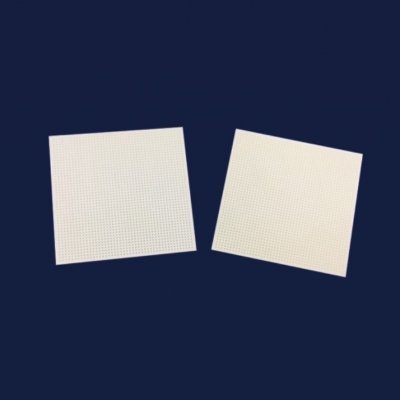
When the calculation shows that the alumina itself causes the largest temperature drop in the heat path, a higher-conductivity insulating ceramic is the next step. One supplier lists its aluminum nitride at 150 W/m·K, about five times its own 99% alumina. For flat alumina parts, our ceramic plates and substrates page lists the shapes we supply.
Frequently Asked Questions
Use the low end. A 99% alumina part is listed at 14 to 21 W/m·K, and the datasheet does not say where in that range a given batch falls, so 14 is the figure a design can count on. If your model only works near 21, ask for a value measured on your batch before relying on it.
Laser flash measures thermal diffusivity, which is how fast a temperature change spreads through the sample. Conductivity is then calculated as diffusivity × density × specific heat (the heat needed to warm 1 kg by 1 °C). In the reference data above, 1.11 × 10⁻⁵ m²/s × 3984 kg/m³ × 755 J/kg·K gives about 33 W/m·K. An assumed density or specific heat that is off carries straight into the result.
Yes. Sapphire is alumina grown as one single crystal, while ordinary alumina is made of many small crystals. Sapphire therefore has no grain boundaries and no glassy layer to slow heat down. One supplier lists its sapphire at 42 W/m·K against 29 for its own 99% alumina, about 45% higher. Compare the two only within one supplier's data, since test methods differ between datasheets.
Matching an Alumina Grade to a Hot Part
The thermal conductivity of alumina you design with depends on service temperature as much as on grade. If your part runs hot, include the service temperature and the heat the part must pass in your request for quote. We reply within 24 hours (business days) with the grade we would start from.
References
- NIST Property Data Summaries for Advanced Materials, sintered alumina (Standard Reference Database 150)
- CoorsTek, ceramic material properties chart (2017)
- Superior Technical Ceramics, alumina property chart
- Kyocera, thermal conductivity of fine ceramic materials
- Thermal conductivity of alumina measured with three techniques, Journal of Testing and Evaluation (2003)
- Experimental and multiscale numerical characterization of the temperature-dependent thermal behavior of FR4 laminates, Luxembourg Institute of Science and Technology