
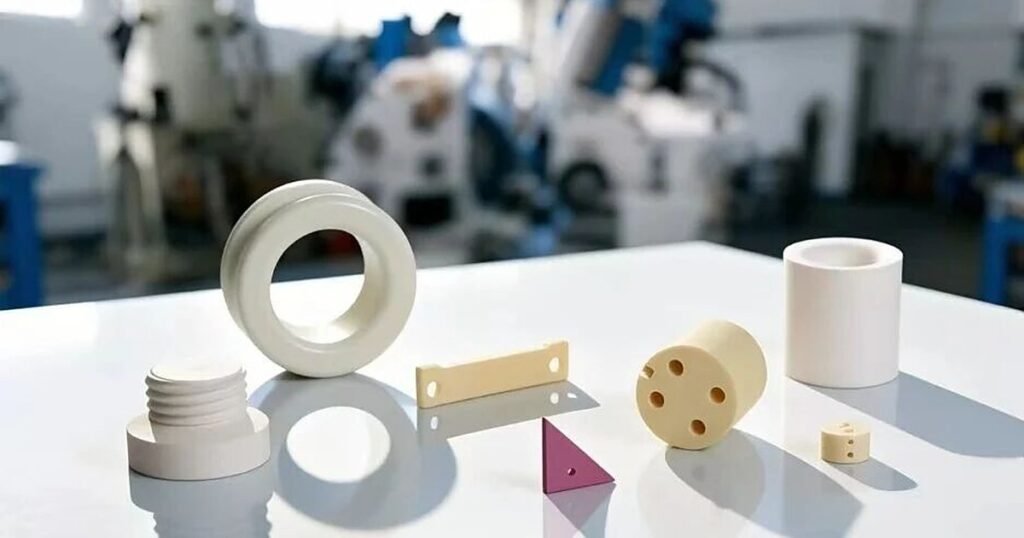
An insulator ceramic is a sintered ceramic material that blocks electrical current, delivered as washers, spacers, bushings, standoffs, feedthroughs, or line insulators across power and electronic systems. Four material families cover almost every commercial insulator ceramic: alumina, porcelain, steatite, and the advanced nitrides. This guide explains what makes a ceramic behave as an insulator, where each material family fits, the key electrical properties to check on a data sheet, and the workhorse forms an insulator ceramic ships in. It links to fuller property data for alumina ceramic parts where relevant.
- Four material families: alumina, porcelain, steatite, nitrides (AlN, Si₃N₄)
- Volume resistivity range: 10¹² to >10¹⁴ Ω·cm
- Dielectric strength range: 10 to 26 AC kV/mm
- Max service temperature: 1,000 to 1,500°C
Why ceramics work as electrical insulators
A ceramic behaves as an electrical insulator because strong ionic and covalent bonds hold its atoms together with a wide band gap between valence and conduction states, leaving no free electrons to carry current under applied voltage.
Not every ceramic is an insulator. Silicon carbide sits around 10⁴ Ω·cm volume resistivity, closer to a wide-band-gap semiconductor than to an insulator, and it is used in heater elements and power devices rather than isolation applications. True insulator ceramics deliver volume resistivity of 10¹² Ω·cm or higher, with the workhorse alumina and nitride grades clearing 10¹⁴. Fuller electrical data for alumina sits in our alumina dielectric constant hub.
The four insulator ceramic material families
Four ceramic material families cover almost every commercial insulator ceramic: alumina, porcelain, steatite, and the advanced nitrides (AlN, Si₃N₄). All four qualify as ceramics; they split into traditional silicate ceramics (porcelain and steatite, made from natural clay and feldspar) and advanced ceramics (alumina and the nitrides, made from synthetic high-purity powders). The industry compares them side by side because their electrical and cost profiles decide most designs.
| Material | Composition | Volume resistivity (Ω·cm) | Max service temp | Cost tier |
|---|---|---|---|---|
| Alumina | Al₂O₃ 95 to 99.99% | >10¹³ to >10¹⁴ | 1,350 to 1,500°C | Baseline |
| Porcelain | Kaolin, quartz, feldspar | >10¹² | ~1,050°C | 0.3x |
| Steatite | Talc + alumina | >10¹³ | 1,000°C | 0.5x |
| AlN / Si₃N₄ | Aluminum nitride or silicon nitride | >10¹⁴ | 1,200°C | 5x to 10x |
Alumina is the modern workhorse across insulator ceramic duty. Six purity grades from 95 to 99.99 percent trade cost for electrical performance, with higher purity raising resistivity and lowering dielectric loss, while dielectric strength varies by grade rather than rising with purity.
Porcelain covers overhead high-voltage transmission and distribution because its ecosystem of pin, suspension, strain, and shackle designs is mature and low-cost for the large forms utility lines demand.
Steatite fits low-voltage electrical duty where cost dominates. Terminal blocks, resistor cores, heater bases, and thermocouple cores are the classic applications, and its low dielectric loss also serves broadcast antenna and RF insulator work.
The nitrides serve narrow niches. Aluminum nitride carries heat at 170 to 230 W/m·K for power module and RF substrate work. Silicon nitride's fracture toughness earns its price in EV inverter modules and thermally cycled insulators. FineCer supplies both alongside alumina.
Key electrical properties to check on a data sheet
Four numbers on an insulator ceramic data sheet decide whether the material will hold up in your design: volume resistivity, dielectric strength, dielectric loss, and dielectric constant. Each answers a different question and none can substitute for another.
Volume resistivity, quoted in Ω·cm, sets the DC insulation baseline. Values above 10¹³ Ω·cm qualify as reliable insulators; alumina at 99 percent and above passes 10¹⁴, and the nitrides sit at the same level or higher. Numbers below 10¹² fall out of general insulator duty.
Dielectric strength, quoted in AC kV/mm, is the short-time voltage the material holds before breakdown. Alumina runs 17 to 24 kV/mm depending on grade, porcelain sits closer to 10 to 15 kV/mm, and steatite lands between the two. The standard test is ASTM D149, and every real design applies a 30 to 50 percent derating factor to move from short-time coupon values to long-term working stress.
Dielectric loss (or loss tangent, tan δ) governs RF and microwave performance. Alumina and porcelain sit in the 10⁻⁴ to 10⁻³ range, low enough for broadcast, antenna, and RF insulator duty. Higher-loss ceramics dissipate signal energy as heat and change the impedance of any circuit they sit inside.
Dielectric constant matters for feedthroughs, capacitors, and any part where stored charge changes device behavior. Alumina sits between 7.8 and 10.3 across grades. Five conditions must match when comparing values across suppliers: purity, test frequency, sample thickness, test temperature, and ambient humidity. A missing condition on a data sheet is a data-quality flag, not a rounding oversight.
Common insulator ceramic forms
Insulator ceramics ship in six workhorse forms: insulating washers, spacers, bushings, standoffs, feedthroughs, and line insulators. Each form pairs with specific materials and voltage ranges.
| Form | Common material | Voltage tier | Typical duty |
|---|---|---|---|
| Insulating washer | Alumina, steatite | Low to medium | Busbar isolation, sensor isolation, heater terminations |
| Spacer | Alumina | Low to high | Electrode spacing, multi-layer stack isolation |
| Bushing | Alumina, steatite | Low to medium | Through-wall pass-through, feedthrough sleeves |
| Standoff | Alumina, porcelain | Low to high | Component elevation, circuit board isolation |
| Feedthrough | Alumina 99.5%+ | Low to high (incl. vacuum) | Vacuum, hermetic, semiconductor equipment |
| Line insulator | Porcelain | HV (>1 kV) | Overhead transmission, pin/suspension/strain/shackle |
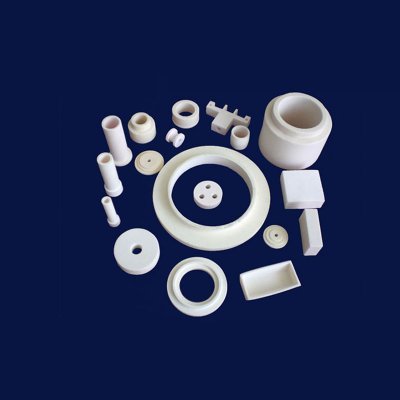
Insulating washers, spacers, and bushings are the most common forms across electronics and industrial equipment. Alumina at 95 or 99 percent covers most of this volume, with lapped faces for even clamping pressure and ID/OD tolerances down to ±0.001 mm on ground features.
Standoffs and feedthroughs handle higher voltage isolation. Standoffs elevate components above a chassis for creepage distance, while feedthroughs pass conductors through a wall while maintaining hermetic or vacuum seal integrity. Alumina 99.5 percent and above is standard for semiconductor and vacuum equipment because its low outgassing and consistent dielectric properties tolerate plasma and process chemistry.
Line insulators are the historical face of the category: pin insulators support conductors on distribution poles, suspension insulators hang from transmission towers, strain insulators handle mechanical tension at dead-ends, and shackle insulators serve low-voltage lines. Porcelain dominates the volume. FineCer's alumina insulating washers, spacers, and bushings cover the electronic and industrial half of the category, while power line hardware sits with utility-specialty suppliers.
Frequently asked questions
Are all ceramics electrical insulators?
No. Silicon carbide sits at roughly 10⁴ Ω·cm volume resistivity, closer to a wide-band-gap semiconductor than an insulator, and it is used in heater elements and power devices rather than isolation duty. The workhorse insulator ceramics, alumina, porcelain, steatite, aluminum nitride, and silicon nitride, all deliver at least 10¹² Ω·cm and pass the practical bar for isolation work.
When should I choose alumina over porcelain or steatite?
Almost every modern electronic and industrial insulator duty defaults to alumina. Its resistivity runs one to two orders of magnitude higher than porcelain, dielectric strength is higher, and service temperature reaches 1,500°C versus porcelain's 1,050°C. Porcelain still leads on overhead high-voltage lines where the hardware ecosystem and lower material cost outweigh peak electrical performance. Steatite holds cost-driven low-voltage niches like resistor cores and heater bases.
What voltage can an alumina insulator handle?
The answer depends on thickness, purity, and geometry, not a single headline number. Alumina's short-time dielectric strength runs 17 to 24 AC kV/mm on thin ground coupons per ASTM D149. Working voltage in a finished part is set by a 30 to 50 percent derating factor plus geometry-specific tests, and creepage distance across the surface matters as much as bulk breakdown. Ask the supplier for values on your actual geometry when the design margin is tight.
Do ceramic insulators degrade over time?
Bulk volume resistivity holds steady over years, but surface resistivity can drop by four orders of magnitude under humid, contaminated conditions. Tracking and flashover across a contaminated surface, not bulk breakdown, cause most field failures. Cracking from mechanical or thermal cycling is the other common failure mode. Clean handling, adequate creepage distance in the geometry, and appropriate glaze or hydrophobic coating on outdoor parts handle both.
Next step
Need alumina insulating washers, spacers, bushings, or feedthroughs? See our ceramic rings and bushings catalog for standard forms in 95 to 99.7 percent alumina grades. For zirconia, silicon carbide, or silicon nitride variants, or for non-standard geometries, our custom ceramic parts service returns DFM feedback and a quote within 24 hours.