
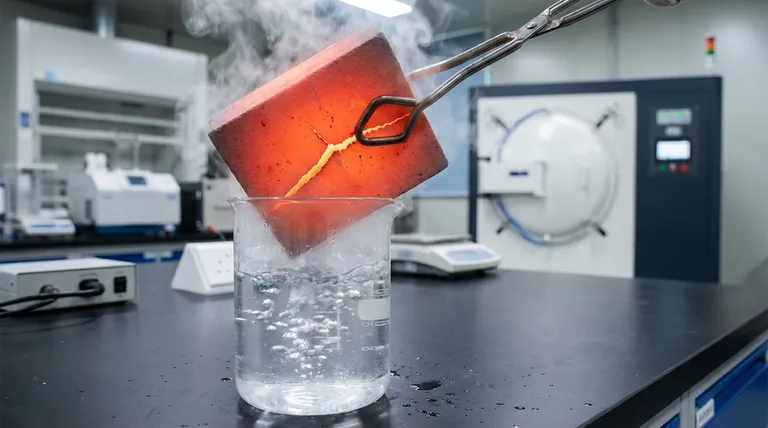
Thermal shock resistance is the largest sudden temperature change a ceramic can take without cracking. In published supplier datasheets, 99% to 99.5% alumina survives a drop of about 150 to 200 °C. Zirconia toughened alumina (ZTA) has reported thermal-shock values of 300 °C in CoorsTek's data and 325 °C for Ideal-tek's MZ grade. Zirconia is listed at about 200 to 350 °C, depending on grade and supplier. Silicon nitride, the strongest of the common choices, reaches 800 °C on one supplier's data.
Those figures come from small lab test pieces, so a real part, thicker and with corners, usually tolerates less. We make alumina, zirconia, and ZTA parts. For how fast each one moves heat, see our guide to the thermal conductivity of ceramics.
What Thermal Shock Resistance Means for a Ceramic Part
A ceramic cracks from thermal shock when its surface changes temperature much faster than its core. Plunge a hot part into cold water and the surface shrinks at once while the core stays hot and expanded. The core holds the surface stretched, in tension.
Tension is where ceramics are weakest. FineCer's Property Parameter Data Sheet lists a compressive strength of 2,300 MPa and a bending strength of 355 MPa for its 99.5% alumina. Datasheets therefore test the cooling case. One supplier drops heated pieces into water and reports the largest temperature difference they survive without defects. Another reports ΔTc (the critical temperature difference), the point where bending strength drops sharply after quenching. Expansion, stiffness, strength, and thermal conductivity set the result. Expansion also governs metal joints, as our alumina CTE guide explains.

Thermal Shock Resistance of Ceramics by Material
Within each supplier's data, alumina sits below ZTA and zirconia. Silicon nitride, listed only by Kyocera, sits highest. The exact numbers differ by supplier, so compare within a column first.
| Material | Kyocera, water quench ΔT (°C) | CoorsTek, ΔTc in water (°C) | Other supplier datasheets (°C) |
|---|---|---|---|
| Alumina, 99% to 99.5% | 150 (99%) | 200 (99.5%) | Not listed |
| ZTA | Not listed | 300 (CoorsTek) | 325 (Ideal-tek MZ) |
| Zirconia, yttria-stabilized | 300 | 350 | 200 (Morgan Nilcra 3Y-TZP) |
| Zirconia, magnesia-stabilized (Mg-PSZ) | Not listed | 350 | 500 (Morgan Nilcra TS) |
| Silicon carbide | 400 | 300 to 400 (two grades) | Not listed |
| Silicon nitride | 800 | Not listed | Not listed |
Values as published on each supplier's datasheet. Kyocera and CoorsTek state a water quench; the Ideal-tek and Morgan datasheets give a ΔT without naming the cooling medium. CoorsTek presents its figures as typical values, not guarantees.
In everyday terms, a 99% alumina part taken from a 200 °C oven and splashed with room-temperature water is already at or past its published limit. Where the same supplier lists both, zirconia and ZTA take roughly 1.5 to 2 times the alumina value.
For alumina thermal shock, higher purity does not buy margin. On the CoorsTek sheet, the 94% and 96% grades list 250 °C, against 200 °C for 99.5% and above. Grade matters for zirconia too. One supplier lists 200 °C for its yttria-stabilized 3Y-TZP grade and 500 °C for a magnesia-stabilized (Mg-PSZ) grade designed for thermal shock. Our stabilized zirconia guide also points to Mg-PSZ for thermal shock.
Why Zirconia and ZTA Outrank Alumina
Zirconia tends to survive a harsher quench than alumina because it is little more than half as stiff as alumina and about 1.8 times as strong in bending, which outweighs its higher thermal expansion. A simple index estimates the drop a ceramic can take if its surface cools instantly: bending strength × (1 − Poisson's ratio) ÷ (Young's modulus × thermal expansion). Poisson's ratio describes how much a material narrows when stretched, and Young's modulus is its stiffness.
| Material | Bending strength (MPa) | Young's modulus (GPa) | Thermal expansion (× 10⁻⁶/°C) | Estimated index (°C) |
|---|---|---|---|---|
| Alumina 99.5% | 355 | 370 | 7.8 | About 96 |
| ZTA | 450 (CoorsTek) | 360 | 8.3 | About 116 |
| Zirconia | 631 | 210 | 10.1 | About 229 |
For alumina 99.5% and zirconia, bending strength and thermal expansion are from FineCer's Property Parameter Data Sheet. Young's modulus and Poisson's ratio for these two rows are published CoorsTek values, as FineCer’s datasheet does not list them. All ZTA values in this estimate are from CoorsTek: flexural strength (450 MPa), Young's modulus (360 GPa), thermal expansion (8.3 × 10⁻⁶/°C), and Poisson's ratio (0.23). ZTA is not listed in FineCer’s datasheet. Estimated indices are calculated from these inputs and are for comparison only.
Real water does not cool a surface instantly, so the Kyocera and CoorsTek water-quench values sit above the index, and the order matches. ZTA is the odd one out. Its index sits only slightly above alumina's, yet its quench results sit clearly higher. The index ignores crack resistance, and the zirconia particles in zirconia toughened alumina help stop cracks from spreading, which likely explains part of the gap.
When Slow Heating Favors Alumina
When heating or cooling is slow, thermal conductivity starts to matter and the ranking can flip, because a good conductor keeps the temperature inside the part even. Using the conductivity ranges in FineCer's Property Parameter Data Sheet—14 to 21 W/m·K for 99.5% alumina and 1.2 to 3.0 W/m·K for zirconia—alumina comes out 2 to 7 times ahead in this planning estimate. So in a slow furnace ramp on a thick section, alumina can outlast zirconia, whose low thermal conductivity works against it. This is a planning estimate, so test thick zirconia parts under your real heating schedule.
How to Read the "Pass, 25 to 800 °C" Result in FineCer's Datasheet
FineCer’s Property Parameter Data Sheet records a “Pass” result for heat-shock resistance over the listed 25 to 800 °C range for the materials shown. Thermal-shock results depend on the test method and cooling conditions, so this pass result should not be treated as a universal critical temperature difference (ΔT) or directly equated with water-quench values published by other suppliers. For a production component, validate a representative sample under the intended geometry, heating and cooling cycle, and operating conditions.
Design Rules: Chamfers, Wall Thickness, and Ramp Rates
A real part tolerates less than the published ΔT, and relieving edges, keeping walls even, and slowing the temperature change usually buy more margin than a material change. They also cost less.
Thickness and cooling medium set how hard a quench hits. Engineers capture both in the Biot number: heat transfer at the surface × thickness ÷ thermal conductivity. The higher it is, the smaller the temperature change a part survives. Doubling a wall doubles it, and water raises it far more than air.
- Chamfer or radius every edge and inside corner. Sharp edges, corners, and holes concentrate stress, and a ceramic fails where stress peaks. Published design guides recommend chamfers or radii, which also reduce chipping in handling.
- Keep walls uniform, with gradual transitions. A thick boss next to a thin wall heats unevenly. Splitting a complex part into simpler pieces with even walls can work better than one part with mixed sections.
- Make walls only as thick as the job needs. Thinner walls even out their temperature faster, which lowers the Biot number.
- Limit ramp rates. Avoid rapid heating and cooling, especially for large ceramic parts and components with uneven wall thickness. The appropriate rate depends on the material, part geometry, dimensions, and furnace conditions. Cool at least as carefully as you heat, since cooling is more commonly associated with cracking in water-quench tests.
- Check metal fits at temperature. Alumina and zirconia expand at different rates from most metals, so a fit that is fine cold can add stress hot.
Choosing Between Alumina, Zirconia, and ZTA for Temperature Swings
Start with alumina for slow temperature changes, thick sections, or service above 1,200 °C. Move to ZTA or zirconia when parts see fast quenches below 1,200 °C. Go to silicon nitride for swings of 500 °C or more.
| Your situation | Start with | Why |
|---|---|---|
| Slow ramps, thick sections, or service above 1,200 °C | Alumina | Higher conductivity evens out temperature; FineCer's datasheet lists maximum working temperatures of 1,350 to 1,500 °C for its alumina grades and 1,200 °C for its zirconia |
| Fast quenches or splashes on thin walls, below 1,200 °C | Zirconia, after checking the grade's ΔT | Kyocera and CoorsTek list zirconia at 300 to 350 °C against 150 to 200 °C for their alumina, but one 3Y-TZP grade lists only 200 °C, so ask for the grade's ΔT before relying on it |
| Alumina parts crack in quenching, and you want to stay with an alumina-based material | ZTA | Published values of 300 °C from CoorsTek and 325 °C for Ideal-tek's MZ grade |
| Temperature swings of 500 °C or more | Silicon nitride | 800 °C on one supplier's water-quench data |
For extreme swings, our silicon nitride parts are the next step. To weigh thermal shock resistance against hardness, toughness, and cost, use our ceramic material selection guide. If you send the temperature swing, how fast it happens, the wall thickness, and a drawing with your request for quote, we reply within 24 hours with the material we would start from.
Frequently Asked Questions
It can. Some fired ceramics withstand many successive thermal shocks but gradually weaken and eventually fail, one ceramics reference notes. A datasheet ΔT comes from a single quench, so a part that survives one swing may still fail after many. If your part cycles every shift, test it over its real number of cycles.
Cooling is the more common culprit. One crucible maker reports that cracks associated with uneven heating and cooling occur more often during cooling. Heating too quickly can still crack parts, which is why furnace makers also set heating-rate limits. Control both ramps.
Often, yes, at a cost. One crucible maker notes that a porous refractory of the same composition can resist thermal shock much better than a fully dense ceramic, which keeps the edge in strength and chemical resistance. Porous grades can suit crucibles and kiln furniture that cycle hard. For precision or load-bearing parts, stay dense and design around the shock.
References
- Kyocera, heat shock resistance of fine ceramics (water quench values)
- CoorsTek, ceramic material properties chart (8510-1042)
- Ideal-tek, technical data sheet for ZTA type MZ
- Morgan Advanced Materials, Nilcra zirconia TS grade (Mg-PSZ) datasheet
- Morgan Advanced Materials, Nilcra zirconia 3Y-TZP grade datasheet
- Wikipedia, thermal shock (resistance parameters and Biot number)
- Morgan Technical Ceramics, design guide for ceramic components
- Carbolite, tube furnace manual (heating rate guidance for ceramic tubes)
- Kyocera Fineceramics Europe, thermal properties of technical ceramics (thermal shock test and cycling)
- Almath Crucibles, how to stop high-temperature ceramics cracking from thermal shock
- Digitalfire, thermal shock (glossary)