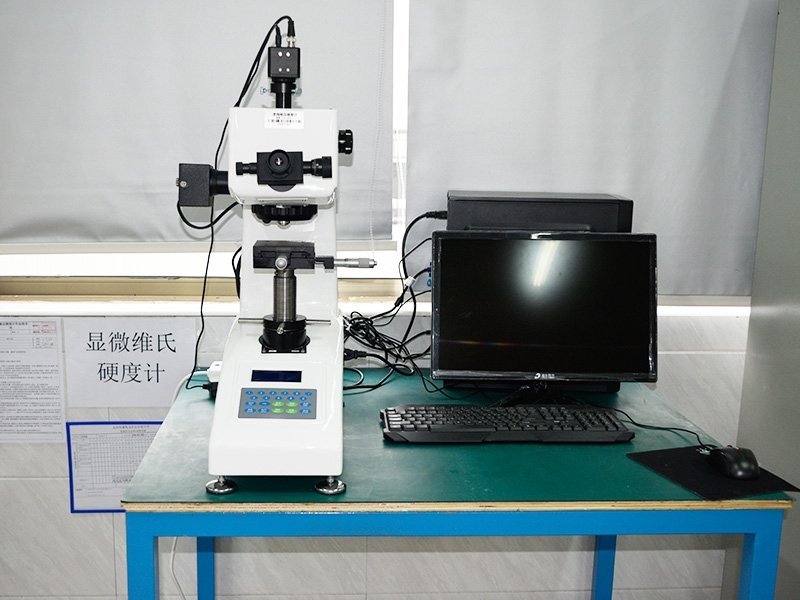
How hard is zirconia? Zirconia hardness sits below that of alumina, but zirconia is about twice as tough: on our data sheet, zirconia (zirconium oxide, ZrO₂) is specified at HV0.5 ≥ 1,200, below every alumina grade, while its fracture toughness is 9.18 MPa·m¹/², against 4.3 MPa·m¹/² for 99.7% alumina. Here zirconia means engineering zirconia such as Y-TZP, not the cubic zirconia sold as a diamond simulant, so gemstone hardness figures do not apply. For dense Y-TZP, the literature commonly reports a Vickers hardness of about 12–14 GPa (roughly 1,220–1,430 HV), depending on grade, microstructure, and test conditions. If you select or buy ceramic components, the sections below help you read data sheets and write a clear request for quotation.
Quick Reference: Zirconia Hardness Values
Vickers Hardness (our data sheet): The Vickers hardness of our zirconia, HV0.5 ≥ 1,200 (approximately 11.8 GPa), is the lower limit for production control.
Mohs Hardness: This is a relative scale used only for general knowledge or gemological reference; it is not used for engineering design and material selection.
Conversion: 1 GPa is approximately equal to 102 HV; that is, multiply the HV value by 0.0098 to obtain GPa.
Y-TZP is not cubic zirconia
Y-TZP is a polycrystalline yttria-stabilized tetragonal zirconia (typically containing 2–3 mol% Y₂O₃), sintered at approximately 1,400–1,500°C, and used in engineering components such as plungers and sealing rings. For the full property data of our zirconia, see the Zirconia Ceramics (ZrO₂) materials page.
When used as a gemstone name, cubic zirconia (CZ) refers to a diamond simulant; in engineering, there are also fully stabilized cubic-phase zirconia materials (such as 8YSZ and CSZ), used in oxygen sensors and similar applications, which are also not Y-TZP. Both have ZrO₂ as their main component and contain stabilizers, but they differ in crystal phase, morphology, and applications.
Why Do Data Vary Among Different Sources?
Published zirconia hardness values differ mainly because of test load, sintering quality, and surface condition.
Test load: The lower the load, the smaller the indentation, and the higher the apparent hardness tends to be; this is related to the indentation size effect. HV0.5, HV1, and HV10 cannot be directly compared.
Sintering and Grain Size: Insufficient sintering leaves pores, while over-sintering causes grain coarsening; both generally lower the measured hardness.
Surface and Grade: The polished condition and yttria content also affect the measured values.
Four Key Items to Check in Data Tables
Test Standards: Values should not be directly compared across different standards.
Load: Comparisons must be made using the same load, and it must be confirmed whether the value is a lower limit (≥) or a typical value.
Surface Condition: Whether the surface is polished and the sampling location.
Grade and Batch: The type of stabilizer and specific grade of Y-TZP.
Which Is Harder: Y-TZP or Alumina?
Alumina is harder than zirconia at every purity grade on our data sheet. The table lists values from the same data sheet; hardness figures are lower limits at HV0.5:
Material (our data sheet)
Vickers Hardness HV0.5 (Lower Limit)
Flexural Strength (MPa)
Fracture Toughness (MPa·m¹/²)
99.99% alumina
≥ 1,660
392
4.4
99.7% alumina
≥ 1,600
370
4.3
99.5% alumina
≥ 1,500
355
5.37
99% alumina
≥ 1,500
346
4.2
97% alumina
≥ 1,460
311
4.0
95% alumina
≥ 1,410
292
3.8
Zirconia
≥ 1,200
631
9.18
Our data shows that the lower limit of zirconia’s hardness is approximately 25% lower than that of 99.7% alumina, but its flexural strength is about 1.7 times higher, and its fracture toughness is about 2.1 times higher. The lower hardness limits for all six alumina purities (95%–99.99%) listed in the table are higher than that of zirconia (HV0.5 1,410–1,660 vs. ≥1,200); see the alumina properties data hub for complete data.
If you wish to balance hardness and strength, consider zirconia-toughened alumina (ZTA).
Balancing Hardness and Toughness
Hardness can be used for a preliminary assessment of a material’s resistance to indentation and localized scratching, but it cannot predict actual wear life on its own. Flexural strength and fracture toughness can help evaluate load-bearing capacity and the risk of crack propagation; however, material selection ultimately requires consideration of the friction pair, lubrication, load, and operating environment.
First, identify your primary failure mode, then review the corresponding performance metrics:
High hardness does not necessarily equate to greater durability. In friction and wear applications, materials with higher hardness do not necessarily have a longer service life. Alumina typically has higher hardness, while some zirconia materials exhibit higher fracture toughness and flexural strength. Which material is more wear-resistant ultimately depends on the friction pair, the wear mechanism, and the operating environment.
Fracture toughness values should be cited with caution. Due to differences in testing methods (such as the indentation method or the notched beam method), fracture toughness values may vary; when comparing across suppliers, the testing method should be confirmed first. The values in the table above are taken from the same data sheet and are comparable.
How to Specify Hardness Requirements in a Request for Quotation
When drafting procurement requirements or technical specifications for drawings, it is recommended to include the following four details:
Material and grade: Y-TZP and stabilizer type.
Minimum HV and test load: An example phrasing is “HV0.5 ≥ 1,200.” Determine the specific value and load based on your design requirements.
Sampling Location and Surface Condition: An example is “test on polished surfaces”; the specific sampling location should be specified in accordance with the drawings and inspection standards.
Inspection Report: State in the inquiry whether you need an inspection report that includes hardness data.
Frequently Asked Questions
Is zirconia harder than alumina?
Generally, no. On our data sheet, the hardness of zirconia (HV0.5) is ≥1,200, which is lower than that of alumina with purities ranging from 95% to 99.99% (≥1,410–1,660); however, zirconia’s flexural strength of 631 MPa and fracture toughness of 9.18 MPa·m¹/² are both higher than those of 99.7% alumina, giving it an advantage when subjected to mechanical loads and at risk of chipping.
What is the Mohs hardness of zirconia?
Mohs hardness is not a standard metric for engineering ceramics. The values of 8–8.5 commonly found online correspond to those of gem-quality cubic zirconia and should not be used as a basis for specifying Y-TZP. For engineering applications, please use Vickers hardness (GPa or HV) and specify the test load.
Is Y-TZP the same as cubic zirconia?
No, they are not the same. Y-TZP is a yttria-stabilized tetragonal phase polycrystal used for engineering components; cubic zirconia (CZ) is a cubic phase primarily used as a diamond simulant. While both have ZrO₂ as their main component, they differ in crystal phase, morphology, and application.
Summary
To understand zirconia hardness, keep three points in mind: our zirconia is specified at HV0.5 ≥ 1,200; when comparing hardness, check the scale, load, and test conditions; and when selecting a grade, evaluate strength and toughness as well. For a comparison of stabilizer types, refer to the Stabilized Zirconia Grades and Selection Guide. For evaluation or help with selection, contact sales@finecer.com or fill out the quote request form; we reply within 24 hours.