
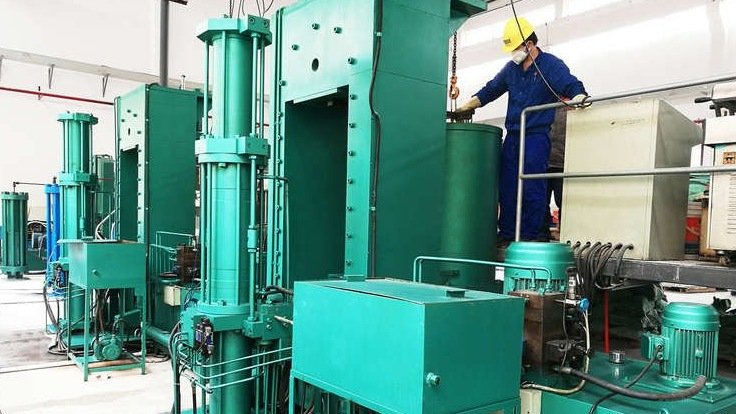
Isostatic pressing uses a liquid or gas to apply pressure evenly from all directions. In cold isostatic pressing (CIP), a pressurized liquid squeezes ceramic powder inside a flexible mold at or near room temperature. The result is a green blank, an unfired shape that can be handled and, if it has enough strength, machined.
Consider a long alumina sleeve with a bore that must fit over a shaft. CIP can help produce a hollow blank with more evenly packed powder along its length. The fit still depends on how the sleeve shrinks in the kiln and how the bore is finished. FineCer’s ceramic manufacturing guide shows where pressing fits in the full production process.
How Cold Isostatic Pressing Forms a Ceramic Blank
You can picture the sleeve mold as a flexible outer wall with a rigid rod down the middle. The rod, called a mandrel, takes up the space that will become the bore. Powder fills the gap around it. As liquid pressure squeezes the outer wall inward, the powder packs against the mandrel. After the pressure is released and the tooling is removed, the sleeve already has a hole running through it. That can save the work of cutting the entire hole from a solid blank.
In wet-bag pressing, the filled, sealed mold goes into the liquid in the vessel. Removable molds make this a practical route to consider when part sizes or blank shapes change. In dry-bag pressing, a flexible membrane stays in the press and separates the pressure liquid from the powder or tooling area. That setup can make repeated filling and unloading easier to automate. The choice depends on which shapes the tooling can make and how often the same shape will be run.
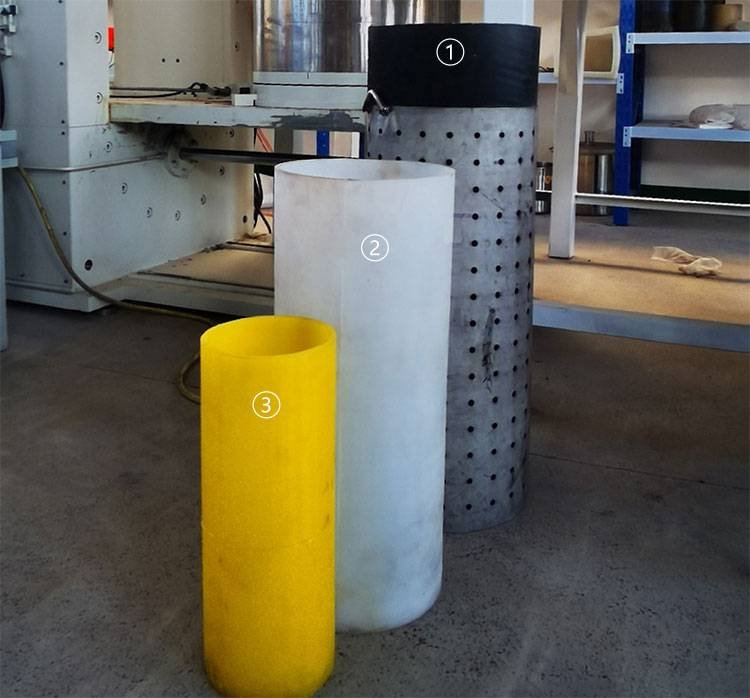
For a hollow part, even pressure in the liquid is only part of the story. If the powder fills unevenly around the mandrel, some areas can start out more loosely packed than others. The stiffness and shape of the flexible mold also affect how it moves during pressing. In a study of pressed refractory tubes, bag stiffness influenced the shape of the compact. For the sleeve, both filling and tooling matter when the shop wants enough wall thickness left for later finishing.
A sleeve can have enough wall thickness on average and still be thin on one side. If the bore and the outside surface are off-center, the finishing cuts may leave too little material on that side. The shop therefore has to consider where the material is left around the bore, along with the overall size of the blank.
When CIP Makes Sense for a Ceramic Part
For a long sleeve with a step, first check whether a standard extruded tube is large enough to cut that step and still leave the required wall thickness. If a suitable tube is unavailable, CIP can make a hollow blank closer to the shape on the drawing. For a straight tube or a short ring, the choices are different.
| Drawing feature | Route to consider | What decides the route |
|---|---|---|
| Long sleeve with a shoulder | CIP around a mandrel or a suitable extruded blank | Check for an available tube with enough wall to cut the shoulder and still leave the required wall thickness. If the available tubes are unsuitable, evaluate a CIP blank sized for the drawing. |
| Long tube with the same cross-section throughout | Extrusion | A single die can form the same section along the length. Check whether the extruded size and straightness leave enough material to finish the specified surfaces. |
| Short, simple ring made in repeat quantities | Uniaxial dry pressing | Check whether the ring can be formed and released from rigid tooling and whether the quantity justifies the tooling. |
Once you have a possible forming route, check what happens in the kiln. A thicker blank can give you more material to work with after firing, but it also takes longer to machine. For repeat orders, compare the machining time per part with the cost of any new tooling.
Why More Even Packing Helps During Sintering
Green density describes how much material is packed into a given volume before firing. During sintering, heat bonds the ceramic particles and reduces pore space, causing the part to shrink. Under comparable firing conditions, regions that start out less densely packed may shrink more as they densify. If one side of a long sleeve shrinks more than the other, the sleeve can bow. A bore can also vary in size or roundness along the length. A consistent green blank helps reduce one source of that variation. The part geometry, support during firing, and firing conditions also affect the result.
Shrinkage can also differ along the sleeve’s length and across its diameter. A study of spray-dried alumina found a greater difference in shrinkage between directions when the samples were first pressed in a rigid die and then cold isostatically pressed. For a new sleeve, measure the same sample’s length and diameters before and after firing at corresponding locations. Compare each pair of measurements to estimate how much that dimension shrinks and how large to make the green blank.
A shoulder can often be cut close to shape by green machining, while the material is still easier to cut. Surfaces that need grinding after firing must have extra material left for the grinder to remove. For example, an outside diameter that will be ground needs to come out of the kiln larger than the finished size.
A hole can measure smaller than the finished size and still have too little material on one side. If the hole shifts off-center or bows in the kiln, part of its wall may already be at or past where the finished wall needs to be. To check the allowance, compare the measured hole with the planned finished shape, using the same centerline the grinder will use. Check all the way around the hole and throughout the depth that needs grinding. Every area to be ground needs enough material left to remove.
For a long, narrow hole, also check whether the shop can grind and measure the full depth on the drawing. The wheel must fit inside the hole, and the shaft that holds it can flex when it extends a long way. This makes a consistent diameter harder to achieve. If the sleeve only needs to fit closely around the shaft at the two ends, those shorter sections may be the only ones that need precision grinding.
On a drawing, identify what the bore does. A hole that simply clears a shaft may accept a wider size range. A bore that locates the sleeve can also need checks for roundness or alignment with the outside diameter. Those requirements can affect how the part is held for finishing and how it is inspected. A sample from the intended production route helps show which dimensions can stay as fired.
Where Hot Isostatic Pressing Fits
Cold isostatic pressing gives the sleeve its basic shape before firing. Hot isostatic pressing (HIP) uses heat and gas pressure to reduce pores in the ceramic. In one common route, the ceramic is fired first to close off pores from the surface, so the pressurized gas cannot enter them during HIP.
For a sleeve or tube drawing, the most useful details for comparing routes are the finished dimensions and tolerances, the surfaces that control fit, and the expected quantity. FineCer’s ceramic manufacturing capabilities cover cold isostatic pressing, sintering, and finishing.
Frequently Asked Questions
Does higher CIP pressure always produce a better ceramic part?
Higher pressure can improve packing up to a point, and the benefit depends on the powder. In a study of a 95.5 wt% alumina formulation, fired density began to level off as CIP pressure increased. A useful trial compares green density and handling strength, then checks fired density and dimensions to see whether the change helps the finished part.
How do you choose a binder for spray-dried ceramic powder?
Choose a binder that mixes well with the liquid used for spray drying and helps form granules that press together readily. The pressed blank needs enough strength for handling or machining. The binder also needs to burn out cleanly during heating. Check each of these against the powder, the other additives, and the planned firing cycle.
Can cracks in a pressed ceramic part start before firing?
Yes. In CIP, the flexible mold changes shape as pressure is released. If it pulls away unevenly, it can still press against parts of the fragile blank and start a crack. If cracks keep appearing in the same place after firing, inspect the green blanks there just after demolding and again after any green machining.
References
- R. Henderson, H. W. Chandler, A. R. Akisanya, and B. Moriarty. Bag Design in Isostatic Pressing. Materials & Design, 2000.
- Effect of Cold Isostatic Pressing on Microstructure and Shrinkage Anisotropy During Sintering of Uniaxially Pressed Alumina Compacts. Journal of the Ceramic Society of Japan, 2002.
- Guidelines to Minimize Manufacturing Induced Anomalies in Critical Rotating Parts, section on internal cylindrical grinding, 2022 revision.
- T. Spusta, J. Svoboda, and K. Maca. Study of Pore Closure During Pressure-Less Sintering of Advanced Oxide Ceramics. Acta Materialia, 2016.
- Effects of Cold Isostatic Pressing Parameters on Mechanical and Insulation Performances of a 95.5 wt% Alumina Ceramic. International Journal of Applied Ceramic Technology.
- Visualizing Isostatic Pressing of Ceramic Powders Using Finite Element Analysis. Journal of the European Ceramic Society, 2006.