
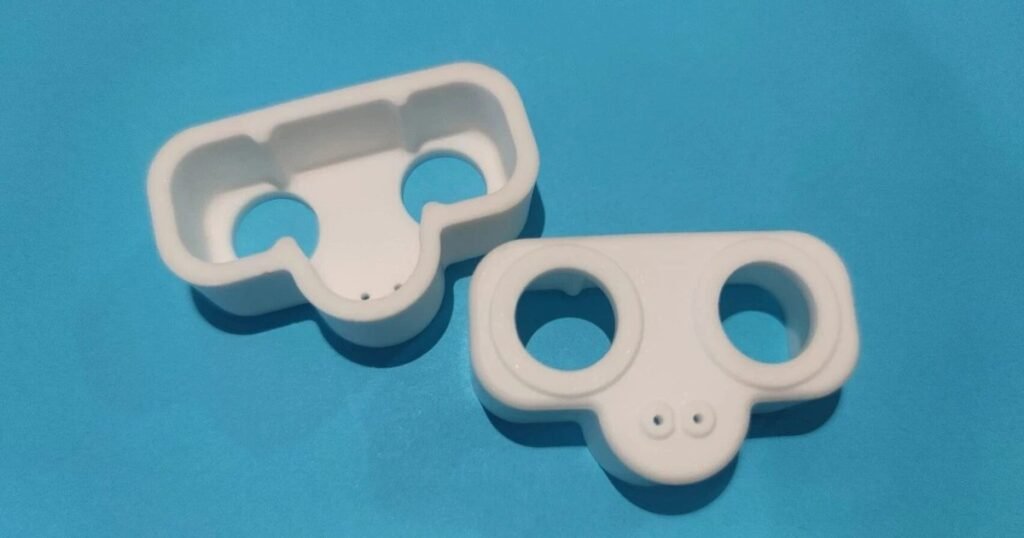
Alumina (aluminum oxide) does have a tensile strength, but it is rarely measured, so most datasheets leave it out. In one supplier's published data, the tensile strength of alumina comes out at about 52 to 71 percent of the same material's flexural strength. Alumina has no yield strength at all. At room temperature it never bends permanently before it breaks.
What datasheets give instead are flexural strength, compressive strength, and fracture toughness. For our six grades of alumina, flexural strength runs from 292 to 392 MPa. Every other property of those grades is on our alumina properties data hub, and if a form asks you for tensile or yield strength, the last section below shows what to write.
Why Most Alumina Spec Sheets Skip Tensile Strength
Most alumina datasheets skip tensile strength because the test is hard to run on a brittle material, so the industry measures strength in bending instead.
A tensile test pulls a bar from both ends. Metal tolerates being clamped, because it gives a little in the jaws. Alumina does not give. Any misalignment or clamping pressure adds stress at the grip, and the bar tends to break there instead of in the middle section being measured. A standard method exists, ASTM C1273, but it calls for carefully shaped specimens, tightly controlled alignment, and enough specimens for a statistical result.
A bending test is far simpler. A small bar rests on two supports and is pressed until it snaps. As it bends, its bottom face is stretched, so the test still measures how the ceramic fails in tension, only over a much smaller region. The result is called flexural strength, also known as bending strength or modulus of rupture, and it is the strength figure you will find on almost every alumina datasheet.
Direct tensile tests still earn their cost in demanding structural work. Because the whole middle section is pulled evenly, they reveal flaws inside the material, not just near the surface, and they give the clean data needed to scale strength to the size of a real part. They are also how ratios like those in the table below get measured in the first place.
Why Alumina Has No Yield Strength
Alumina has no yield strength because at room temperature it does not deform permanently: it stretches elastically, then breaks in one step.
Yield strength is the stress at which a metal starts to bend for good, usually read at 0.2% permanent stretch. Metals can do this because layers of atoms slip past each other under load. In alumina, strong bonds lock the atoms in place, so nothing slips before a crack runs through the part.
The numbers show how little alumina stretches. One supplier lists its 99.5% alumina at 262 MPa in tension with a stiffness of 370 GPa. Divide one by the other and the bar breaks at about 0.07% stretch, so a 100 mm bar grows about 0.07 mm, roughly the width of a human hair, and then snaps. That is about a third of the 0.2% stretch used merely to define where a metal begins to yield. For stiffness values by grade, see our guide to the Young's modulus of alumina.
For design, the result is simple. No visible bending, no necking, no warning. The part holds, or it breaks.
What Measured Tensile Strength of Alumina Looks Like
In the paired supplier data below, alumina tensile strength sits at roughly half to seven tenths of flexural strength. It also scatters widely between specimens.
Paired Values From One Supplier
One US supplier publishes both values for eight alumina grades on a single chart, which allows a fair side-by-side comparison.
| Al2O3 content | Flexural strength (MPa) | Tensile strength (MPa) | Tensile ÷ flexural |
|---|---|---|---|
| 85% | 296 | 155 | 0.52 |
| 90% | 338 | 221 | 0.65 |
| 94% | 352 | 193 | 0.55 |
| 96% | 358 | 221 | 0.62 |
| 98.5% | 375 | 248 | 0.66 |
| 99.5% | 379 | 262 | 0.69 |
| ≥99.8% | 390 | 272 | 0.70 |
| ≥99.9% | 400 | 283 | 0.71 |
Supplier values from a published ceramic material properties chart (2017): flexural strength per ASTM F417, tensile strength per ACMA Test #4. The ratio column is our calculation.
The ratio is not a fixed number. It generally rises with purity, but not in a straight line: the 94% grade sits below the 90% grade. A single conversion factor copied from a handbook can therefore be noticeably off for any particular material.
Same Material, Four-Fold Spread
Even within one material, tensile results vary far more than metal users expect. A 2024 study tested 99.5% alumina specimens in tension and recorded failures anywhere from 79.5 to 322.6 MPa, about four times apart. Scans traced each failure to a critical manufacturing defect in that specimen, ranging from 92 μm, about the width of a hair, to 3.4 mm.
That is the rule behind the scatter: a ceramic part breaks at its most critical flaw within the region under tension. A larger region under tension is more likely to contain a large flaw, which is why the ASTM tensile test standard notes that specimens of different sizes give different strengths.
Why Two Datasheets Disagree
The test setup alone can make the flexural number about a quarter higher or lower. One supplier lists a nominal 99.5% alumina at 380 MPa in three-point bending and 300 MPa in four-point bending, the same material measured two ways. In three-point bending, peak stress acts only on a thin line under the center load. In four-point bending, it acts along the whole span between the two inner loads, so the bar is more likely to contain a weak spot there.
When you compare suppliers, check which setup each one used. Our grade data does not state the setup, so treat comparisons between our values and another supplier's as approximate.
What to Use Instead: Flexural, Compressive, and Fracture Toughness
Use flexural strength for any part that bends or is pulled, compressive strength for parts that are only squeezed, and fracture toughness for parts with holes, sharp corners, or a risk of impact.
| Property | 95% | 97% | 99% | 99.5% | 99.7% | 99.99% |
|---|---|---|---|---|---|---|
| Flexural strength (MPa) | 292 | 311 | 346 | 355 | 370 | 392 |
| Compressive strength (MPa) | 1910 | 2100 | 2210 | 2300 | 2300 | 2300 |
| Fracture toughness (MPa·m½) | 3.8 | 4.0 | 4.2 | 5.37 | 4.3 | 4.4 |
Flexural strength is the closest stand-in for tensile strength, and it rises steadily with purity. Compressive strength, the squeezing load before failure, is about 5.9 to 6.8 times the flexural value in every grade. That gap is the practical lesson: design the part so the ceramic is squeezed rather than pulled wherever you can.
Fracture toughness measures how well the ceramic stops a crack from spreading once it starts. Higher values are more forgiving of chips, holes, and sharp corners. It does not follow purity: 99.5% reads highest at 5.37 MPa·m½, while 99.99% reads 4.4. Choosing among grades for other reasons, such as insulation or acid resistance, is covered in our guide to alumina grades.
How to Fill a Tensile or Yield Field on a Metal-Style Spec
Mark the tensile field as not measured and give the flexural strength beside it, clearly labeled as flexural, then mark yield strength and elongation as not applicable.
| Field on a metal-style form | What to enter for alumina |
|---|---|
| Tensile strength | Not measured. Give the flexural strength labeled as flexural, for example "flexural strength 346 MPa (99% grade), not a tensile value", with the test method stated |
| Yield strength | Not applicable: linear elastic to fracture |
| Elongation at break | Not applicable: brittle, breaks at under 0.1% stretch |
| Compressive strength | Compressive strength for the grade (for example, 2210 MPa for 99%) |
If the form will only accept a tensile number, you can estimate one, as long as it is labeled as an estimate. Multiplying our 99% grade's flexural strength of 346 MPa by the 0.52 to 0.71 ratios above gives roughly 180 to 246 MPa. Those ratios come from another supplier's material and test methods, so use the low end for anything that carries real tensile load, and record the value on the drawing as an estimate, not a measured property.
Even the low end is an estimate of typical strength, not a design allowable. In the 2024 study above, the weakest 99.5% specimen broke at 79.5 MPa. An allowable stress has to come from strength data scaled to your part, as the FEA question below explains.
If the spec belongs to a metal part you are replacing, the strength fields are only half the job. Our metal-to-ceramic conversion service starts from how the metal part fails and reworks features such as radii and seats so the ceramic stays in compression.
Frequently Asked Questions
Check the maximum principal stress, the peak pulling stress, not von Mises stress, which suits metals that yield. Compare it with a strength scaled to the area or volume under tension in your part, since larger stressed regions fail at lower stress. ASTM C1239 covers fitting strength data for this. Without such data, stay well below any tensile estimate.
Yes, either way. In ring-on-ring bending tests on 99.5% alumina tiles, the characteristic strength (the stress at which about 63% of tiles break) was 280 MPa after fine 320-grit grinding, 264 MPa as fired, and 244 MPa after the supplier's coarse standard grind. Coarse grinding leaves hidden damage that cracks start from. Our guide to machining alumina covers the grinding choices involved.
It can. In older published tests on a commercial alumina body, the material resisted constant tension poorly at higher stress levels. About 18,000 psi (about 124 MPa), 60% of the average tensile strength, could be held for long periods, and 24 hours at that load did not lower the strength. For long-held loads, design well below the short-term value.
Specifying Alumina for Parts Under Tension
The tensile strength of alumina is real but rarely listed, lower than its flexural strength, and set by the most critical flaw in the stressed region. Specify flexural strength with its test method, keep the ceramic in compression where you can, and label any tensile figure as an estimate. To have a grade and its strength values stated on a quote, send the drawing and load case through our quote request form; our engineers reply within 24 hours.
References
- CoorsTek, ceramic material properties chart (2017): flexural, tensile, and compressive strength and elastic modulus of alumina grades
- CoorsTek, semiconductor oxides material properties chart: three-point and four-point flexural strength per ASTM C1161
- Pagnoncelli, Tridello, Paolino, and Peroni, Materials & Design 238 (2024): ultrasonic tensile test and micro-CT defect analysis on alumina 99.5%
- Sedlacek, Tensile strength of brittle materials, technical report AD0473410: stress rate and static stress effects on alumina
- Wereszczak, Swab, and Kraft, ARL technical report (2003): effects of machining on uniaxial and equibiaxial flexure strength of CAP3 AD-995 alumina
- ASTM C1273-18(2024), tensile strength of monolithic advanced ceramics at ambient temperatures