
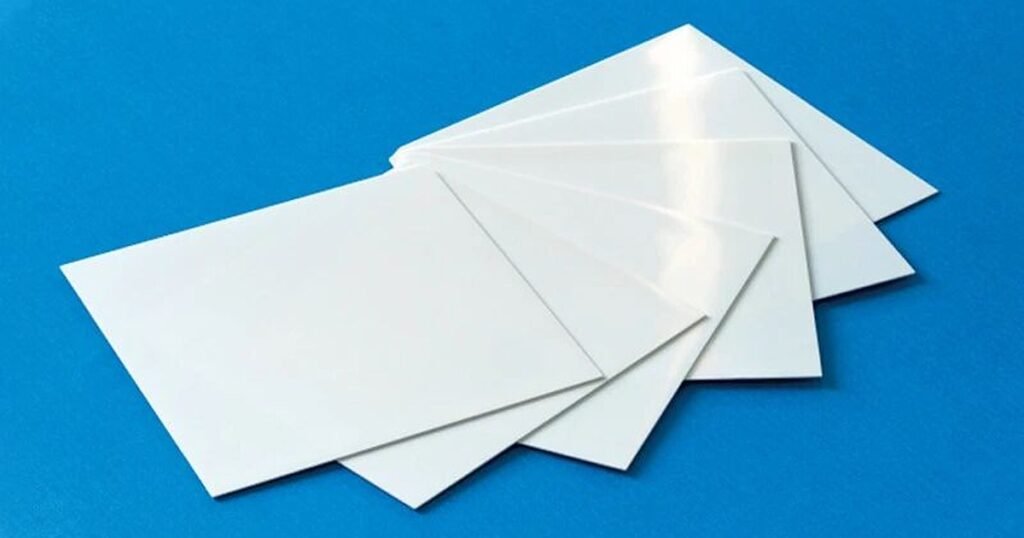
Alumina's room-temperature thermal conductivity runs from 10 to 22 W/m·K across the six commercial purity grades, rising with Al2O3 content. Thermal conductivity drops sharply as temperature increases, roughly halving by 500 °C, which is the single most important factor that datasheet-driven designs get wrong. The room-temperature values on this page are from our internal quality control data, and the temperature-dependence numbers come from published high-purity alumina references. The full six-grade datasheet, including density, strength, and electrical values, is in our alumina properties data hub.
Thermal Conductivity by Alumina Purity Grade
Thermal conductivity climbs with purity because heat in alumina moves through phonons (lattice vibrations), and phonons scatter every time they meet a grain boundary decorated with glassy sintering-aid phase. Higher purity means less glassy phase, less phonon scattering, and higher conductivity.
| Grade | Thermal Conductivity at 25 °C (W/m·K) |
|---|---|
| 95% Al2O3 | 10.0 to 16.0 |
| 97% Al2O3 | 10.0 to 16.0 |
| 99% Al2O3 | 14.0 to 21.0 |
| 99.5% Al2O3 | 14.0 to 21.0 |
| 99.7% Al2O3 | 14.0 to 21.0 |
| 99.99% Al2O3 | 16.0 to 22.0 |
The values group into three bands. The 95% and 97% grades share the 10 to 16 W/m·K band because both carry enough glassy phase to keep phonon scattering high. From 99% to 99.7% the values move to the 14 to 21 W/m·K band, a step change of 30 to 40% between the two bands. The 99.99% grade reaches 16 to 22 W/m·K by removing almost all glassy phase and running the microstructure close to pure polycrystalline alumina. Within each band, the exact value on a given batch depends on grain size, residual porosity, and the specific sintering-aid formulation.
Thermal Conductivity Falls Sharply With Temperature
Alumina is unusual for a ceramic because its thermal conductivity behaves like a semiconductor's, not a metal's. Where copper and aluminum metal keep their conductivity roughly constant with temperature, alumina loses it fast as phonon-phonon scattering intensifies with rising lattice vibration amplitude. The room-temperature datasheet value overstates what your part actually delivers in service if that part runs hot.
| Temperature | Retention of Room-Temperature Value |
|---|---|
| 25 °C | 100% |
| 200 °C | ~80% |
| 500 °C | ~50% |
| 800 °C | ~30% |
| 1000 °C | ~25% |
These are typical retention percentages for high-purity alumina, drawn from published research. Lower-purity grades follow a similar curve but with less dramatic drops, because their room-temperature value was already suppressed by glassy phase and there is less to lose. For heat-dissipation designs running above 200 °C, use the temperature-corrected value rather than the room-temperature spec, or your junction temperatures will run higher than the calculation predicts.
Density and Porosity Set the Ceiling
Thermal conductivity in alumina tracks with density more tightly than with any other property because both climb as porosity and glassy phase drop. A 1% increase in density typically corresponds to a 4 to 6% increase in thermal conductivity across our grade range. This is the strongest transfer function in the whole alumina datasheet, and it is why an incoming batch density check is a fast proxy for expected thermal performance.
Porosity is the more damaging of the two ceiling-setters. Each pore is a small vacuum or trapped gas pocket that phonons cannot cross, which forces heat to detour around it. A 3% residual porosity can reduce thermal conductivity by 10 to 15% compared to a fully dense sample of the same chemistry. This is why the 99% and 99.5% grades sit in the same 14 to 21 W/m·K band despite different purities, and why hot isostatic pressing (HIP) is used when the top of the 99.99% range is needed.
Alumina vs AlN, SiC, and FR4 for Electronic Substrates
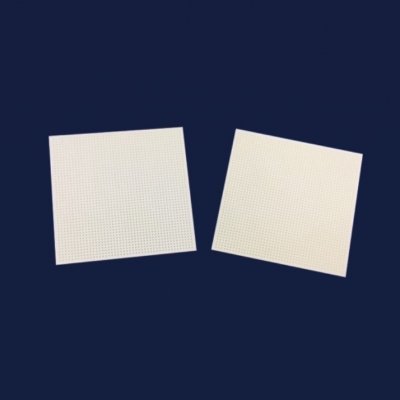
For heat-dissipating electronic substrates, alumina is the workhorse but not always the right answer. The comparison below gives the practical trade-off with the other common substrate materials.
| Material | Thermal Conductivity at 25 °C (W/m·K) | Practical Notes |
|---|---|---|
| FR4 (glass-epoxy PCB) | 0.3 to 0.4 | Baseline for standard PCBs, useless above a few watts |
| 99% Alumina | 14 to 21 | Cost-effective, mature supply chain, most common ceramic PCB substrate |
| Silicon Carbide (SiC) | 80 to 100 | Higher conductivity, harder to machine, higher cost |
| Silicon Nitride (Si3N4) | 80 to 100 | Similar to SiC on conductivity, higher fracture toughness |
| Aluminum Nitride (AlN) | 170 to 230 | Best conductivity of practical ceramics, cost roughly 5 to 10x alumina |
The switching point from alumina to AlN is typically driven by power density rather than absolute power. For low-power-density substrates (below roughly 10 W/cm²), alumina handles the job at a fraction of the AlN price. For medium power density (10 to 30 W/cm²), the choice depends on package geometry and the acceptable junction temperature rise. Above 30 W/cm², AlN's roughly tenfold advantage in conductivity usually justifies the cost. SiC and Si3N4 sit in between but bring machining complexity that raises the effective cost above their raw material premium.
High Thermal Conductivity and High Electrical Insulation Are Not a Contradiction
Alumina carries heat well and blocks electricity strongly, which surprises engineers used to metals where the two go together. In metals, both are carried by free electrons, so a good electrical conductor is a good thermal conductor. In alumina, electrons are locked into ionic bonds and cannot move, which is what makes the material a strong electrical insulator with volume resistivity above 1013 Ω·cm. Heat, however, moves through phonons, which are lattice vibrations that do not need mobile electrons. That is why alumina can hit 22 W/m·K on thermal conductivity while staying an insulator strong enough to hold off line voltage. The two transport mechanisms are independent, and alumina exploits both.
Frequently Asked Questions
My part runs at 400 °C. Should I use the room-temperature or the derated thermal conductivity in my heat-sink calculation?
Use the derated value. At 400 °C alumina retains roughly 60% of its room-temperature conductivity, which changes the heat-sink math substantially. Design the junction temperature against the derated number and you will get a stable service temperature; design against the datasheet value and the part will run hotter than planned.
Why does alumina conduct heat well but block electricity?
Because the two are carried by different things. Heat in alumina moves through phonons (lattice vibrations), which do not need free electrons. Electricity needs mobile electrons, and alumina's ionic bonding locks them in place. The result is a material that is good at heat and bad at electricity, which is exactly what an electronic substrate needs to be.
When should I upgrade from alumina to AlN?
When power density exceeds roughly 30 W/cm², or when your junction temperature calculation shows more than 10 to 15 °C headroom loss from the substrate alone. AlN costs 5 to 10x more per part but carries roughly ten times the heat. Below that power density, alumina is the more economic choice by a wide margin.
Ready to Match a Grade to Your Thermal Design?
Thermal conductivity is only useful when tied to your part's actual operating temperature and power density. Send us your heat flux, service temperature, and geometry, and we will match the alumina grade that clears your thermal budget with margin. Request a quote with your thermal requirements and part drawing.