
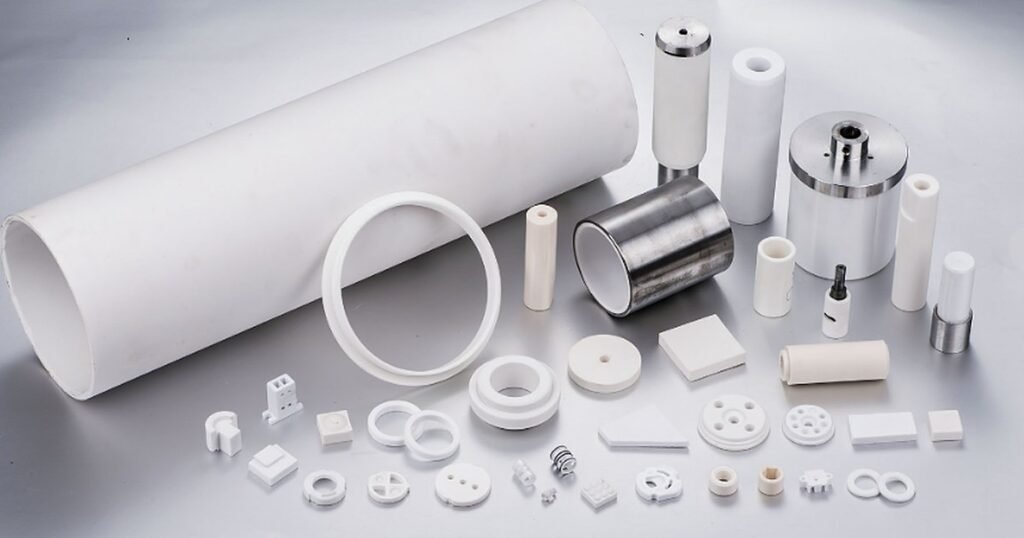
The six commercial alumina grades we produce (95%, 97%, 99%, 99.5%, 99.7%, and 99.99%) span a wide performance range. Density runs from 3.62 to 3.95 g/cm³, Vickers hardness HV 1410 to 1660, bending strength 292 to 392 MPa, and dielectric strength 17.84 to 24.38 kV/mm. Every value below is grade-specific, drawn from our internal quality control data, and cross-referenced with the finished-part performance our customers report back.
What "Alumina Properties" Actually Lock In
The properties on any alumina datasheet come from three things at once: the Al2O3 content, the sintering aids that lower firing temperature and control grain growth, and the firing schedule that turns pressed powder into a dense ceramic. Two parts pressed from the same raw powder behave differently in service if any of those three vary, which is why every number below is tied to a specific grade rather than a generic industry average. Purity percentage on a drawing does not fully determine part behavior on its own; specifying a grade locks in the process route along with the chemistry.
Three numbers get quoted more often than any others when engineers first look at alumina, and each deserves a sentence of context rather than a headline. Mohs hardness is 9 across all commercial grades, which is often described as second only to diamond. The Mohs scale is coarse though, so it cannot distinguish 95% from 99.99% alumina; for wear design and grade selection you need Vickers hardness, which ranges from HV 1410 to 1660 across our grades. The theoretical density of pure Al2O3 is 3.98 g/cm³, and that is the ceiling our commercial grades approach as the lower-density glassy phase gets displaced (3.62 at 95%, 3.95 at 99.99%). The melting point of pure Al2O3 is approximately 2050 °C, but this is not a design temperature. Continuous working temperature for commercial grades ranges from 1350 °C at 95% to 1500 °C at 99% and above, because the sintering-aid phase softens and creep begins hundreds of degrees below the pure-phase melting point.
The properties fall into four groups: mechanical (density, hardness, strength, toughness), thermal (conductivity, expansion, service temperature), electrical (resistivity, dielectric strength, dielectric constant, dielectric loss), and chemical (acid, alkali, and vacuum performance). The master data table below covers each group in grade-by-grade detail.
The Six Alumina Purity Grades
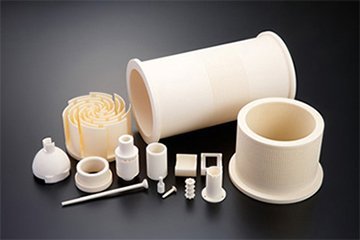
We produce alumina in six standard purity grades, each optimized for a different combination of cost, strength, and electrical performance. The percentage refers to the Al2O3 content by weight; the remaining fraction is sintering aids (typically SiO2, MgO, and CaO) that lower the firing temperature and control grain growth. Color shifts from white at 95% and 97%, to ivory across 99% to 99.7% as trace additives concentrate at grain boundaries, and back to white at 99.99% where those additives fall below detectable levels.
| Grade | Al2O3 Content | Color | Best For |
|---|---|---|---|
| 95% | ≥95% Al2O3 | White | General wear parts, industrial insulators, cost-driven jobs |
| 97% | ≥97% Al2O3 | White | Higher-strength wear parts, moderate-temperature service |
| 99% | ≥99% Al2O3 | Ivory | Electronic substrates, higher-voltage insulators |
| 99.5% | ≥99.5% Al2O3 | Ivory | Vacuum feedthroughs, laboratory ware, precision insulators |
| 99.7% | ≥99.7% Al2O3 | Ivory | Semiconductor process components, high-purity fluid handling |
| 99.99% | ≥99.99% Al2O3 | White | Semiconductor wafer contact, precision optics, sapphire-adjacent parts |
Master Alumina Property Data Table
The tables below are the canonical alumina property reference across our documentation. Values are typical minimum specifications from our internal QC data, taken at 25 °C unless otherwise noted. All six grades pass vacuum permeability, airtightness, and 25 to 800 °C thermal shock testing.
Mechanical Properties
| Property | Unit | 95% | 97% | 99% | 99.5% | 99.7% | 99.99% |
|---|---|---|---|---|---|---|---|
| Density | g/cm³ | ≥3.62 | ≥3.75 | ≥3.85 | ≥3.90 | ≥3.93 | ≥3.95 |
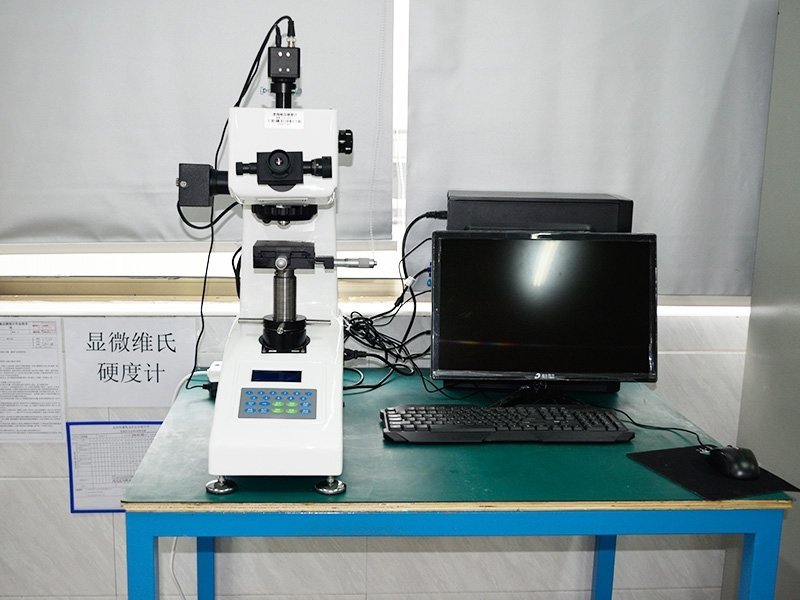
| Hardness (Vickers, HV0.5) | – | ≥1410 | ≥1460 | ≥1500 | ≥1500 | ≥1600 | ≥1660 |
| Bending strength | MPa | 292 | 311 | 346 | 355 | 370 | 392 |
| Compressive strength | MPa | 1910 | 2100 | 2210 | 2300 | 2300 | 2300 |
| Fracture toughness (KIC) | MPa·m½ | 3.8 | 4.0 | 4.2 | 5.37 | 4.3 | 4.4 |
| Water absorption | % | ≤0.01 | ≤0.01 | ≤0.01 | ≤0.01 | ≤0.01 | ≤0.01 |
| Permeability | – | Pass | Pass | Pass | Pass | Pass | Pass |
| Airtightness | – | Pass | Pass | Pass | Pass | Pass | Pass |
| Straightness | ‰ | 1 | 1 | 1 | 1 | 1 | 1 |
Mechanical properties climb with purity because every point of Al2O3 content displaces a fraction of lower-density glassy phase, pushing the finished ceramic closer to the theoretical alumina density of 3.98 g/cm³. Vickers hardness rises from HV 1410 at 95% to HV 1660 at 99.99%, a 17.7% increase across the grade range. On the coarser Mohs scale this whole spread still reads as 9, which is why HV rather than Mohs is the correct hardness reference for wear-part design. Bending strength scales similarly, moving from 292 MPa to 392 MPa (a 34% increase), while compressive strength saturates at 2300 MPa from 99.5% onward, meaning that above that purity, further increases in Al2O3 content stop paying off in compressive load capacity. Fracture toughness is the one property that does not scale monotonically with purity: 99.5% shows the highest KIC at 5.37 MPa·m½, tied to the balance between grain size and glassy phase distribution at that specific composition.
Thermal Properties
| Property | Unit | 95% | 97% | 99% | 99.5% | 99.7% | 99.99% |
|---|---|---|---|---|---|---|---|
| Max working temperature | °C | ≤1350 | ≤1450 | ≤1500 | ≤1500 | ≤1500 | ≤1500 |
| Thermal conductivity (25 °C) | W/m·K | 10.0–16.0 | 10.0–16.0 | 14.0–21.0 | 14.0–21.0 | 14.0–21.0 | 16.0–22.0 |
| Coefficient of thermal expansion (25–800 °C) | 10−6/°C | 8.4 | 8.3 | 7.7 | 7.8 | 7.8 | 8.0 |
| Thermal shock resistance (25→800 °C) | – | Pass | Pass | Pass | Pass | Pass | Pass |
Thermal properties are shaped by the same glassy-phase story, but the mechanism runs through phonon scattering rather than density. Below 97%, thermal conductivity sits in the 10 to 16 W/m·K range because the sintering-aid phase concentrates at grain boundaries and scatters phonons before they can carry heat across the ceramic. From 99% onward, that phase drops enough for conductivity to jump into the 14 to 21 W/m·K band, and the 99.99% grade tops out at 16 to 22 W/m·K. The maximum working temperature story is separate: the pure-Al2O3 melting point is around 2050 °C, but continuous service tops out at 1350 °C for 95% and plateaus at 1500 °C from 99% upward, because sintering aids begin to soften and creep sets in hundreds of degrees below the melting point of the pure phase. Coefficient of thermal expansion is the property that stays remarkably flat across grades, moving only from 7.7 to 8.4 × 10⁻⁶/°C over the full 25 to 800 °C range. That stability is why alumina works so well in ceramic-to-metal seals with kovar and molybdenum, and why designers can swap purity grades without recalculating seal stresses. Where higher fracture toughness is the driving requirement instead of purity, zirconia and zirconia-toughened alumina cover the ground alumina alone cannot.
Electrical Properties
| Property | Unit | 95% | 97% | 99% | 99.5% | 99.7% | 99.99% |
|---|---|---|---|---|---|---|---|
| Dielectric strength (AC) | kV/mm | 17.84 | 18.44 | 22.5 | 21.5 | 17.72 | 24.38 |
| Dielectric constant (25 °C, 1 MHz) | – | 9.6 | 9.3 | 10.04 | 7.8 | 10.26 | 10.18 |
| Dielectric loss (25 °C, 1 MHz) | – | ≤4×10⁻⁴ | ≤4×10⁻⁴ | ≤2×10⁻⁴ | ≤2×10⁻⁴ | ≤1×10⁻⁴ | ≤1×10⁻⁴ |
| Volume resistivity | Ω·cm | >1×10¹³ | >1×10¹³ | >1×10¹⁴ | >1×10¹⁴ | >1×10¹⁴ | >1×10¹⁴ |
Electrical properties are where alumina earns its industrial reputation. Volume resistivity jumps a full order of magnitude between 97% and 99%, moving from greater than 1013 to greater than 1014 Ω·cm. That step is the cleanest threshold in the whole datasheet, and it is the reason 99% is the default specification for anything running at line voltage or above: below the threshold you are in wear-part territory, at or above it you are in insulation territory. Dielectric loss drops steadily as purity climbs, falling roughly four-fold from 95% (≤4×10⁻⁴) to 99.99% (≤1×10⁻⁴), which matters most at RF and microwave frequencies where every fraction of tan δ turns into heat inside the substrate. Dielectric strength does not track purity monotonically. It climbs to 22.5 kV/mm at 99%, dips to 17.72 at 99.7%, and reaches its highest value of 24.38 kV/mm at 99.99%. The non-monotonic pattern reflects the trade-off between grain-boundary chemistry (which lowers strength) and the residual porosity that changes with each grade's specific sintering recipe. Dielectric constant sits between 7.8 and 10.26 across the range, with the low value at 99.5% reflecting a specific low-loss formulation rather than a purity trend.
Chemical Resistance
| Property | Unit | 95% | 97% | 99% | 99.5% | 99.7% | 99.99% |
|---|---|---|---|---|---|---|---|
| Acid resistance (1:9 HCl, 100 hr) | mg/cm² | ≤0.7 | ≤0.7 | ≤0.7 | ≤0.7 | ≤0.1 | ≤0.1 |
| Alkali resistance (10% NaOH, 100 hr) | mg/cm² | ≤0.2 | ≤0.2 | ≤0.1 | ≤0.1 | ≤0.1 | ≤0.1 |
Chemical resistance in alumina traces to grain-boundary behavior rather than to the alumina crystal itself. Acid corrosion is a grain-boundary phenomenon: the glassy sintering-aid phase is what dissolves, not the Al2O3 crystal. That mechanism explains the seven-fold step in acid resistance between 99.5% (≤0.7 mg/cm²) and 99.7% (≤0.1 mg/cm²). The 0.2% difference in purity does not sound like much, but it translates into a step-change reduction in exposed glassy phase, which changes the corrosion regime entirely. For continuous exposure to strong acids or hot caustics, 99.7% and above is the honest specification, not 99% or lower. Alkali resistance follows a similar pattern with an earlier threshold: performance improves from ≤0.2 mg/cm² at 95% and 97%, to ≤0.1 mg/cm² from 99% onward, which is why 99% is the practical minimum for parts running in caustic environments.
Quick Lookup: Failure Mode to Suggested Grade
Working backwards from how a part is likely to fail is often faster than working forwards from the application name. Instead of asking "what alumina do I use for a valve seat?", ask "what will fail first in service?" This table maps the failure mode to the property that drives it and the minimum grade that clears the requirement with margin.
| Failure Mode | Driver Property | Suggested Grade |
|---|---|---|
| Abrasive wear on pump liners, seal faces, or slurry valves | Hardness + compressive strength | 95% or 97% |
| Dielectric breakdown at line voltage | Volume resistivity + dielectric strength | 99% |
| Dielectric loss at RF or MHz frequencies | Dielectric loss | 99.5% or 99.7% |
| Thermal creep above 1350 °C | Max working temperature | 99% or higher |
| Chemical attack in strong acid or hot caustic | Acid or alkali resistance | 99.7% or 99.99% |
| Vacuum leak at feedthroughs and viewports | Airtightness + dielectric strength | 99.5% |
| Semiconductor process contamination | Metallic impurity level | 99.99% |
| Fracture on impact loading | Fracture toughness (KIC) | 99.5% (or consider ZTA/zirconia) |
Frequently Asked Questions
Is 99% alumina always better than 95%?
No. 99% wins on hardness, strength, and volume resistivity, but costs two to three times more and is more brittle. In thermal cycling 95% often outlasts 99% because its higher glassy-phase content distributes stress better. For abrasive wear or moderate insulation, the jump to 99% gains only 6 to 19% depending on the property, at multiplied cost. Select by failure mode, not by purity ranking.
How long will an alumina part last in service?
It depends on duty cycle, not the material. Clean high-temperature furnace parts commonly run 5 to 10 years. Continuous acid or hot caustic exposure drops that to 1 to 3 years. Slurry-facing wear liners run 6 to 24 months. Rapid thermal cycling, steam, and continuous chemical attack are the three accelerators.
Why do vendors' spec sheets show different numbers for the same grade?
Three reasons. Test method (HV0.5 vs HV1 vs Knoop; 3-point vs 4-point bending give different numbers). Typical batch value vs guaranteed minimum, which can differ noticeably between vendors. And how "purity" is measured (chemical assay vs X-ray phase analysis). Always ask for test method, sample size, and whether the number is typical or minimum.
How do I verify the grade I received matches what I ordered?
Density is the fastest check. 95% reads ≥3.62 g/cm³, 99% reads ≥3.85, 99.99% reads ≥3.95. The low-purity grades separate cleanly by water displacement (3.6% gap from 95% to 97%, 2.7% from 97% to 99%), but from 99% upward the gaps close and density needs cross-checking. Vickers hardness helps (HV 1410 at 95% up to HV 1660 at 99.99%), though 99% and 99.5% both read HV 1500. Always request a material certificate with batch number and test standards.
When should I switch from alumina to zirconia?
When fracture toughness drives your part. Alumina KIC runs 3.8 to 4.4 MPa·m½ across most grades (5.37 at 99.5%), while zirconia reaches 9.18, roughly double. That matters for impact loading and cyclic mechanical stress. Zirconia costs more and does not match kovar for hermetic seals. ZTA is the middle path.
Are hairline surface cracks acceptable, or should I reject the batch?
Depends on location and depth. Marks under 50 microns deep, away from radii and step edges, and parallel to load axis are usually cosmetic. Cracks longer than 50 microns, or at stress concentrators like corners and thread starts, will grow under load. Any crack penetrating over 10% wall thickness on a pressure or vacuum part is a reject.
Ready to Turn These Alumina Properties Into a Part?
Every number on this page traces to a specific grade and a specific test protocol. Whether you already know the grade you need or want help matching a failure mode to a purity level, our engineering team can turn either into a quote within 24 hours.
Request a 24-hour alumina quote, or browse our alumina ceramic manufacturing page for the full production, tolerance, and certification story behind these alumina properties.
Pingback: Alumina Dielectric Constant & Electrical Properties Hub