

An alumina spacer is a sintered aluminum oxide part that maintains distance between components while providing electrical isolation, thermal isolation, or both. Six geometric forms cover almost every commercial alumina spacer, and purity from 95 to 99.7 percent decides electrical and thermal margin. For most spacer duty, picking the right geometry matters more than picking between 95 and 99 percent purity, but both decisions belong in the design conversation. This guide covers the six common forms with typical sizes, how to pick purity for spacer applications, engineering design considerations from aspect ratio to threading limits, and the typical applications where alumina beats polymer or metal spacers. Links point to fuller property data at our alumina ceramic parts page.
- Six main forms: solid rod, tube, twin/multi-bore, stepped, threaded standoff, custom feedthrough spacer
- Purity range: 95 to 99.7 percent (rare 99.9%+ for optical or UHV work)
- Volume resistivity: >10¹³ to >10¹⁴ Ω·cm
- Max service temperature: 1,350 to 1,500°C
- Typical size range: OD 1 to 100 mm, length 3 to 550 mm
Common alumina spacer forms
Alumina spacers ship in six geometric forms, each paired with typical applications and size ranges. Selecting the right form is usually more consequential than selecting purity: a wrong geometry means the part will not fit or will not do the job at all, while a wrong purity often just costs more than necessary.
| Form | Typical size range | Common purity | Typical use |
|---|---|---|---|
| Solid cylindrical rod | OD 1 to 100 mm, length 5 to 200 mm | 95% or 99% | Component separation, heater element support |
| Cylindrical tube (hollow) | OD 2 to 100 mm, ID 0.5 to 90 mm | 95% or 99% | Wire pass-through, heater sleeves |
| Twin-bore or multi-bore tube | OD 2 to 25 mm, 2 to 6 holes | 99% or 99.7% | Thermocouple insulation, heater lead separation |
| Stepped spacer | Custom | 99% or 99.7% | Feedthrough pin positioning, precision alignment |
| Threaded standoff | M2 to M6, length 3 to 40 mm | 95% or 99% | PCB stacking, high-temperature panel mounting |
| Custom feedthrough spacer | Matched to pin count (4, 6, 10, 20, 35 pins) | 99.5%+ | Vacuum feedthroughs, UHV systems |
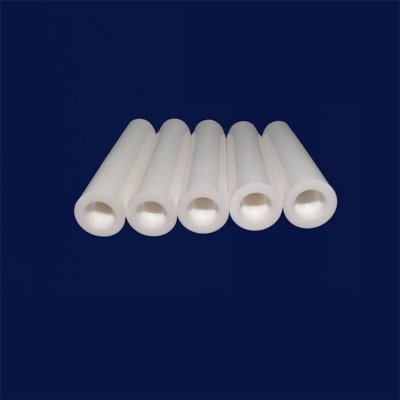
Solid rods and hollow tubes cover the bulk of general isolation at 95 or 99 percent alumina. Twin-bore and multi-bore tubes carry thermocouple pairs or heater leads inside a single insulating body, standard in furnaces, kilns, and process heaters. Stepped spacers and custom feedthrough spacers serve precision positioning inside pin arrays. Threaded standoffs replace metal or polymer standoffs where temperature, voltage, or radiation makes those alternatives unreliable. FineCer's ceramic rings and bushings catalog covers cylindrical, tubular, and threaded forms in 95 to 99.7 percent grades; custom bores and stepped geometries are made to drawing.
Alumina purity selection for spacers
For most alumina spacer duty, 95 percent handles low-voltage isolation and general mechanical separation at the lowest cost, and 99 percent covers high-voltage, high-temperature, and precision applications. Above 99 percent, gains target niche outgassing or optical requirements rather than raw insulation performance.
| Purity | When to use | Trade-offs |
|---|---|---|
| 95% | Low-voltage isolation, mechanical separation, cost-sensitive volume parts | Adequate resistivity, lower dielectric strength margin |
| 99% | High-voltage insulators, thermocouple bodies, precision spacers | Higher cost, tighter tolerance possible |
| 99.5% to 99.7% | Vacuum feedthroughs, RF spacers, semiconductor process equipment | Lower dielectric loss for RF and vacuum duty |
| 99.9%+ | UHV chambers (low outgassing), optical (translucent grades) | Highest cost, niche use only |
Our alumina ceramic insulator guide covers the electrical trade-offs across purity grades in more detail, including why higher purity lowers dielectric loss but does not raise breakdown strength. For spacer duty specifically, the practical decision usually comes down to service temperature and voltage, both of which 99 percent alumina handles in almost every industrial application.
Engineering design considerations
Alumina spacer design turns on four things most catalogs do not spell out: aspect ratio and mechanical margin, threading limits when a standoff is needed, dimensional tolerance for pin fit, and the practical decision of ceramic versus polymer or metal for the same slot.
Aspect ratio and mechanical margin
Long, thin spacers are more brittle than short, thick ones because bending stress at midspan scales with length while cross-section area sets the resistance. A safe rule for cantilever-style standoffs is a length-to-diameter ratio below 10; longer aspect ratios need clamping at both ends or reinforcement through the geometry.
Threaded standoff limits
Ceramic threads are ground or machined after sintering, not molded. M2 is the practical lower limit for reliable production. Below M2, thread strength drops sharply because alumina is brittle and small threads chip during handling and installation. M3 through M6 is the standard cost-competitive range. For M2 threaded standoffs, expect a price premium of 3 to 5 times the equivalent M3 part.
Dimensional tolerance and pin fit
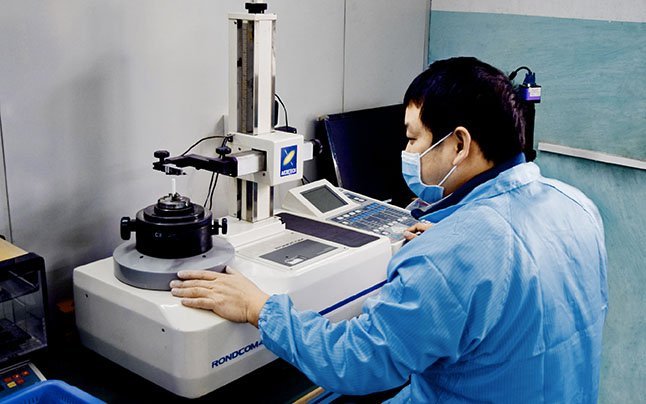
Ground alumina reaches ±0.001 mm on outside diameters and ±0.002 mm on inside diameters, adequate for most pin-fit applications. When the spacer mates with a metal pin under thermal cycling, plan for the CTE gap between alumina (7.7 to 8.4 ppm/°C) and the pin material, typically Kovar (4.5 to 5.5) or copper (17). Wider clearance absorbs the mismatch but reduces alignment accuracy.
Ceramic versus polymer or metal standoff
Polymer standoffs, mostly nylon, dominate the PCB standoff market at roughly one-tenth the cost of ceramic, and metal standoffs cover conductive-mount and high-mechanical-load applications. Alumina earns the switch when the design crosses one of these thresholds: continuous service above 200°C, working voltage above 10 kV, hard vacuum or UHV, radiation exposure, or long-life reliability where polymer aging matters. Below these thresholds, nylon or brass usually wins on cost.
Typical applications
Alumina spacers appear across five practical application areas: thermocouple and heater insulation, vacuum feedthroughs, semiconductor process equipment, industrial through-wall insulators, and precision instruments.
- Thermocouple and heater insulation: twin-bore and multi-bore tubes carry noble-metal wires (K, J, R, S types) inside a single insulating body up to 1,500°C.
- Vacuum feedthroughs: alumina spacers position feedthrough pins inside a hermetic assembly, typically 99.5 percent or higher for outgassing.
- Semiconductor equipment: wafer chuck standoffs, plasma chamber isolators, and process gas nozzle mounts at 99 percent or above.
- Industrial through-wall insulators: electrostatic precipitator bushings and high-voltage feedthroughs at 95 or 99 percent, standard in air-pollution control and power distribution.
- Precision instruments: analytical column supports, laser cavity spacers, and calibration fixtures where thermal stability and cleanliness matter.
Frequently asked questions
Which alumina purity should I pick for a spacer?
95 percent handles most low-voltage, general isolation duty at the lowest cost. 99 percent covers high-voltage, high-temperature, or precision applications and is the default for industrial spacer duty above 200°C or 5 kV. 99.5 percent and higher earns the premium in vacuum feedthroughs, RF spacers, and semiconductor process work where outgassing, dielectric loss, or purity matters more than raw breakdown voltage.
What is the smallest threaded standoff I can make in alumina?
M2 is the practical minimum for reliable production. Below M2, thread strength drops sharply because alumina is brittle and small threads chip during handling and installation. M2 standoffs cost 3 to 5 times M3 equivalents due to lower yield and slower machining. For most PCB and panel applications, M3 through M6 covers the working range at competitive cost.
How accurate can multi-bore alumina tubes be for thermocouple use?
Ground alumina bore diameters hold ±0.002 mm on standard production, and hole-to-hole pitch on twin-bore or quad-bore tubes runs ±0.05 to ±0.1 mm depending on production run. Bore surface finish reaches Ra 0.4 μm ground or Ra 0.1 μm honed. For K and J type thermocouples, 95 percent alumina is rated to 1,350°C; for R and S types, 99 percent alumina is rated to 1,500°C.
Should I use alumina or nylon standoffs on a PCB?
Nylon at roughly one-tenth the cost is the default for standard PCB standoff duty. Move to alumina when the board sees continuous temperatures above 200°C, working voltage above 10 kV, hard vacuum, radiation exposure, or long-life reliability where polymer aging matters. For consumer or general industrial PCBs, nylon wins on cost.
Next step
Need alumina spacers in standard cylindrical, tubular, or threaded forms? Our ceramic rings and bushings catalog ships 95 to 99.7 percent alumina in common sizes. For twin-bore tubes, stepped feedthrough spacers, or custom geometries, our custom ceramic parts service returns DFM feedback within 24 hours.