
What is Silicon Nitride Ceramic?
Silicon nitride ceramic (Si₃N₄) is the ceramic engineers specify when temperature swings destroy everything else. Silicon nitride ceramic retains over 80% of its room-temperature strength at 1,200°C and survives quenching differentials beyond 600°C that crack alumina instantly — the product of low thermal expansion (3.2×10⁻⁶/°C) and an interlocking elongated-grain microstructure that gives 6–7 MPa·m¹/² toughness. At 3.2 g/cm³, roughly 60% lighter than zirconia, it is also the lightest structural ceramic in common use. FineCer manufactures custom Si₃N₄ parts in GPS, HIP, and RBSN grades — from single prototypes for ceramic bearings and turbocharger rotors to volume production.
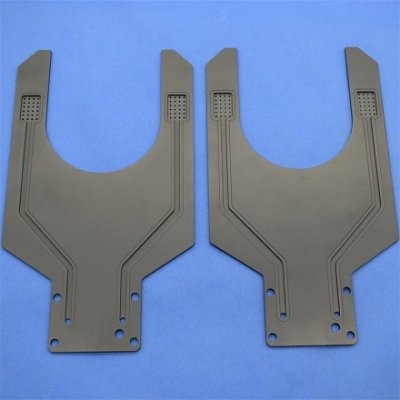
Si₃N₄ Grade Comparison: GPS vs HIP vs RBSN
| Property | GPS | HIP | RBSN |
|---|---|---|---|
| Density (g/cm³) | 3.20–3.25 | 3.25–3.30 | 2.4–2.6 |
| Flexural Strength | 700–900 MPa | 800–1,100 MPa | 200–350 |
| Toughness | 6–7 | 7–8 | 2–3 |
| Typical Use | Bearings, turbo rotors | Highest-performance | Large/complex shapes |
Gas pressure sintered (GPS) Si₃N₄ is the volume workhorse — 700–900 MPa flexural strength covers bearings, rotors, and most structural duties. Hot isostatic pressing (HIP) closes residual porosity for the most demanding parts, pushing strength to 800–1,100 MPa and toughness to 7–8 MPa·m¹/². Reaction-bonded RBSN trades strength (200–350 MPa) for near-zero shrinkage, making large or intricate shapes economical. Specify the grade by load case, not by habit — we will confirm the right one on your drawing review.
Why Si₃N₄ Owns High-Speed Bearings
| Property | Si₃N₄ | Steel (GCr15) |
|---|---|---|
| Density | 3.2 g/cm³ | 7.8 g/cm³ |
| Max Speed (DN) | >3,000,000 | ~1,500,000 |
| Service Life | 3–5× steel | Baseline |
| Lubrication | Self-lubricating | Required |
| Corrosion | Immune | Susceptible |
The physics is straightforward: ball mass drives centrifugal load, and centrifugal load caps speed. Cutting density from 7.8 to 3.2 g/cm³ lets silicon nitride bearing balls run DN values above 3,000,000 — twice steel's practical ceiling — while lasting 3–5× longer, ignoring corrosion, and surviving brief lubrication loss thanks to a self-lubricating surface. Machine-tool spindles, turbomolecular pumps, and EV motor test rigs all standardized on Si₃N₄ for exactly these numbers.
Key Applications of Silicon Nitride
Bearings and rollers: full-ceramic and hybrid bearing elements, cam followers, and check balls. Turbomachinery: turbocharger rotors in the automotive sector exploit the low inertia — spool-up improves measurably when rotor mass drops 60%. Molten metal handling: riser and dosing tubes, thermocouple protection sheaths, and welding fixtures, because aluminum melt does not wet Si₃N₄. Hot structural parts: aerospace and energy components such as glow systems, valves, and precision rods that must combine heat, load, and vibration. Cutting and forming tools: the toughness-hardness balance (14–15 GPa) suits interrupted cuts on cast iron and severe metal-forming dies.
Si₃N₄ vs the Alternatives
Against silicon carbide ceramic, Si₃N₄ gives up hardness and thermal conductivity but nearly doubles toughness — the deciding factor for anything that rolls, impacts, or vibrates. Against zirconia ceramic parts, Si₃N₄ runs 200°C hotter, weighs half as much, and laughs at thermal shock, while zirconia keeps the toughness crown for room-temperature impact. Against alumina, Si₃N₄ costs more but solves the two failure modes alumina cannot: cracking from thermal cycling and chipping from mechanical shock. The ceramic material selection guide puts all four side by side; or skip the homework and send us your operating conditions — as a single supplier for all four advanced ceramics, our recommendation is grade-by-application, not catalog-by-default.
Manufacturing Si₃N₄ at FineCer
We form silicon nitride by pressing, CIP, and injection molding for complex small parts, sinter under nitrogen, and finish with diamond grinding to ±0.001mm and Ra 0.1μm where the drawing demands it. Bearing-grade surfaces are lapped and inspected for roundness in our quality control lab, and every shipment carries its measured inspection report.
Need Si₃N₄ Parts?
Send your drawings or specs to sales@finecer.com — response within 24 hours.
Frequently Asked Questions
Ready to Order Si₃N₄ Components?
Send us your drawings or specifications — grade recommendation, DFM review, and a detailed quote within 24 hours.
Request a Free Quote → Order a Sample