
Product Overview
Industrial ceramic tubes do the jobs metal pipe cannot: insulate a 1,700°C furnace element, carry concentrated acid without corroding, sheath a thermocouple in molten aluminum, or hold gas-tight vacuum where alloys creep and outgas. FineCer manufactures custom ceramic tubes and pipes in Al₂O₃ (95–99.99%), ZrO₂, SiC, and Si₃N₄ — ID 0.5–145mm, OD to 150mm, lengths to 550mm — fully sintered to 0% porosity for reliable gas-tight sealing at extreme temperatures, with critical diameters ground to ±0.001mm. Minimum order: 1 piece.
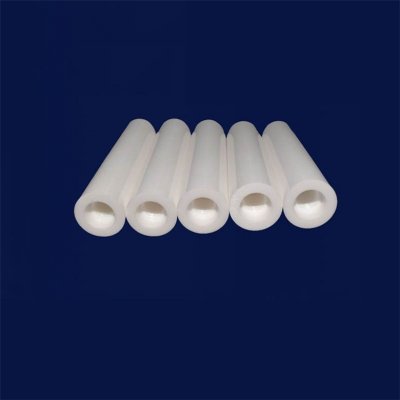
Ceramic Tube Specifications
| Parameter | Range |
|---|---|
| Length | 3–550mm |
| Inner Diameter | 0.5–145mm |
| Outer Diameter | 1–150mm |
| Tolerance | ±0.001mm |
| Surface Finish | Ra 0.1μm |
| Porosity | 0% |
These are envelope figures, not a fixed catalog: within them we produce to your drawing. As-fired tubes hold roughly ±1% of nominal dimension — adequate for many furnace and insulator duties — while ground bores and ODs reach the ±0.001mm class for sealing fits and sliding assemblies. Specify ground surfaces only where the function needs them; that single drawing note often cuts a tube quote substantially.
Available Tube Types
- Standard cylindrical (single bore)
- Thick/thin wall tubes
- Multi-bore tubes (2, 4, custom)
- One-end closed (thermocouple sheaths)
- Bushings and sleeves
- Threaded tubes (internal/external)
- Custom cross-sections
Material Selection for Ceramic Tubes
| Application | Recommended | Key Reason |
|---|---|---|
| High-temp furnace | 99% Al₂O₃ | 1,700°C service |
| Chemical environments | SSiC | Acid/alkali resistance |
| High-pressure sealing | ZrO₂ | Toughness, metal-bondable |
| Molten metal contact | Si₃N₄ | Non-wetting, thermal shock |
Alumina vs Zirconia vs SiC Tubes in Practice
Alumina tube stock is the workhorse — the best insulator (>10¹⁴ Ω·cm), the highest service temperature, and the lowest cost, which is why furnace tubes, insulator sleeves, and protection sheaths default to 95–99% Al₂O₃. Zirconia tubes earn their premium where the tube is also a mechanical part: high-pressure sealing sleeves, plunger liners, and any tube that gets brazed to steel fittings, since zirconia's thermal expansion matches steel. SiC tubes own the chemical end — SSiC shrugs off hot acids and abrasive slurries that etch everything else — and double as radiant elements thanks to 120–160 W/m·K conductivity. Si₃N₄ tubes are the thermal-shock specialists: riser and dosing tubes in aluminum foundries survive melt contact and quench cycles that crack alumina. If two of those duties overlap, send the conditions; as a single supplier for all four advanced ceramics we will quote the genuinely optimal material, not the only one on our line.
Thermocouple Protection Tubes
One-end-closed protection tubes are among our most repeated items. For clean furnace atmospheres to 1,700°C, 99% alumina is standard; for molten non-ferrous metal — especially aluminum, which does not wet Si₃N₄ — silicon nitride sheaths run thousands of immersion cycles. Bore-to-tip concentricity and a crack-free closed end are the quality drivers here, so every sheath is visually and dimensionally inspected before shipping, with multi-bore insulator inserts available to suit paired thermocouple wires.
How We Manufacture Ceramic Tubes
Long thin tubes are extruded; thick-walled, stepped, or large-bore tubes are formed by cold isostatic pressing (CIP) for uniform density; small complex tubes can be injection molded. After sintering, diamond grinding brings sealing diameters, faces, and threads to final tolerance, and honing or lapping finishes bores to Ra 0.1μm where the application demands it — precision dispensing and plunger sleeves typically do. Each production batch passes density verification and CMM dimensional checks, documented in the inspection report that ships with your order. Need to validate before volume? Order 1-piece samples off the same tooling first.
Wall Thickness and Length Guidance
Two ratios drive tube manufacturability: wall-to-diameter and length-to-diameter. Walls down to 0.3mm are practical on small bores, but as diameter grows, very thin walls need support strategies during sintering that add cost — sometimes a 0.5mm wall is meaningfully cheaper than 0.3mm with no functional loss. Likewise, long slender tubes sinter straighter when the drawing allows a light grind allowance on the OD. Flag your truly critical dimensions and let the rest float; our DFM review will return the cost-optimal tolerance scheme with the quote.
Need Custom Ceramic Tubes?
Send your drawings or specs to sales@finecer.com — response within 24 hours.
Frequently Asked Questions
Ready to Order Ceramic Tubes?
Send your tube drawing or dimensions — material recommendation, DFM review, and itemized quote within 24 hours.
Request a Free Quote → Order a Sample