
What is Silicon Carbide Ceramic?
Silicon carbide ceramic (SiC) is the material of last resort for abrasion and heat — specified when alumina wears through and metals melt or corrode. Silicon carbide ceramic is the hardest structural ceramic in common industrial use at 9.5 Mohs (2,800 HV), and its thermal conductivity of 120–160 W/m·K rivals aluminum metal — the highest of any non-metallic structural material. The combination is unique: a part that resists grinding slurries, conducts heat away from hot zones, survives 1,600°C, and ignores almost every acid. FineCer manufactures custom SiC components in SSiC, RBSiC, and SiSiC grades, from 1-piece prototypes to volume production with diamond-ground precision.
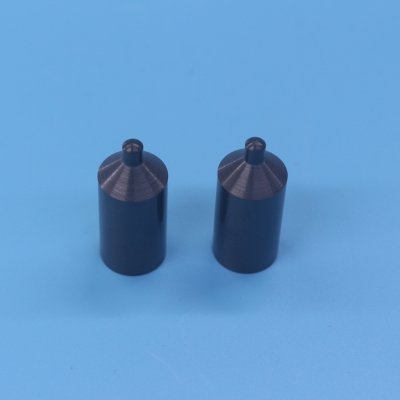
SiC Grade Comparison: SSiC vs RBSiC vs LPSSiC
| Property | SSiC | RBSiC/SiSiC | LPSSiC |
|---|---|---|---|
| SiC Content | 99% | 85% | 90–95% |
| Free Silicon | 0% | 10–15% | 0% |
| Max Service Temp | 1,600°C | 1,350°C | 1,500°C |
| Flexural Strength | 380–450 MPa | 250 MPa | 525 MPa |
| Hardness (HV) | 2,800 | 2,500 | — |
| Sintering Temp | >2,000°C | 1,450°C | 1,850°C |
How to Choose Between SSiC and RBSiC
Start with chemistry and temperature. The 10–15% free silicon in RBSiC is the grade's weak point: strong alkalis and hydrofluoric acid attack it, and above ~1,350°C it softens. SSiC, sintered above 2,000°C with zero free silicon, holds its 380–450 MPa strength to 1,600°C and resists the full acid/alkali spectrum — the default for mechanical seal faces in chemical pumps. RBSiC fights back on manufacturability: its near-zero shrinkage during reaction bonding lets us produce large or geometrically complex parts — burner nozzles, beams, cooling components — with minimal distortion and lower cost. LPSSiC sits between them, trading a little temperature ceiling for the highest flexural strength of the three (525 MPa).
Key Applications of Silicon Carbide
Mechanical seals and bearings: SiC-on-SiC seal faces are the standard for chemical and slurry pumps — our ceramic seal rings page covers face geometries and finishes. Severe abrasion: sandblast and spray nozzles in SiC outlast tungsten carbide in many slurries at a fraction of the weight. Semiconductor processing: high purity and thermal stability make SiC fixtures, susceptor components, and wafer-handling parts core items for semiconductor equipment. High-temperature structure: kiln furniture, burner components, and heat-exchanger elements run continuously where metals scale away. Heat dissipation: when a wear part must also move heat — laser and electronics hardware — SiC's 120–160 W/m·K does both jobs in one material.
SiC vs the Other Technical Ceramics
Against alumina ceramic parts, SiC is roughly twice as hard, five times more thermally conductive, and far more thermal-shock tolerant — but costs more and conducts electricity. Against silicon nitride ceramic, SiC wins on hardness (9.5 vs 8.5 Mohs) and conductivity (120 vs 25 W/m·K), while Si₃N₄ wins on fracture toughness (6–7 vs 3.5 MPa·m¹/²) for impact-loaded parts like bearings. And where impact dominates entirely, zirconia remains the toughness king. Because FineCer manufactures all four — plus ZTA — our engineers compare them on your actual duty cycle and recommend the optimal grade, not just the material you first asked about. The ceramic material selection guide condenses this comparison into two decision tables.
Manufacturing SiC at FineCer
We form SiC by pressing and slip casting, sinter SSiC above 2,000°C in dedicated furnaces, and reaction-bond RBSiC for complex geometries. Finished parts are diamond-ground and lapped in our precision machining department — seal faces flat to light-band standards, critical diameters to ±0.001mm — and every batch ships with a CMM-backed inspection report from our quality lab.
Design Tips for SiC Parts
Design for the grade, not just the material. SSiC shrinks substantially during sintering, so generous tolerances on non-critical features keep grinding cost down; RBSiC's near-zero shrinkage allows tighter as-formed dimensions on large parts. Avoid sharp internal corners and abrupt section changes — like all ceramics, SiC concentrates stress at geometric discontinuities. Where a SiC face seals against a mating ring, specify the flatness and finish explicitly; we lap to the requirement rather than a generic default. Send your drawing for a free DFM review and we will mark exactly which features to grind, which to leave as-fired, and which grade fits — typically with the quote, within 24 hours.
Need Silicon Carbide Parts?
Send your drawings or specs to sales@finecer.com — response within 24 hours.
Frequently Asked Questions
Ready to Order SiC Components?
Send us your drawings or specifications — grade recommendation, DFM review, and a detailed quote within 24 hours.
Request a Free Quote → Order a Sample