
Why Ceramic Valves?
Metal valves in corrosive or high-temperature service face an inevitable problem: degradation. Even high-alloy steels and nickel-based superalloys corrode, pit, and lose dimensional accuracy when exposed to concentrated acids, strong alkalis, or abrasive slurries over time. Valve seat surfaces that were once precision-ground develop micro-pitting, leading to leakage, flow instability, and eventually unplanned shutdowns — the exact failure chain custom ceramic valves are built to break.
Alumina, zirconia, and silicon carbide are inherently immune to the chemical mechanisms that destroy metal valve surfaces. The sealing faces we grind to Ra 0.1μm maintain that finish indefinitely in environments that would pit stainless steel within months.
The result: 3–10× longer service life, zero corrosion-related leakage, and significantly reduced maintenance downtime. For many chemical processing and industrial operations, the total cost of ownership of ceramic valves is lower than metal — even though the initial unit price is higher.
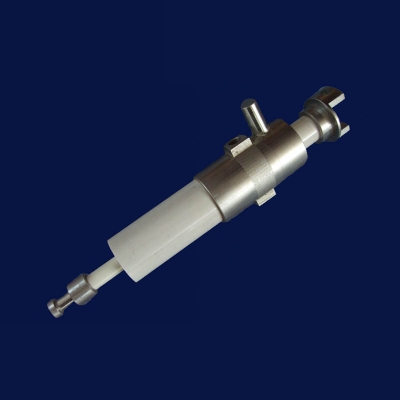
Valve Types We Manufacture
| Valve Type | Description | Typical Application |
|---|---|---|
| Valve Cores (Discs) | Precision-ground flat or conical sealing surfaces. Al₂O₃ or ZrO₂. | Ball valves, butterfly valves — sealing element replacement |
| Dispensing Valves | Micro-volume precision dispensing with ceramic needle and seat. ZrO₂. | Electronics manufacturing — solder paste, adhesive, conformal coating |
| Valve Bodies | Full ceramic or ceramic-lined valve housings. SSiC or Al₂O₃. | Corrosive chemical service — replacing Hastelloy or titanium valves |
| Control Valves | Precision flow regulation with ceramic trim. SiC or ZrO₂. | Process control — flow regulation in abrasive or corrosive media |
| Seal Valves | Gas-tight ceramic-to-ceramic or ceramic-to-metal sealing. ZrO₂. | High-purity gas systems, vacuum equipment |
| Metering / Dosing Valves | Precision volumetric dispensing. Ceramic piston + cylinder matched set. | Pharmaceutical filling, food processing dosing |
| Water Valves | Faucet cartridge ceramics. Al₂O₃ disc pairs. | Sanitary valve OEM components |
Ceramic vs Metal Valves — Detailed Comparison
| Property | Ceramic Valve | Stainless Steel Valve | Hastelloy Valve |
|---|---|---|---|
| Corrosion Resistance (HCl) | Immune | Limited | Good |
| Corrosion Resistance (H₂SO₄) | Immune | Poor | Good |
| Thermal Deformation | Near zero | Significant | Significant |
| Seal Surface Durability | 10+ years | 1–3 years | 3–5 years |
| Weight | 40–60% lighter | Baseline | Heavier |
| Service Life | 3–10× | Baseline | 2–3× |
| Unit Cost | Higher | Lower | Much higher |
| Total Cost of Ownership | Lower | Higher (replacements) | Moderate |
Material Selection for Ceramic Valves
| Application Environment | Recommended Material | Key Advantage |
|---|---|---|
| Strong acids (HCl, H₂SO₄) | SSiC or Al₂O₃ 99% | Complete chemical inertness |
| Impact-prone service | ZrO₂ (Y-PSZ) | Fracture toughness prevents chipping |
| Abrasive slurry | SSiC | 9.5 Mohs hardness |
| High temperature (>500°C) | Al₂O₃ or SiC | Dimensional stability at extreme temps |
| Precision dispensing | ZrO₂ | Fine surface finish, edge strength |
| Food / pharma (FDA) | Al₂O₃ or ZrO₂ | Biocompatible, non-porous, sterilizable |
Zirconia Ball Valve Cores and Trim
The most requested single conversion: replacing the metal ball, disc, or plug in an otherwise serviceable valve. Zirconia is the default for these cores — its 10–15 MPa·m¹/² toughness shrugs off seating impact and water hammer that chip harder ceramics, and its lapped spherical or conical sealing surfaces hold bubble-tight shutoff in media that erode metal trim within a season. We grind balls, segmented discs, conical plugs, and matching seats as matched sets, lapped together where the application warrants, so the pair you install seals on day one and on year five. Alumina cores remain the value option for clean, low-impact media such as water cartridge pairs.
Industries Using Our Ceramic Valves
- Chemical processing — acid/alkali handling, reactor feed control, corrosive waste treatment
- Petroleum refining — high-temperature sour service, catalytic cracking unit valves
- Pharmaceutical manufacturing — sterile filling lines, API dosing systems
- Electronics manufacturing — precision dispensing of solder paste, adhesives, underfill
- Water treatment — chlorinated water service, desalination systems
- Power generation — ash slurry handling, FGD (flue gas desulfurization) systems
Ordering and Validating Ceramic Valve Components
Start from either end: send the drawing of the metal component you are replacing, or describe the media, pressure, temperature, and cycle rate and let us propose trim geometry. Every quote includes a manufacturability review covering edge radii, compression loading, and sealing-face specification, and matched sets are dimensioned together so field fit is guaranteed. Validation is low-risk by design — samples from 1 piece on production tooling, full inspection data from our quality lab with each shipment, and a dedicated engineer tracking the order through all seven production stages.
Need Ceramic Valves?
Send your drawings or specs to sales@finecer.com — response within 24 hours.
Frequently Asked Questions
Need Ceramic Valve Components?
Send your valve specifications or existing metal valve drawings. We provide a free material recommendation and DFM review within 24 hours.
Request a Free Quote → Order a Sample