
Our Custom Capabilities
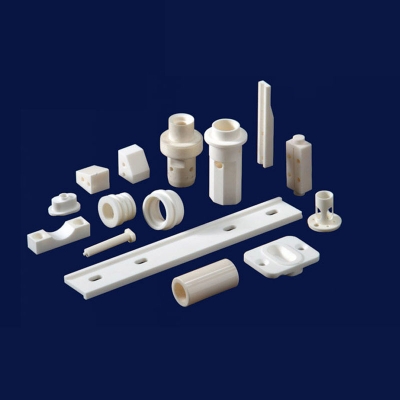
When no catalog shape fits, custom ceramic parts are the product — and they are most of what FineCer builds. We manufacture OEM ceramic components to customer drawings in all four advanced ceramics — ZrO₂, Al₂O₃, SiC, and Si₃N₄ — machined to ±0.001mm with Ra 0.1μm finishes, using whichever forming process the geometry and volume favor: ceramic injection molding, cold isostatic pressing, or dry pressing. From 1-piece prototypes to multi-year production programs, every project starts with a free DFM review and ends with a measured inspection report.
How to Order — 5 Steps
Achievable Precision
| Spec | Value |
|---|---|
| Dimensional Tolerance | ±0.001mm |
| Concentricity | ±0.003mm |
| Parallelism | ±0.002mm |
| Cylindricity | ±0.004mm |
| Surface (ground) | Ra 0.4–1.6μm |
| Surface (polished) | Ra 0.1μm |
Machinable Features
- Holes ≥0.7mm, threads ≥M2
- Steps, grooves, keyways
- Curved and spherical surfaces
- Metallization patterns
- Ceramic-metal bonded assemblies
These features are cut after sintering with diamond tooling on our CNC grinding line, which is what makes the ±0.001mm class achievable on fully dense material. Features that do not need ground precision are formed in the green state instead — far cheaper — and the DFM review tells you which is which before you commit.
What the Free DFM Review Actually Checks
Within 24 hours of receiving your file, a ceramic engineer walks the design for the failure points specific to ceramics: sharp internal corners that concentrate stress, unsupported thin walls, abrupt section changes that warp in sintering, tolerances tighter than the function needs, and hole or thread features below process minimums. You get back concrete suggestions — usually a radius here, a relaxed tolerance there — each annotated with its effect on yield and price. The review also confirms the material: describe the operating conditions and we recommend the optimal grade for your application, not just the material you request, drawing on the same logic as our ceramic material selection guide.
Forming Process Selection: CIM vs CIP vs Dry Pressing
Process choice drives cost more than material choice on most custom parts. Ceramic injection molding shines on small, intricate geometries at hundreds-to-millions volume: a mold investment up front, then near-net parts that need minimal grinding. CIP needs no part-specific tooling — powder is pressed isostatically into dense uniform blanks, then green-machined to shape — making it the default for prototypes, large parts, and low volumes. Dry pressing wins simple, flat-ish shapes at high volume. We run all three under one roof, so the recommendation in your quote is the economical route for your numbers, with a stated crossover if your volumes are likely to grow.
From Prototype to Production Without Surprises
The reason our MOQ is 1 piece is engineering, not marketing: samples are produced on production powders, production sintering curves, and production grinders, so prototype data transfers directly to the volume run. Many of our 500+ delivered projects began as a single validation piece. When you scale, the same dedicated engineer carries the part through our seven-stage project management process, and every shipment — sample or production — includes the dimensional report, material certificate, surface roughness data, and batch traceability from our ISO 9001:2015 quality system. If a quality issue ever surfaces, that same engineer coordinates root-cause analysis and corrective action with priority replacement scheduling — manufacturing-defect replacements at no cost. Across 40+ countries served, that accountability loop is a large part of why on-time delivery has stayed above 98%.
File Formats
STEP, IGES, DWG, DXF, PDF, SolidWorks, or hand-drawn sketches — whatever you have today is enough to start the conversation and get a real quote moving.
Start Your Custom Project
Send your drawings or specs to sales@finecer.com — response within 24 hours.
Frequently Asked Questions
Start Your Custom Ceramic Project
Send drawings for a free DFM review and quote within 24 hours.
Request a Free Quote → Order a Sample