
Overview
Custom ceramic plates, substrates, and blocks from FineCer span an unusually wide envelope: 0.2mm electronic substrates to heavy wear liners, up to 550mm wide, in alumina (95–99.99%) and zirconia. The same flat-form factor serves three very different jobs — electrical insulation, mechanical wear protection, and thermally stable work surfaces — and the manufacturing decisions differ for each, which is why every plate order starts with a free engineering review of how the part is actually loaded. Lapped faces reach Ra 0.1μm; ground dimensions hold ±0.001mm; minimum order is 1 piece.
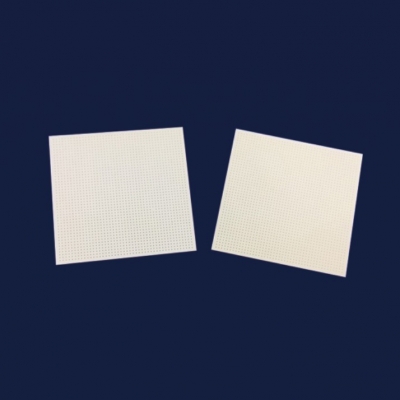
Plate & Substrate Specifications
| Parameter | Range |
|---|---|
| Max Width | 550mm |
| Min Thickness | 0.2mm |
| Flatness | Ra 0.1μm |
| Tolerance | ±0.001mm |
Plate Types We Manufacture
- Wafer chucks (semiconductor)
- Electronic substrates (96%/99% alumina)
- Insulating plates
- Wear-resistant liners
- Guide blocks
- Setter plates and kiln furniture
- Laser cutting bases
- Precision-ground blocks and blanks
Alumina Substrates for Electronics
96% alumina remains the global default for thick-film circuits, power resistor carriers, and sensor packages because it balances dielectric performance, strength, and cost — and our substrates ship lapped flat with the thickness uniformity printing processes depend on. Where higher purity matters — RF, optical, or semiconductor fixtures — 99% and 99.5%+ grades raise thermal conductivity and cleanliness; the trade-offs are laid out on our alumina ceramic parts page. Laser scribing for snap-apart panels and metallization patterns for solderable pads are both available as finishing options. Substrate orders are inspected for thickness uniformity, camber, and surface quality on every lot — the three parameters that decide print yield downstream — and the measured values ship with the parts so your incoming inspection can simply confirm rather than re-measure.
Wafer Chucks and Semiconductor Plates
Vacuum chucks, handling plates, and stage components live or die on flatness, cleanliness, and stiffness. Fully dense alumina delivers all three: it holds lapped flatness through thermal cycling, sheds no magnetic or conductive particles, and resists the plasma and chemical exposure of fab environments. We grind vacuum grooves, drill port holes (≥0.7mm), and lap working faces to Ra 0.1μm, then verify flatness and parallelism (±0.002mm) by CMM — with the measured report shipped per piece for tool-qualification files.
Wear Plates, Liners, and Guide Blocks
At the heavy end, alumina wear plates protect chutes, guides, and presses where hardened steel wears through in months — alumina's 15–17 GPa hardness is several times that of HRC-60 steel. Plates are supplied as squares, rectangles, and custom profiles with countersunk mounting holes, chamfers, and weld-tab pockets ground in. For impact-loaded liners where alumina edges chip, zirconia or ZTA plates trade some hardness for toughness — a substitution we will recommend honestly when your duty cycle calls for it, since all three materials run on our own lines.
Setter Plates and Thermally Stable Work Surfaces
Alumina's 1,700°C service ceiling and low creep make flat setters and kiln furniture a natural use; the same stability serves laser-cutting bases and inspection surface plates at room temperature, where near-zero thermal drift keeps references true. Specify as-fired surfaces for furnace duty and ground or lapped faces where parts locate against the plate. For repeated firing cycles, alumina setters hold their flatness batch after batch because creep at soak temperature is negligible — the practical difference between trays that warp into scrap and furniture that lasts years. We supply setters plain, drilled for gas flow, or with located pockets ground to position parts repeatably.
How Thin Plates Are Made Flat
Thin substrates are tape-formed or dry-pressed, sintered on precision setters, then double-side lapped — removing material from both faces simultaneously so the plate ends flat, parallel, and stress-balanced rather than potato-chipped. Thicker plates are pressed or CIP-formed and diamond-ground. Edge condition matters more than most drawings state: we chamfer or radius edges by default to protect handling strength, and call out any sharp-edge requirement at DFM review. Every batch ships with dimensional and flatness data from our quality control lab; 1-piece samples are available before committing a panel run.
Need Ceramic Plates?
Send your drawings or specs to sales@finecer.com — response within 24 hours.
Frequently Asked Questions
Ready to Order Ceramic Plates?
Send plate drawings or dimensions — flatness strategy, material recommendation, and quote within 24 hours.
Request a Free Quote → Order a Sample